


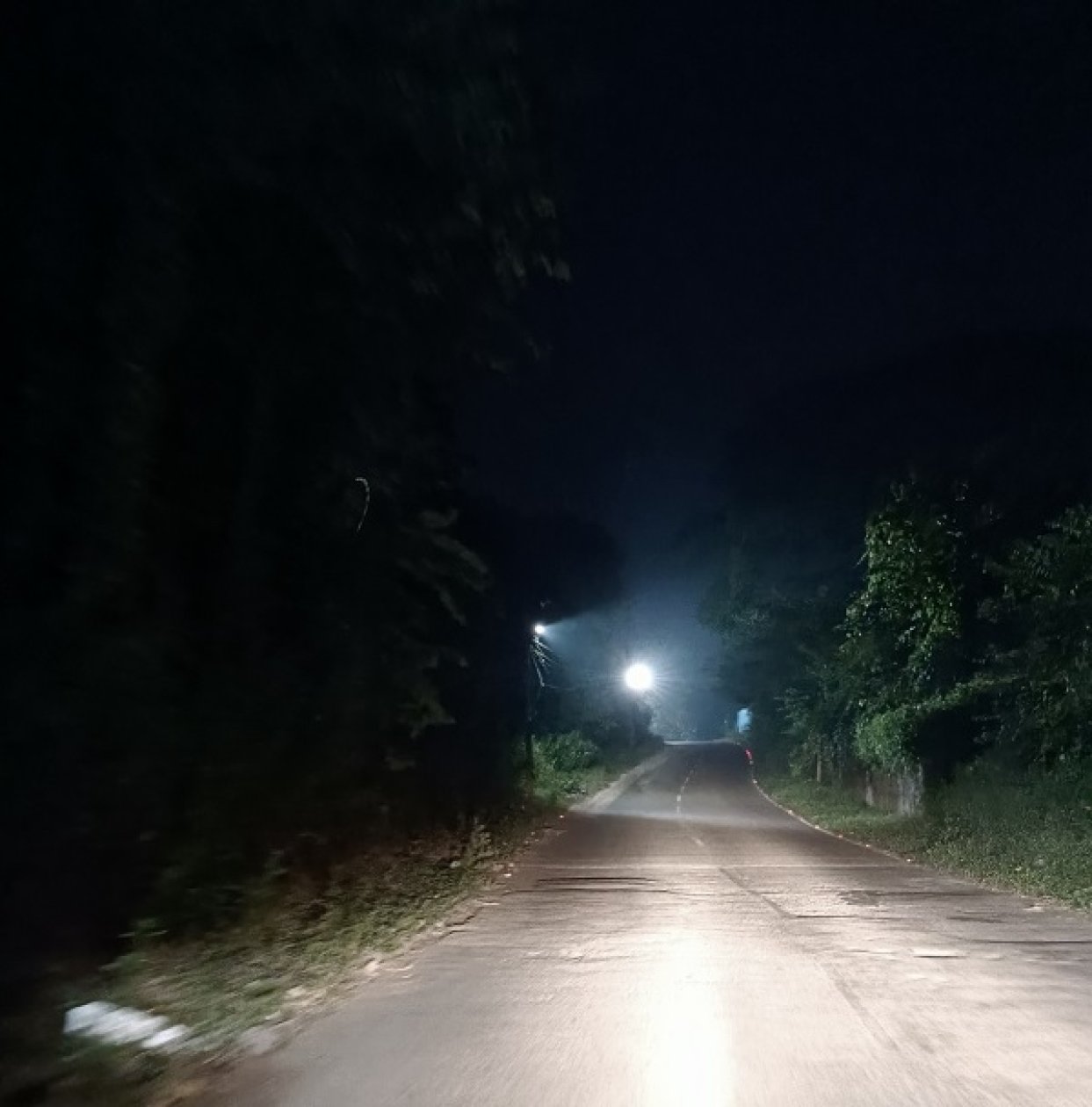
 The deserted internal road at Curca.
VIBHA VERMA
PANAJI
A police jeep parked at a strategic junction can offer reassurance, but what happens when the road beyond that junction disappears into darkness, an isolated underpass goes without a patrol for hours, or a crowded tourist stretch sees little sign of the police? The difference between having a police force and having one visibly present on the streets often becomes most apparent after nightfall.
With Goa police adding more vehicles to its fleet to improve mobility and emergency response, the real test lies in how often citizens actually see them on the streets, particularly after dark.
GROUND ASSESSMENT
Against the backdrop of two recent cases of sexual assault on minors, The Goan, this week, undertook a ground assessment across several parts of Goa to examine police visibility at locations frequented by students, tourists, commuters and residents. The exercise revealed that while police personnel manned some strategic points, several vulnerable stretches remained without visible patrols for considerable periods.
In Tiswadi, parts of Goa Velha, Agassaim, Panaji, Chimbel, Merces and St Cruz revealed particular concerns, with poor illumination and limited police visibility adding to the vulnerability of several locations.
At the Cujira education complex, which remains busy during the day, the surroundings turn pitch dark as night progresses. One patrolling jeep was usually stationed near the exit, with two to three policemen present.
Their presence offered some reassurance, although the sprawling complex and adjoining stretches warranted sustained attention.
DARK STRETCHES
Goa Velha presented a different picture with several under-construction sites unlit and without visible security while large stretches of road, particularly in Curca, lay in darkness. During the assessment, The Goan did not encounter a single police patrol, either on two-wheelers or four-wheelers.
The Bambolim bypass, its underpass and several bridges and subways along the route from Panaji also lacked visible police deployment. These isolated stretches, with limited movement during late hours, required regular patrolling.
At Old Goa, police had established a nakabandi near the approach to the Basilica of Bom Jesus and Se Cathedral. However, several adjoining stretches lacked comparable police presence, despite the police station nearby.
TOURIST VULNERABILITY
The stretch through Viceroy's Arch towards the Old Goa Captain of Ports jetty offered another telling example. With the weekend approaching, a party was underway aboard a vessel and several vehicles parked along the road. Tourists, many arriving in outstation and rental vehicles, formed a sizeable part of the crowd. Yet, there was no police presence to monitor the activity or reassure visitors.
The road towards Healthway Hospital and further down towards Sharda Mandir School remained largely isolated for considerable periods. Poor illumination and the absence of visible patrols added to the concern.
Lights from the hospital and nearby residential areas offered some relief, but further along, darkness took over.
Even the highway at Old Goa lacked visible police patrolling, although a few garages and shops remained open late into the night. Several streetlights were also not functioning.
CAPITAL GAPS
The gaps were not confined to the outskirts but in Panaji too. The SAG ground, riverfront promenade and Caranzalem beach, among other prominent locations in the capital, also had no noticeable police presence during the ground check.
The already contentious casino belt presented a chaotic picture, with heavy vehicular movement, people spilling onto the road and little visible police presence. Despite the High Court having flagged traffic-management issues, police presence was barely seen, both for regulating traffic and ensuring public safety.
The road remained busy late into the night, with vehicles competing for limited space and congestion posing challenges similar to peak daytime conditions.
BANK SECURITY
The assessment also covered banks and ATMs, where periodic visits are a mandatory part of preventive policing. Several establishments appeared to have little security beyond private bank guards, while some smaller banks did not even have a guard on duty.
Official sources told The Goan that police presence generally increases during festive periods such as Diwali, Christmas and New Year. “Beat staff are directed to visit banks twice a day, but many times it doesn’t happen. The bank registers will speak for themselves, as every police visit is recorded there,” the source said, adding, “extra staff is posted during festive and peak time of the year; however, it is an admitted fact that public safety cannot be a seasonal exercise.”


