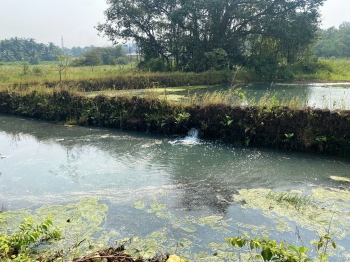
 File photo of water discharged from the Cuncolim IDC into the adjoining water bodies.
MARGAO
One of the key grounds cited by the Goa State Pollution Control Board (GSPCB) for granting Consent to Establish the proposed fish meal plant at Cuncolim is the set of recommendations made by the Technical Advisory Committee (TAC) and the Expert Panel. These recommendations emphasise strict control of effluents, effective odour management, regulated transportation of raw materials, and adherence to proper processing protocols.
The significance of these conditions cannot be overstated. They come against the backdrop of frequent complaints from the residents of Cuncolim, who have long alleged that they are subjected to unbearable fish odour emanating from existing units. Notably, this appears to be one of the rare instances where the GSPCB has formally acknowledged the trauma faced by locals due to the persistent foul smell.
On paper, the recommendations appear well-intentioned and comprehensive. They aim to curb fish odour both during processing within the plant and during the transportation of fish from landing jetties or across state borders to the industrial estate.
However, a critical question remains: how will these conditions be monitored and enforced? Who will oversee the transportation of fish supplied to the plant? Will the GSPCB establish a robust monitoring mechanism to ensure that only fresh fish is brought to the facility for processing?
These concerns assume greater importance in light of persistent allegations that pollution from fish meal and processing units stems largely from the absence of an effective enforcement mechanism within the Cuncolim Industrial Estate.
Consider this: while approving the new fish meal plant, the GSPCB stressed that trucks transporting fish must be sealed and insulated. The Board also accepted the TAC’s recommendation that no wastewater from these trucks should be discharged onto public roads. Instead, all such wastewater must be retained within the vehicle and transported to the plant for treatment.
Further, the Expert Committee recommended that fish be transported exclusively in insulated vehicles and that all wastewater generated during transportation be emptied into the plant’s Effluent Treatment Plant (ETP) for proper treatment.
Another key recommendation stipulates that only fresh fish be processed at the facility, and that no spoiled or decomposed fish be accepted. Additionally, plant operators must ensure that all vehicles exiting the premises are thoroughly washed and cleaned in a designated, contained area. These vehicles must also pass through an operational wheel-washing system before leaving the premises.
Given these stringent conditions, the GSPCB”headed by Chairman Levinson Martins”may now have to clarify the mechanisms it intends to establish for monitoring compliance, both within the plant and during transportation outside its premises.
Environmental activist Dr Jorson Fernandes has dismissed the Board’s conditions as inadequate unless accompanied by strong enforcement measures. Questioning the practicality of implementation, he remarked, “For over a decade and a half, since fish meal and fish processing plants began operations at the Cuncolim Industrial Estate, residents have had to breathe and sleep with the foul odour. The GSPCB’s conditions may look good on paper, but the Board must clearly spell out the inbuilt mechanisms it plans to put in place to ensure compliance.”
He said: “GSPCB has asked the new fish meal plant to transport raw material which has foul odour in a sealed truck. When GSPCB needs monitoring by citizens themselves, who will monitor the transportation of raw material by fish meal plant?
He added: “It is a matter of "lives and livelihood". IPB, IDC look into livelihoods but GSPCB is an arm of the government that needs to look into the lives of people and the incompetent, dubious, unscientific, unreasonable GSPCB has miserably failed over the years.”
Technical Advisory
Committee recommendations
*GSPCB should not give any expansion permissions at a later stage. This causes process upsets. The PP should take permission for the maximum capacity in advance and accordingly design the plant. Construction/ operation could be completed in stages
*Propose that negative pressure to be maintained with proper sealing of all equipments as well as doors/ windows. 0.25 mm of Hg should be sufficient by using an ID fan. Suction filters to be cleaned regularly
*Some buffer area to be maintained around the plant for green belt
*There is no CETP at Cuncolim as such a state-of-the art ETP needs to be designed and constructed for the proposed plant
*Incoming trucks should be sealed/insulated
*No water discharge from these trucks on public roads. This water has to be collected in the truck and delivered to the plant for treatment
Special Committee recommendations
vis-a-vis existing fish meal plant
*The unit shall be asked to ensure that fish brought at the plant in only insulated vehicles and all waste water generated in the transporting vehicles is emptied in the unit and treated in the ETP However, the unit may consider a storage facility for raw material of sufficient capacity as standby
*The unit shall ensure that as informed during the visit, only fresh fish is processed in the unit and no spoiled/decomposed fish is processed in the unit
*ll vehicles exiting the unit premises shall be thoroughly washed/cleaned after unloading in a designated contained area and mandatorily passed through an operational wheel-washing system prior to leaving the premises. Unloading arm should be provided with berm. All waste water generated shall be channelized to ETP