PANAJI: The El Niño weather phenomenon is expected to intensify further before peaking in December 2026 and could rank among the strongest recorded, the World Meteorological Organization (WMO) has warned. The development raises concerns over rising global temperatures and shifting rainfall patterns, with potential consequences for droughts, floods, agriculture and energy demand.
In its monthly Global Seasonal Climate Update, the United Nations' weather and climate agency said El Niño was likely to continue strengthening in the coming months, bringing above-average temperatures to much of the world and altering regional rainfall patterns.
“El Niño will continue to intensify ahead of its forecast peak in December,” the WMO said. “It is likely to bring above-average temperatures to much of the globe and shift rainfall patterns, increasing the risk of drought and floods in different regions.”
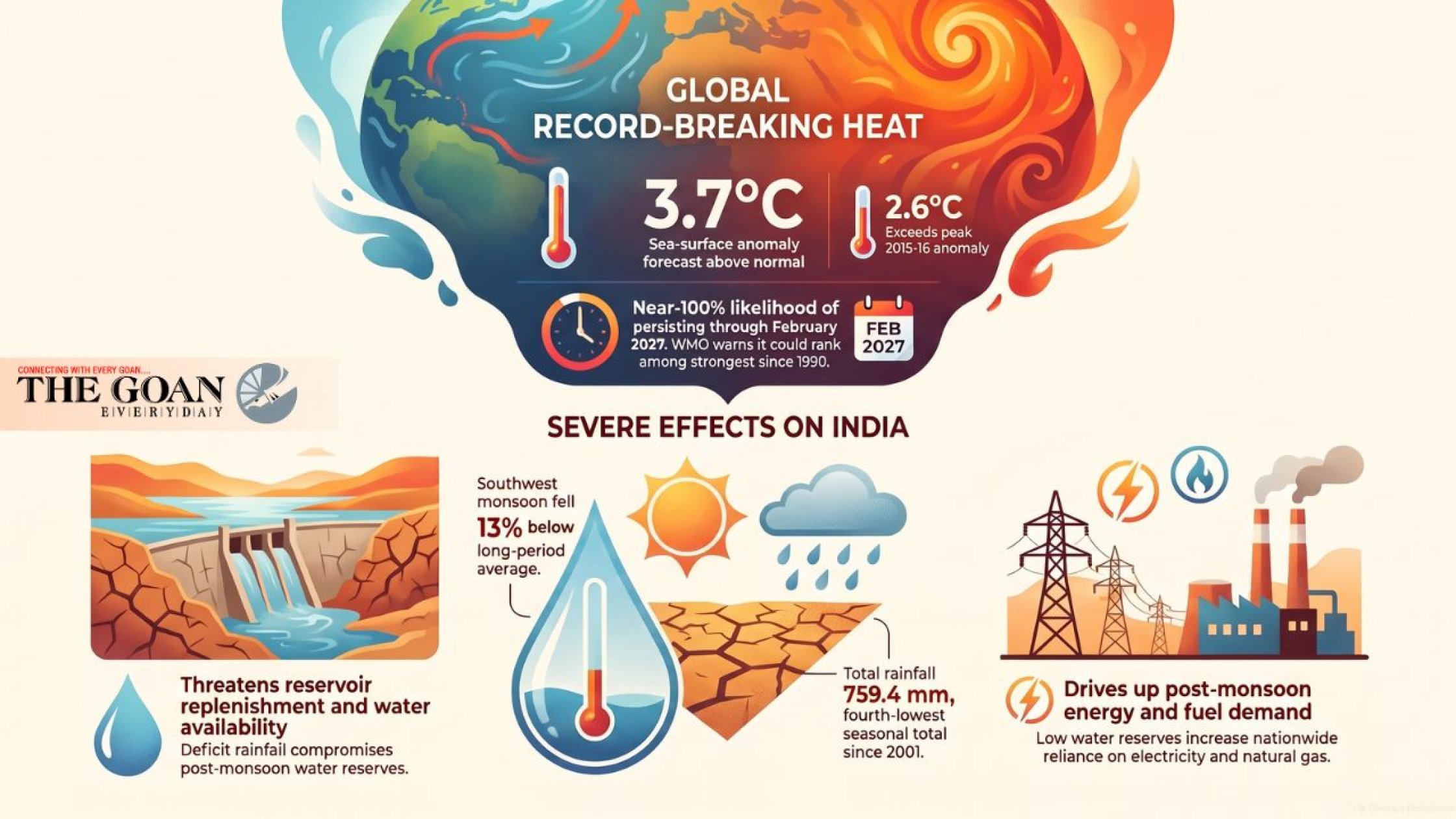
The agency's outlook, based on a consensus among 13 leading national and international meteorological centres, indicates a near-100 per cent likelihood that the event will persist through February 2027. “El Niño is firmly established and strengthening rapidly,” Secretary-General of WMO Celeste Saulo said, adding that forecasts suggest it could be “one of the strongest since at least 1950”.
The WMO forecasts that sea-surface temperatures across the central and eastern tropical Pacific will reach record levels during October-November-December 2026. The Niño 3.4 index, which measures sea-surface temperature anomalies in a key region of the equatorial Pacific, rose from 1.6°C above normal in June to 2.5°C above normal in August. For October-November-December, the anomaly is forecast to reach approximately 3.7°C above normal. If realised, this would exceed the peak values recorded during the powerful 2015-16 El Niño event, when the anomaly reached 2.6°C, according to the figures provided in the outlook.
El Niño occurs when surface waters in the central and eastern equatorial Pacific become warmer than usual, disrupting atmospheric circulation and changing wind patterns, air pressure and rainfall across different parts of the world. The phenomenon typically occurs every two to seven years and lasts around nine to 12 months. Explaining the role of the ocean, Saulo said El Niño does not generate additional heat but releases heat stored in the ocean. “The ocean it's drawing from is the warmest we've ever measured it. There is simply more heat available to release,” she said.
Although El Niño generally peaks between November and February, its effects on global temperatures can continue to intensify afterwards. The previous event contributed to exceptionally high global temperatures, with 2023 ranking as the second-hottest year on record and 2024 becoming the hottest, at approximately 1.55°C above the 1850-1900 pre-industrial average. The current event is already affecting some regions, including parts of Central America, where drought has damaged crops and resulted in animal deaths.
The warning comes as India records a below-normal southwest monsoon, raising concerns over water availability and post-monsoon conditions. The India Meteorological Department (IMD) said on September 30 that the country received 759.4 mm of rainfall during June-September, 13 per cent below the long-period average (LPA). It was the fourth-lowest seasonal total since 2001 and the 13th-lowest since records began in 1901. The outcome was broadly in line with the IMD's April and May forecasts, which had projected below-normal rainfall.
Lower rainfall has raised concerns over reservoir replenishment and water availability in the coming months. Persistent strong El Niño conditions could add uncertainty to rainfall patterns, while below-normal monsoon rainfall and pressure on reservoir levels may influence post-monsoon energy demand, including requirements for natural gas.
El Niño's effects vary by region, and the phenomenon alone does not determine India's rainfall or energy requirements. However, the WMO's latest projections point to a potentially powerful event whose effects could extend into early 2027.