PANAJI
Fifteen working days, 4,226 questions -- 896 starred and 3,330 un-starred -- and in addition discussions on 30 'calling attention' motions, dozens of private members' resolutions and bills, besides a whole load of official government business, including government bills and demands for grants of individual departments. It has indeed been a whirlwind session of the Goa Legislative Assembly.
And, while the government had its way on most occasions during the monsoon session's 15 working days with its 32-against-seven advantage, not all was lost for the minuscule seven-member Opposition.
The Pramod Sawant-led government consistently leveraged this numerical advantage in the House ” sometimes even overlooking House conventions and precedents ” to rush through its agenda and official government business. Yet, the Opposition managed to land a few punches.
The most striking of the Opposition's punches at the government in the House was its conduct which compelled the government to abandon its plans of pushing through the bill on 'public universities' and instead refer it to a select committee, and the political brownie points seven legislators seemingly scored with their 'Bhumitra 2.0' stance and the ruckus they created on the government bill to amend the Comunidade Code to regularise illegal houses on Comunidade land.
CM concedes on 'Public University' bill
On the last day of the session, Chief Minister Pramod Sawant himself yielded to Opposition pressure and demands not to "bulldoze" the passage of the bill he was piloting -- the Goa Public Universities Bill, 2025.
Taking note of serious concerns raised by Opposition members, Sawant agreed to refer the bill to a select committee and picked his confidant, WRD Minister Subhash Shirodkar, to head it, with a rider that the panel finish its work on the bill in time to bring it before the House at its next session.
It was not the first time during the session that Sawant displayed sufficient magnanimity and conceded to the Opposition's demand. The bill featured on the agenda for "consideration and passing" exactly a week ago, and the Chief Minister agreed to postpone it to the last day.
'Bhumiputra 2.0' earns Oppn political points
Another occasion where the Opposition managed to push the government into a corner was when the most contentious of its bills ” Goa Legislative Diploma No. 2070, dated April 15, 1961 (Amendment) Bill, 2025 ” came up for discussion at the consideration and passing stages.
It was a time when the Opposition displayed its unity at its best. The bill amends the Code of Comunidade and provides legal remedy by granting ownership of land to occupants of illegal structures built on Comunidade land via a quasi-judicial process.
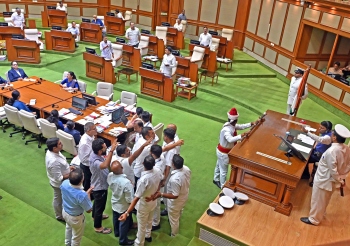
It may have finally been passed in the dead of the night on Thursday, but not before each of the seven Opposition members made convincing arguments against it and unitedly opposed it, even rushing to the well of the House multiple times, raising a ruckus.
While sloganeering in the well, they hit the government side where, in the game of politics, it hurts most ” public perception. They stole the narrative by shouting slogans and calling the bill 'Bhumiputra 2.0', an obvious reference to 'The Goa Bhumiputra Adhikarini Bill', which is the Sawant-led government's Achilles' heel.
Back in 2021, the Sawant government had passed 'The Goa Bhumiputra Adhikarini Bill' in the House. However, the move triggered a State-wide public backlash. With elections then due in 2022, the government was forced to backtrack, and it quietly put the bill first in cold storage and then eventually allowed it to lapse by refraining from sending it to the Governor for the mandatory gubernatorial assent.
The ruckus by the Opposition forced Speaker Ramesh Tawardkar to adjourn the House for five minutes. On reassembling after this adjournment, the Opposition still did not relent and continued to raise slogans in the well, but in that din, Tawardkar went through the motion of taking a vote for both the 'consideration' as well as 'passing' stages, thus giving formal legislative clearance to the piece of legislation.
When the legislation was discussed, the tone for the Opposition was set by two of the younger and less experienced legislators ” AAP's Venzy Viegas and RGP's Viresh Borkar ” who were the first to draw parallels between this bill and 'The Goa Bhumiputra Adhikarini Bill' of 2021.
Both termed it 'Bhumiputra 2.0'. While Borkar said he strongly opposes the Bill as it is meant to benefit encroachers who are mostly migrants, as Goans usually shy away from illegalities like usurping Comunidade land, Viegas, on the other hand, said Gauncares and Comunidade managements will challenge this government-aided loot of land, only landing the encroachers and illegal house occupants into more trouble than they already are in.
Congress' Carlos Alvares Ferreira and GFP's Vijai Sardesai also echoed similar sentiments and questioned the State's and the government's locus standi and authority to grant to third parties (encroachers) land which is owned not by it but by Comunidades, which are private entities.
When his turn came after all MLAs had spoken, Opposition Leader Yuri Alemao added more pelf to the Opposition charge against the bill and led the entire seven-member Opposition to the well of the House, raising the ruckus.
=====
Turning point for Oppn unity
When the Goa Legislative Assembly convened at 11.30 am on July 21 to kick-start the monsoon session, the seven-member Opposition ” three MLAs of the Congress, two of the AAP and one each of the RGP and the GFP ” were a hopelessly disjointed lot.
The cracks were exposed days before the session when a meeting to discuss floor coordination called by Leader of the Opposition Yuri Alemao ended up being attended by only five MLAs ” Alemao himself, the Congress's Carlos Alvares Ferreira and Altone D'Costa, and the two from AAP, Venzy Viegas and Cruz Silva.
RGP's Viresh Borkar and GFP's Vijai Sardesai 'boycotted' the meeting, the latter even launching a public tirade against Alemao, prompting political analysts to ponder and speculate over the wily Fatorda MLA's motives and future political alignment.
But by the end of the first week of the session, the wisdom of unity seemingly dawned on the members of the outnumbered Opposition, and they began to close ranks.
The turning point came during the uproar in the House after Borkar's private member's resolution seeking a definition of 'Goan' from the government was taken up. The bedlam was triggered by Chief Minister Pramod Sawant's rejection of the resolution because the definition was already notified in the February 10, 1995 Official Gazette, which is only the domicile rule.
It triggered a vociferous protest, with the Opposition MLAs led by Alemao rushing into the well and flinging papers from the desk of the Legislature Secretary into the air. The commotion led to Borkar being marshalled out of the House and Alemao apologising later for his act of flinging papers at the Speaker's table.
It also led to Viegas forfeiting his own turn, as he preferred to demand that Borkar be allowed to speak and place his views on the resolution rather than move his own resolution listed in the agenda when his (Viegas's) name was called out by the Speaker.
It unarguably was the turning point for Opposition unity this monsoon session, even if it's anybody's guess whether it will last outside the House, as each of the four political entities -- Congress, Aam Aadmi Party (AAP), Revolutionary Goans Party (RGP) and Goa Forward Party (GFP) -- goes about appropriating political turf at the grassroots outside the House, here on.