


the goan I network
CANACONA
Ranked among the top beaches in the world, Agonda beach is also frequented by the protected Olive Ridley Sea-Turtles who descend on the same beach where they were born to lay eggs deep in the sand.
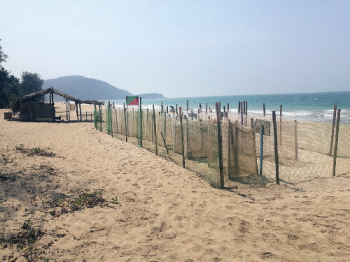
The Nature Rehabilitation Centre, set up by the Forest Department (Wildlife) on Agonda beach as part of a Turtle Nesting Site is presently home to 16 Olive Ridley turtle nests, since the nesting season began in October last.
Incidentally, it was only on 16th January, after a delayed start that Agonda beach coast had it’s first turtle nest, and since then the forest department has been guarding 16 turtle nests holding approximately over 2500 Olive
Ridley eggs.
The most recent contains over 130 eggs, the nest for which was dug up and then covered by the mother turtle herself on March 5. This, too, has been safely cordoned-off by the forest guards posted around the Rehabilitation Centre.
At the same time, Agonda has also witnessed a massive infrastructural development on the tourism front with many alleged commercial activities taking place in the No Development Zone, inviting the ire of the National Green Tribunal for CRZ violations and the forest department for endangering the turtle nesting site.
However, locals disagree. “In spite of the allegations that tourism activities are resulting in mother turtles keeping away from the shoreline, the ground reality is just the opposite,” says a resident from the locality, Godwin Fernandes, who is also a tourism stakeholder.
When this correspondent spoke to some forest guards at the Rehabilitation Centre, it was however revealed that mother turtles visits the shore as and when needed to lay their eggs before returning back to the sea.
“I don’t think tourism activities along the shoreline are hindering any visiting mother turtles,” said one of the guards, adding, “Instead, from a mere 4-5 turtles in previous years, the 2016-17 season witnessed 28 mother turtles visiting the shore. Last season (2017-18), we protected 18 turtle nests and this season we already have 16 pits with over 2500 turtle eggs. Besides, there are another two months to go for the turtle procreation season.”
Each of the pits are believed to carry between 100 to 130 eggs. The turtle nesting season normally begin in October and mother turtles visit the shores to lay eggs even in the month of May.
It takes somewhere between 55-58 days for the hatchlings to emerge.
At Agonda, the first pit of turtle eggs was laid on 16th January, and the first hatching of Olive Ridley’s is expected any day now, informed one of the forest guards at the Nature Rehabilitation Centre, Agonda.
While at least 3 mother turtles came and laid eggs just around the Rehabilitation Centre, most other pits here are a result of shifting of eggs laid elsewhere along the 2.9 kms long Agonda beach shore.
Agonda panch Tipu Pagui, who is also a fisherman by profession says, “tourism activities which take precautions to not disturb the natural marine habitat is no way hinders the turtle nesting site at Agonda. And moreover, with no known incidents of poaching of sea turtles and their eggs reported in the last few years, there is no direct threat to the Olive Ridley at least at Agonda. We believe it’s a natural process “ the turtles come, lays eggs and go back. In some seasons, more mother turtles visit, while in other seasons there are lesser numbers.”
Incidentally, locals also believe that the Agonda Turtle Site should be applied to any one of the several uninhabited coasts (beach-coves) existing in the village, thus leaving the 2.9 km Agonda main beach shore for tourism activities.
‘It is not understood as to how a densely populated beach coast with human settlements all around is notified for turtle protection. Instead, notify uninhibited beach coasts away from human settlements as Turtle Protection Sites instead,” opines former village sarpanch Jovi Fernandes.


