PANAJI
After facing flak from the citizenry, particularly, the business community of the capital city who have taken a big hit due to the ongoing smart city work, the Imagine Panaji Smart City Development Limited (IPSCDL) came under severe scrutiny from the judiciary when the Bombay High Court at Goa took up two Public Interest Litigations (PILs) filed by several residents.
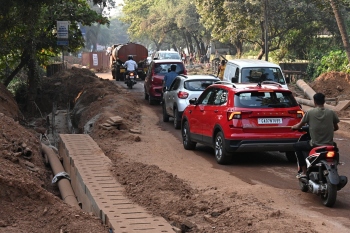
So intense was the scrutiny of the Bombay High Court Bench of Justices Mahesh Sonak and Valmiki Menezes, that the judges even went down to ground zero walking through the ravaged streets and localities in the capital to observe first hand the situation on the ground.
Clearly, the IPSCDL and its contractors had spared little thought to the fact that Panaji was a living city and therefore ignored issues linked to the safety of the public and residents during the execution of work.
In fact, a number of conditions laid down by the then North Goa collector, Mamu Hage, IAS, at the time of granting permission to excavate the roads and carry out work, have been ignored or simply not followed.
Cordoning off areas where work was being executed, putting up adequate warning signs around dangerous work sites, lining obstructions with neon lanterns to ensure visibility at night, were some of the conditions outlined by Hage in her order. However most of these conditions were ignored.
Neon lights come up after Mala death
On New Year's day, a 21-year-old Ribandar youth, Ayush Halarnkar, died after falling into one of the pits dug by the contractor executing the sewerage work at Mala.
Halarnkar, perhaps blinded by the pitch-darkness, rode his bullet into the pit, shattering through the loosely held planks along the periphery. He died of his injuries later but clearly the dangerous pit had not been adequately barricaded nor were there any neon lanterns as mandated by the District Magistrate's order.
Facing flak in the aftermath of Halarnkar's death, IPSCDL moved swiftly to ensure all such pits dug up to construct manhole chambers for the sewerage project were properly barricaded, strapped with radium tape and neon lanterns attached to help visibility at night.
The matter of alleged negligence on the part of the contractor and officials of IPSCDL in the case of Halarnkar's death, is under scrutiny and adjudication by the Goa State Human Rights Commission. The process is ongoing.
It was also stipulated when the North Goa collector permitted excavation of roads that maximum traffic marshals be deployed round-the-clock to guide motorists and regulate vehicular traffic but none of it is being followed.
Dust pollution
With almost every other road in the city excavated, commuters and residents being affected by the dust pollution was a common complaint for long. In fact, it was the reason in chief cited by several of the Panaji residents who are party to the PILs before the Bombay High Court. Through the PILs, the citizens have demanded that the authorities install ambient air quality monitoring devices in and around the city where the infrastructure work related to the smart city projects are being carried out.
With the city's ambient air quality gone for a toss due to the excavations sending dust rising into the air the petitions cite cases of residents suffering from health issues, particularly respiratory problems among senior citizens.
Again, none of the measures laid down in the district magistrate's order to prevent dust pollution including use of water sprinklers and covering the work sites where excavated mud is dumped with tarpaulin or plastic, were followed by the contractors.
Now, through the PILs, a direction to the government is sought to deploy mechanical road sweeping machines/vacuum cleaners to clear roads of dust and control the pollution which is affecting the health of many.
IPSCDL revamped but trouble for Panaji continues
The State government in June last year effected a bureaucratic shuffle which saw Chief Minister Pramod Sawant replace Hage as Managing Director and CEO of IPSCDL with Sanjit Rodrigues, IAS. The move was at the time tom-tommed as a 'masterstroke' citing Rodrigues' vast experience working with Panaji, including during the time infrastructure work was executed in the runup to the first edition hosted by Goa of the International Film Festival (IFFI) and also as Commisioner of the Corporation of the City of Panaji.
But nine months later, Panaji and its residents continue to struggle in the dust and mess created in the city with the ongoing work. The dust pollution has caused several residents, senior citizens in particular, to fall sick and the movement of traffic, or lack of it, has come to haunt both residents and hundreds of visitors who enter and exit the capital city on a daily basis.
With Rodrigues taking over the leadership at IPSCDL in June last year, the focus of those planning the execution and of the contractors actually carrying out the work has continued to remain centred around completion and meeting deadlines fixed by the government. Public safety and the thought to spare residents and the general public in Panaji the inconvenience they face due to the ongoing work seems to have been relegated lower down in their priority list, as workers continue to dig and re-dig several of the city's roads without making alternative arrangements.
Areas affected
The projects being implemented as part of the 'Smart City Mission' in Panaji are basically a new underground sewerage system for the capital and two major stretches of road being converted to smart roads -- the first from the Old Patto Bridge to the 'Four Pillars' junction and the second from the Taj Vivanta junction in St Inez to the Hotel Goa International T-junction.
Those most affected by the ongoing work therefore are residents in the main city square stretching from the Immaculate Conception Church in Panaji to the CCP market area and the stretch around St Inez circle, the T-junction at Tonca, Caculo mall and Madhuban Complex area.
Post their inspection, the judges of the Bombay High Court have said the progress of work will be monitored to ensure that the May 31 deadline for completion is met. Residents and commuters meanwhile, will have to continue to live with the 'smart city' nightmare until then.