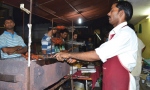
As you walk down the road, you are greetedby the wafting smell of hot butter on a heated pan. Turning to your right (orleft, if you approach from the opposite direction), you will see that the edificethat lies before you is the Jama Masjid. An odd place perhaps, to expect foodto be served. Yet, during the month of Ramadhan, there are a series of tableslaid out, with some of the most delectable preparations to be had.
The Jama Masjid was built by Aba Sheth andSuleiman Sheth around the year 1779, with renovations having been done in theyear 1935. Further renovations were then carried out in the year 1995. Whilethis place is a house of worship for most of the year, the sidewalk outsidehouses some of the best street food to be had.
Iftar cuisine needs no introduction, but isstill, for the most part, novel to Goa. This is true to the point that thesestreet stalls have been set up by caterers from Bombay in the avatar of LuckyHotel from Bhindi Bazaar. Being open for five hours every day from 5:30 pm to10:30 pm, the stalls are a complete ‘must visit’ for anyone who has not indulgedin this kind of food before. The Bayda Roti, a preparation of minced meat, egg,and dough, will melt in your mouth and literally make you stop and wonder whereit disappeared in a matter of a few seconds. To its left on the stove,occupying a place of no less importance, you can pick from an assortment ofrolls (the beef being the best by far). Wrapped in pastry and deep fried, itwill have your cardiologist raising an eyebrow before casting an indulgentsmile (doctors eat too). The sheekh kababs and boti kababs are also the mostauthentic that are to be found. On your way out, don’t forget to stop for aglass of saffron and cardamom flavoured falooda. It promises to be a great wayto wash down your already satisfactory meal.