THE GOAN
PANAJI
As the cameras begin issuing e-challans, social media has already delivered its verdict. "If AI cameras can spot someone without a helmet, can they also spot a pothole?" read one of the many comments shared online. Behind the humour and sarcasm, however, lies a serious conversation. With AI-powered traffic surveillance cameras going live, the State has taken a significant step towards stricter traffic enforcement. However, commuters continue to debate whether technology alone can make roads safer.
AI rollout
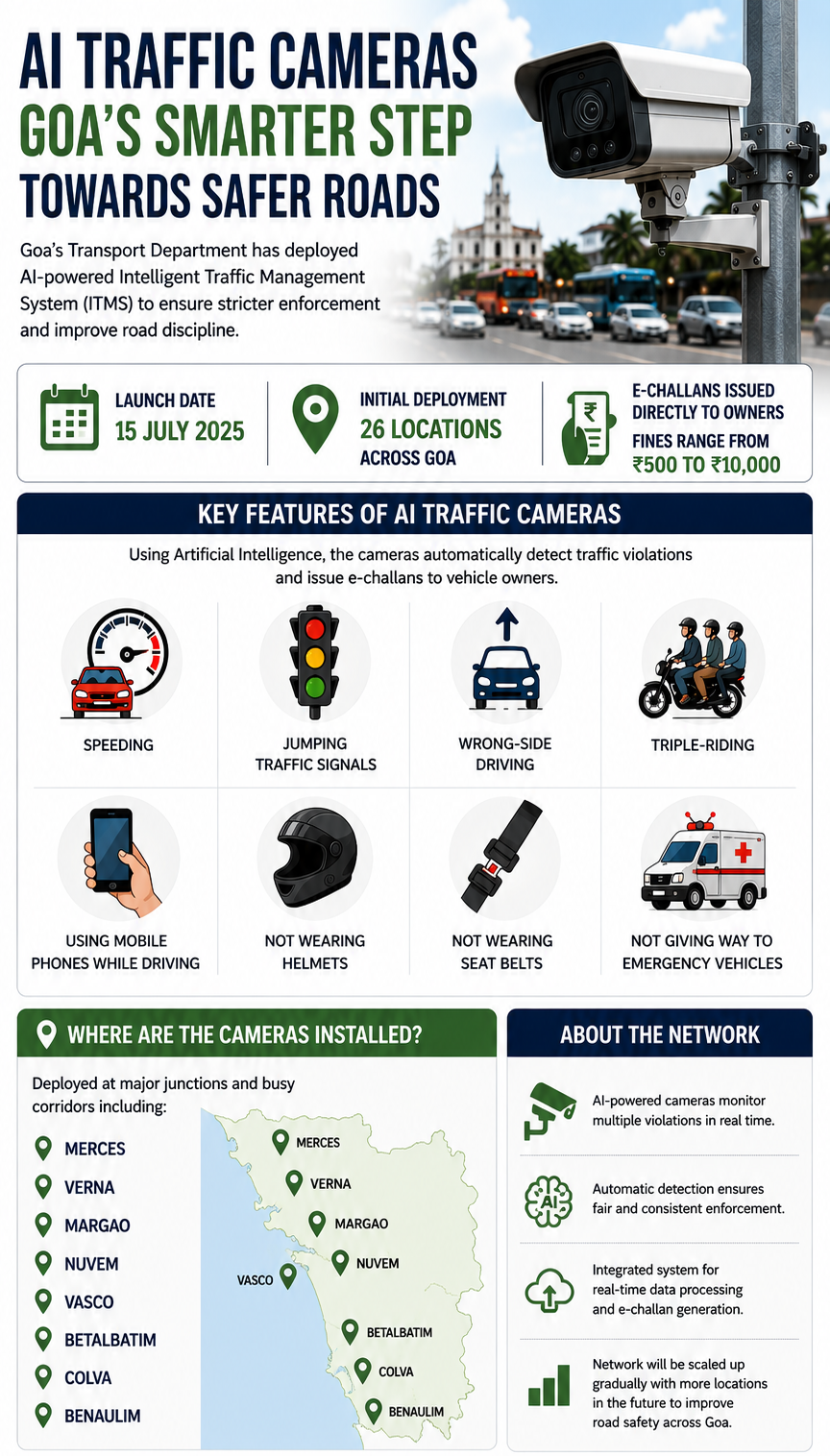
Beginning on July 15, Goa's Transport Department has deployed the Artificial Intelligence-powered Intelligent Traffic Management System (ITMS) at 26 locations across the State. Using AI, the cameras automatically detect offences such as speeding, jumping traffic signals, wrong-side driving, triple-riding, using mobile phones while driving, failing to wear helmets or seat belts, and not giving way to emergency vehicles. E-challans carrying fines ranging from Rs 500 to Rs 10,000 are issued directly to vehicle owners. Installed at major junctions and busy corridors including Merces, Verna, Margao, Nuvem, Vasco, Betalbatim, Colva and Benaulim, the network is expected to expand to over 50 locations.
Public response
While the rollout has largely been welcomed as a much-needed step towards improving road discipline, the reactions reveal that people see the cameras as only one part of the solution. While stricter enforcement is necessary, many feel Artificial Intelligence cannot compensate for poor roads, inconsistent implementation or irresponsible driving habits. Among those who support the initiative is Dale Dias, a physics teacher from North Goa, who believes the cameras were long overdue. While he expects them to improve road discipline, he feels it would be unrealistic to expect them to eliminate accidents. "They will definitely reduce the number of accidents; however, the reduction will be minimal," he says.
Behaviour matters
The large number of violations detected within days of the system's launch has highlighted the need for stricter monitoring, but some believe it has also exposed a deeper problem. Jonas Rodrigues, Assistant Professor from Miramar, says lasting change depends more on civic responsibility than technology. "It finally depends upon the mentality and responsibility of citizens to follow traffic rules. If their mentality is not supportive of traffic rules, no matter what new provisions are implemented, they will continue to violate traffic rules and etiquette," he remarks. Others believe enforcement should be accompanied by additional safety measures. "There should be stricter implementation of rules; traffic violations may reduce, but to reduce the number of accidents, there should be more measures put in place," says Sayli Gaonkar, a student from South Goa.
Past experience
Most of the scepticism stems from experience rather than opposition. Goa has experimented with CCTV surveillance before, and many of those cameras eventually stopped functioning, leaving commuters hopeful that the new system does not meet the same fate. "While people are only following the rules now wherever there is a camera, it would be better if the authorities could get the pre-installed cameras also to work again," says Calvin Velho, a VJ from North Goa. Although he believes the new system will spread awareness, he hopes it remains functional in the years ahead. Shaunak Desai, a proprietor from Margao, also feels it is too early to judge. “It is too short a period to comment on the effectiveness, though I feel it will eventually stop working; I hope I am proven wrong,” he says.
Infrastructure first
Beyond surveillance, commuters say improving infrastructure must remain a priority. Better roads, regular maintenance and reliable traffic facilities are just as important in reducing accidents as stricter enforcement. Jonas echoes this sentiment, saying, "An important measure should be the constant maintenance of traffic facilities and provisions."
Road ahead
The success of Goa's AI traffic cameras will not ultimately be measured by the number of e-challans issued, but by whether they help create a lasting culture of road discipline. Artificial Intelligence can detect a traffic violation in seconds, but it cannot repair a pothole or make someone choose to drive responsibly. For Goa's roads to become safer, technology must go hand in hand with better infrastructure, consistent enforcement and a collective willingness to follow the rules. Will these AI cameras finally make motorists think twice before breaking traffic rules and help reduce fatal accidents, or will they eventually become another piece of technology left to gather dust? Only time will tell.