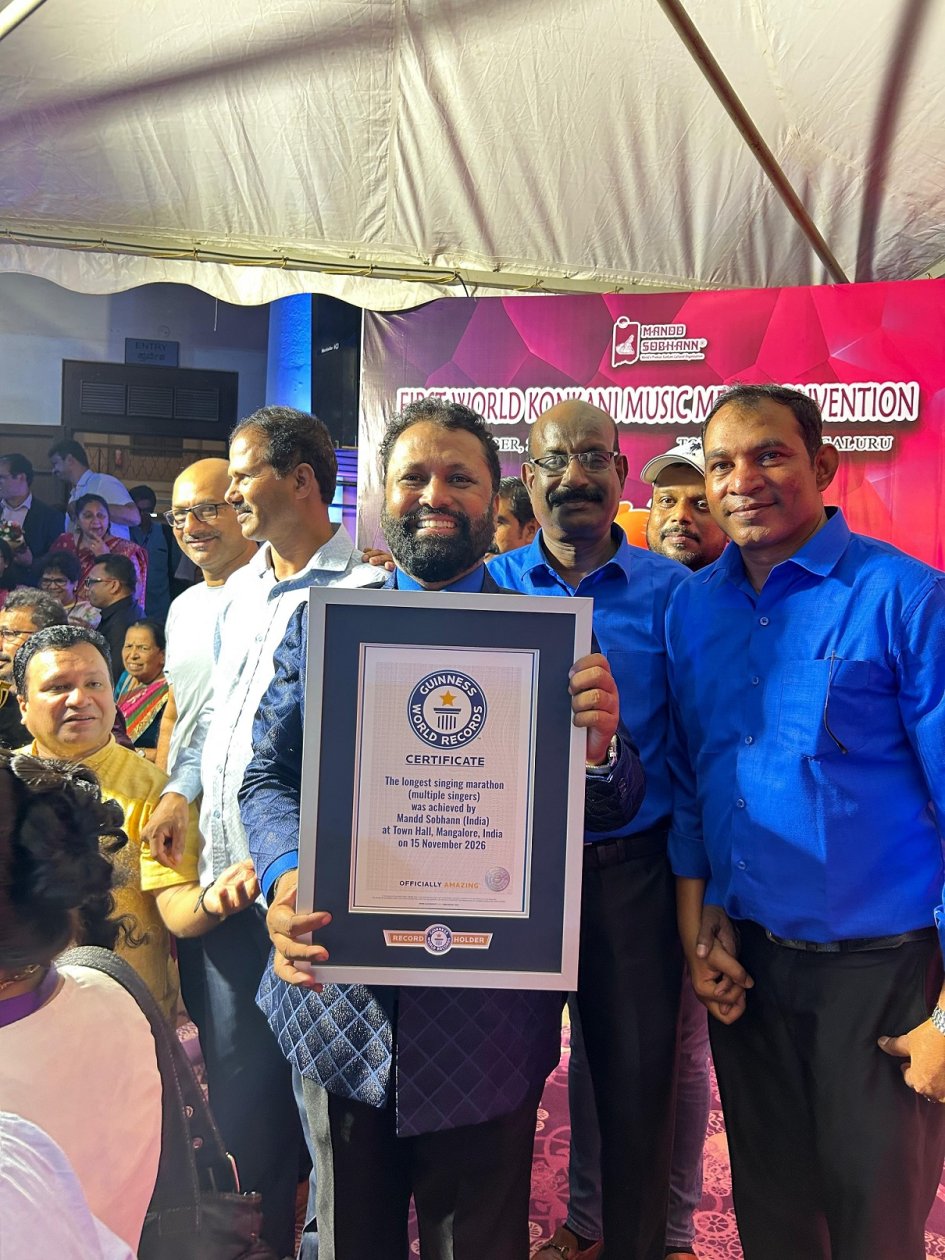
A Guinness World Record may take 12 days to complete, but getting 53 Goan groups on stage took months of persuasion, planning, and coordination. For Michael Gracias, who brought the groups together for the World Konkani Mega Music Convention in Mangaluru, what began as a request for 20 groups soon became a much bigger challenge.
“When I was asked for 20 groups, I said, ‘20 groups are not a problem. We can manage 20 groups in Goa,’” he recalls.
After registering four groups in January 2026, he managed to bring the number to 20 within two days. Studying Gujarat’s previous record of 11 days, 11 hours and 11 minutes, set with around 1,200 singers, he felt Goa should aim for a similar number. He asked the organisers to reserve 50 places for Goa.
“If you are reserving 50 groups for Goa, I take it as a challenge,” he told them.
Winning over groups
Getting the first 35 groups was relatively easy through phone calls. Reaching 50 meant visiting priests and making appeals in parishes. Some questioned why he was making so much effort for an event in Mangaluru.
His response was clear: “It is for Konkani. Konkani is entering the Guinness World Record. For me, what matters is Konkani, not who is doing it.”
The final count reached 53 Goan groups, but the work did not end there. Some groups withdrew, while others had to be reminded to follow the guidelines.
“You either comply, or I will withdraw,” Gracias told those who did not meet the requirements. Lyrics had to be submitted in advance, and songs could not be repeated within the stipulated period.
Around 95 per cent of the Goan groups presented original compositions, while lyrics were submitted in Roman, Kannada and Urdu scripts by different groups. The coordination extended to every detail, from travel and accommodation to meals and stage arrangements. Organisers tracked trains and received groups at Suratkal station before taking them to their hotels and the Town Hall.
Precision backstage
Each group had to report three hours before its performance, already dressed. One of Gracias’ groups, scheduled for 4 am, had to wake up at midnight and reach the venue by 1 am. Participants underwent Aadhaar checks for age eligibility and rehearsed on a dummy stage, where their positions and lighting were finalised.
Phones and bags were kept in lockers, while groups performing with live musicians had to arrive early for instrument set-up. With two stages operating in rotation, the next group had to be ready as soon as the previous performance ended. The changeovers were carried out in “pin-drop silence” to avoid disturbing performances on either stage.
“It was that precise,” Gracias says. Despite the demanding schedule, he says the Goan groups were well looked after, with transport, accommodation and meals arranged. The performances also showcased the range of Goan music, from Mandos and folk songs to Alfred Rose compositions, Konkani Christmas carols, dekhni and tiatr songs.
“Goan music was not just tiatr songs,” he says.
Showcasing Goan music
The convention brought together around 300 teams, which performed 4,596 songs during the marathon. Joel Lasrado, a retreat preacher who attended the performances at Town Hall, said, “Goan groups have won the hearts of Konkani-speaking people worldwide, especially in Mangaluru. The music and the voices were top-notch.”
He was particularly encouraged by the young participants, saying, “It was wonderful to see so many youth in their 20s singing and lifting our mother tongue to new heights and assuring us that the future of Konkani is secured.”
Personal commitment
The preparations also involved considerable personal expenses. Gracious held simultaneous rehearsals in his hall and on the terrace for around 65 people for nearly a month, arranging food for them every day. “The individual groups bore all these things,” he says.
The groups also approached the government through the Tiatr Academy, meeting the minister and officials of the Directorate of Art and Culture to seek support.
“Nothing has happened so far, but we hope it will happen,” he says.
Recognition follows
However, recognition followed after the groups returned to Goa. At the novenas at Pilar, people approached Gracias to congratulate him on taking 53 groups to Mangaluru.
He also recalls receiving a call from Father Adrian, a parish priest, who told him, “Michael, well done. So proud of all that you are doing. Goans rocked it.”
A record achieved
Yet, the most overwhelming moment was completing the record itself. The singers surpassed the previous achievement and completed the marathon of 12 days, 12 hours and 12 minutes.
For Gracias, seeing so many Goans come together for Konkani and take its music to a wider audience made the months of hard work worthwhile. Goa had not only brought 53 groups to Mangaluru but had also played its part in taking Konkani music into the record books.