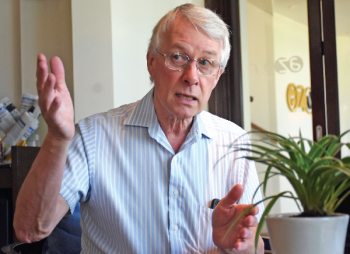
Nobel laureate Richard Roberts’ discovery is fundamental but of utmost importance.
It was in 1977 that Richard (who was a chief scientific officer at New England Biolabs at Beverly, Massachusetts at the time) and Phillip Sharp, both independent of each other, successfully demonstrated how RNA can be divided up into introns and exons, after which the exons can be joined together.
This can occur in different ways, giving a gene the potential to form a number of different proteins. For this, he and Sharp shared the Nobel Prize in Physiology or Medicine in 1993.
Although he had been interested in and doing research since he was young, Richard admits it took him 18 months for this particular research.
An organism’s genes lie within the chain of nucleotides found inside DNA molecules.The genetic information contained within DNA is transferred to ‘messenger’ RNA, and is then converted during the formation of proteins.
An RNA molecule’ chain contains both elements needed for protein formation, exons, and parts that are not needed - introns.
“Actually we were looking for something totally different. We were sequencing DNA and RNA and looking to see where RNA began on the DNA. There is a signal in the DNA that says start making RNA here. There is an enzyme called RNA polymerase which is a protein that makes RNA. When it sees the signal, it says starts and it starts making the RNA,” briefs Richard.
Until then, it was assumed that the signal used in this process for higher organisms was the same as that used by bacteria, Richard elaborates. “However, we decided to look to see if this was indeed the case. In the process we found out that it was not only a little bit different, but what happens in the RNA after it is made was different here then what happens in bacteria,” he says.
In higher organisms, a gene is a much longer piece of DNA than it is in bacteria, explains Richard.
“In bacteria you take a single piece of DNA and you just read what makes an RNA and that copy goes to make a protein. In higher organisms, like bird or animals or human beings - you make this long piece of RNA that makes the copy of the gene but the bits of it that are actually called protein are split into pieces. When the RNA is cut into pieces it is taken and split, then all the pieces that make sense are taken, joined together so as to make meaning.” he says. “In bacteria the RNA is straight but in higher organisms it’s split and so one has to join it to read.”
To simplify the process, Richard cites an example.“It’s like making a movie. When you make a movie, you shoot a scene and then another scene and in the end cut the unimportant parts and put it together to have a movie that makes meaning.”
But how has it helped science in detecting diseases or viruses? “These days if we want to know about an organism we sequence its DNA. If we didn’t know that the genes are split up into pieces, we wouldn’t be able to interpret it. So that was an important and fundamental discovery,” shares Richard.