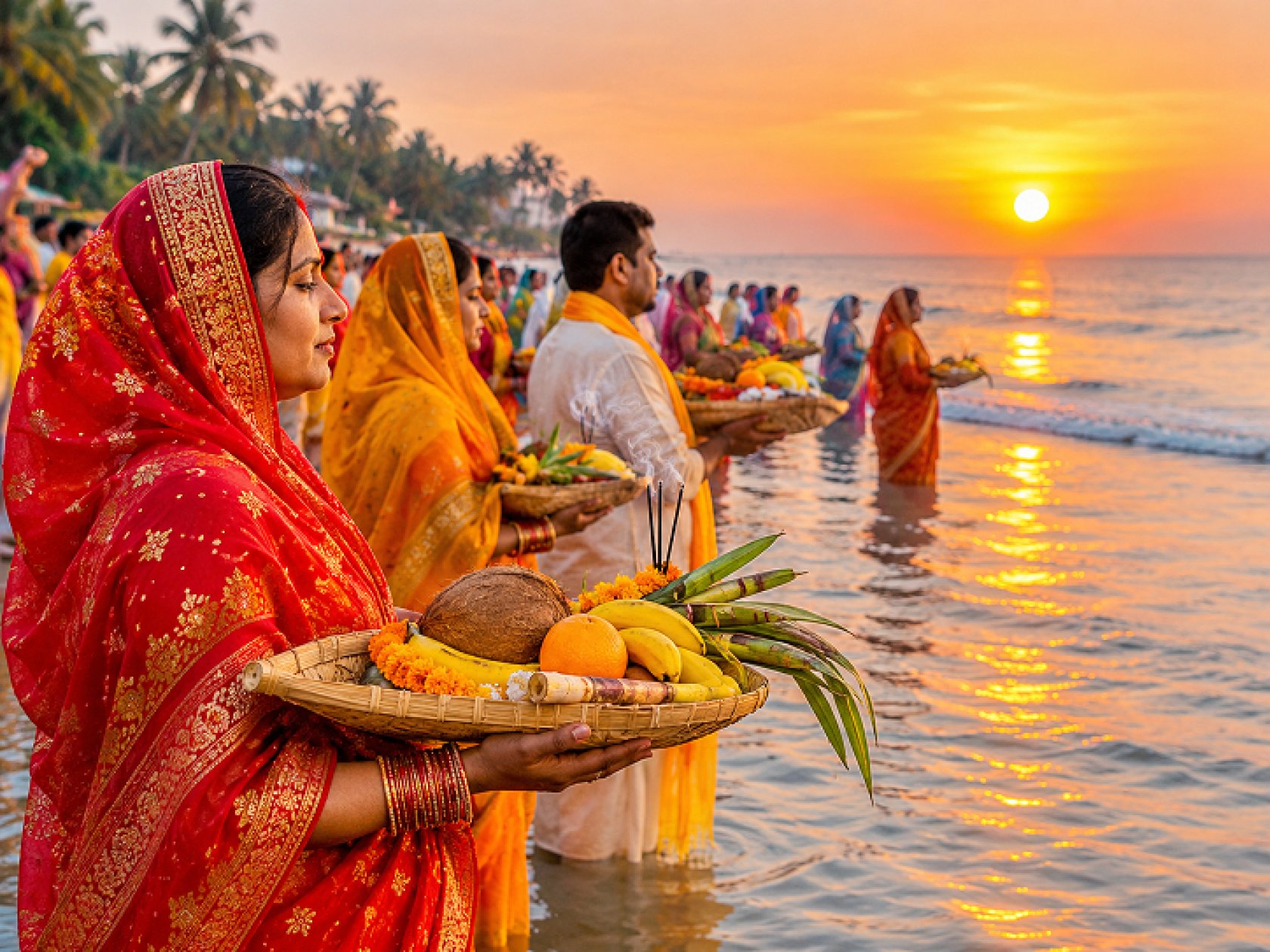
As the sun sets over Goa’s beaches today, families will gather with offerings to pray to the setting sun. For many, Chhath Puja is a tradition they grew up celebrating along rivers and ponds in Bihar, Jharkhand and eastern Uttar Pradesh. Though the setting has changed, the rituals and togetherness remain rooted.
Four-day festival
Dedicated to Surya, the Sun God, and Chhathi Maiya, Chhath is observed over four days. The festival expresses gratitude to nature and the sun, while devotees pray for their families’ health, prosperity and long life, particularly that of their children. Chicalim Sarpanch Kamla Prasad Yadav says, “Chhath is not just about worshipping the Sun God; it is about expressing gratitude to nature and acknowledging the sun’s role in sustaining life.”
The observance begins with Nahay-Khay, when devotees bathe and prepare rice, bottle gourd and chana dal. This is followed by Kharna, a day-long fast after which jaggery kheer, roti and fruits are prepared as prasad. Devotees then begin a 36-hour fast without food or water. On the third day, during Sandhya Arghya, they gather at water bodies with bamboo baskets of thekua, fruits, sugarcane and coconut. They offer arghya to the setting sun while standing in water. The ritual is repeated the next morning during Usha Arghya, when prayers to the rising sun mark the end of the fast. Thekua, made with wheat flour, jaggery and ghee, is essential. Devotees prepare food themselves and perform rituals without idol worship or a priest.
Home and family
Chhath also brings families home. Poonam Kumari says her family travels to their hometown every year to celebrate with loved ones. “It is considered one of the toughest fasts, but the atmosphere at home is so pious and beautiful. Celebrating it in Goa is lovely too, but at the end of the day, home is home,” she remarks.
Deeper significance
Kamlesh Mishra, a doctor from Jairam Nagar, Dabolim, who has lived in Goa for 30 years, traces Chhath to the Dwapar Yuga and Lord Krishna’s time. He shares an account from the Mahabharata, according to which the Pandavas began worshipping Surya after the death of their elder brother Karna, believed to be the Sun God’s son. For Mishra, praying to the setting sun before the rising sun carries a deeper message: while people celebrate success, the ritual reminds them to acknowledge those facing difficult times. “Everyone pays homage to the rising sun, but we first pay homage to the setting sun,” he says.
Changing arrangements
Mishra says the rituals remain unchanged in Goa, although preparations differ. In North Indian villages, families collect firewood and cook on clay stoves, while farmers grow and distribute sugarcane, lemons and other produce. In Goa, families buy ingredients and prepare offerings on gas stoves. “The puja is performed in the same way, but the arrangements have changed. In our villages, farmers themselves grow produce for Chhath and distribute it among families, whereas here we have to purchase everything from the market,” he says.
For Rajiv Gupta, an ex-serviceman who runs Dexa, changes have been more about facilities than the festival. Having observed Chhath since childhood in Bihar, he recalls families travelling to rivers and ponds to pray. With growing crowds, particularly in Patna, artificial ponds and rooftop arrangements make it easier to find spaces for rituals. However, he believes traditions are preserved. “There have been many changes in the facilities over the years, but there has been no change in the traditions. The food, thekua, firewood, fasting and timings remain the same as they were when I was a child,” he says. He adds that Goa’s celebrations follow the same practices as those in Bihar.
Growing community
Chhath has grown into a community celebration in Goa. Bharat says Baina Beach in Vasco is among the biggest gathering points, attracting an estimated 15,000 to 20,000 devotees. Celebrations are also held at Miramar, Colva and Bogmalo beaches, and near Mahadev Mandir in Ponda. The Chhath Puja Seva Samiti was formed in Ponda in 2013, he says, helping organise celebrations. Community organisations, local representatives and panchayats assist with temporary ghats, lighting, security and cleaning. Around 200 to 250 women observe the vrat at the Ponda riverbank every year.
With families across Vasco, Ponda, Porvorim, Sanquelim, Bicholim and Margao, these gathering points offer spaces to reconnect. Many travel to celebrate together, while Baina and Miramar beaches draw tourists who witness the rituals. A celebration once largely confined to villages has found a wider community in Goa.
From returning home to celebrating along the coastline, Chhath brings people together across distances. The rivers may have been replaced by beaches, but the festival remains a familiar connection to home, family and tradition.