TGLife
In an appreciable effort of sharing the skills of yesteryear with the GenNext, Socorro Socio-Art and Cultural Association is taking initiative of organising workshops and fests. Identifying people with extraordinary skills that were a part and parcel of their lives in the Goa that's almost gone now, the association has collected a data base with names of the resource persons across Goa willing to volunteer and train others.
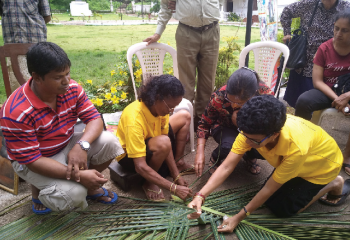
The association succeeded in training many youngsters the art of weaving ‘mollan' out of coconut leaves and baskets out of bamboo, at the Mollancheam fest at Socorro. The fest also saw ‘rotesao' chairs weaving where cane or plastic strips are woven to make the seats and backs of wooden chairs. Many volunteers displayed various skills, including the de-husking of coconuts.
While Philo D'Souza displayed her skills in weaving ‘mollan' and trained others too, Aurora Lobo taught the enthusiastic to weave ‘rotesao' chairs. Anusuya Dhargalkar shared her skills of weaving ‘paatlo' (bamboo basket) and John Fernandes de-husked the coconuts in more than one manner.
"In the midst of nature, our ancestors lived a typical ‘susegad' life in the past. With advances in science and technology the Goans have embraced modernity. But that does not mean one should deviate from nature. ‘mollan', ‘rotesao' and ‘paatlo' symbolise our harmonious living in the lap of nature and that's why we wish to rejuvenate these forgotten skills and by allowing an open platform for the youngsters to learn them, we can preserve them for posterity," says Connie Pinto, president of Socorro Socio-Art and Cultural Association, Porvorim.
The fest cum workshop began at 11 am on Sunday, August 20 at the Church premises with historian Sanjeev Sardesai, art collector Shaista Thapar and Konkani rock singer O'luv aka Olavo Rodriguez making their presence felt. After the learning sessions the entire gathering was served a sumptuous lunch of Goan delicacies, free. The objects that were readied after the workshop were in much demand and enthusiastic buyers were keen in taking them home as mementos. "The eco-friendly ‘mollan' offer natural ventilation and are still in use at shacks, hotels, restaurants and beachside bars in the other than villages. The plastic covers block air and ventilation, so airy ‘mollan' are preferable in summers," admits Fr Santana Carvalho, parish priest at Our Lady of Socorro Church that hosted the event. "The life that we lived once, some decades ago, was indeed, carefree and full of joy. Though cultural transitions do not allow one to bring back the time that has passed and days that are gone by, one can still taste the slice of that life, through traditional cuisine, music, folklore, folkdances, household objects that were a part of our day-to-day life. By reviving these, one can still re-live the life," believes Fr Carvalho who wholeheartedly supports all positive initiatives taken by the association in the larger interest of the local community as well as Goa.
The fest served as a get-together for the women and children who joyfully played ‘ghumot' on the tune of Konkani songs in the music and dance session after the workshop. Having bought their ‘ghumots' at the ‘Ghumotanchem fest' held at the same venue in the recent past, they found an opt occasion to showcase their skills.
"As the ‘ghumot' is now available with legal skin and can be played in the public, we shall soon hold ‘ghumot' training workshops for all, including women and children," promises Connie, appealing, "We are looking out for ‘out-of-the-box' ideas to hold more such skill-sharing workshops in future and suggestions from Goans are welcome." The next event that would have a ‘ghumot' playing workshop will be ‘Ramponkaranchem fest' on September 17 at Arambol. This fest will also have free food, music, workshops and talks.