BHARATI PAWASKAR
Gone are the days when parents could spend time teaching their kids morals through inspiring stories. The modern nuclear family culture has no place for grandparents or uncle-aunts, either. In the absence of this, most kids have turned to talking toys and storytelling apps. With machines replacing humans, modern kids today miss the once ‘live and lively’ bed-time storytelling ritual.
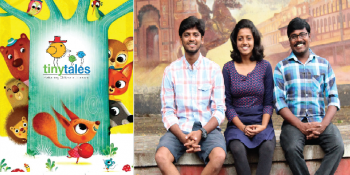
To fill this gap, three young theatre graduates from Lalit Kala Kendra (Pune) have teamed up under the umbrella of ‘Tiny Tales: Performing Children’s Literature’. The trio travel together, covering villages and cities, performing stories live in the schools in the vicinity. Having begun on June 15 this year, the team covered village schools in Kolhapur and Sangli and will now be visiting Goa on June 20 with a four-day schedule to perform in schools at Canacona, Mashe and Ponda.
“We illustrate and perform tales for children picking them up from children’s literature, expressing them through the medium of theatre,” says Pratiksha Khasnis, 21. It was after receiving the ‘best child actress’ award at state-level kids’ theatre competition in her hometown Kolhapur that Khasnis decided to dedicate herself to theatre. While pursuing Theatre from (Savitribai Phule Pune University’s) Lalit Kala Kendra in Pune, she continued performing for school children.
Khasnis who has been conducting theatre workshops for seven years, will now be devoting two years to the ‘Tiny Tales’ project. Believing that a change does not occur overnight, she begs, “We are not entertainers, we are change makers, take us seriously. Don’t demean our efforts to bring back the fast-fading culture of storytelling.”
Explaining their concept, 24-year old Kalpesh Samel adds, “Up till now, there have been plays specially crafted for children and are still being made; but not everyone has the privilege to see that play in a theatre or an auditorium. We solve this problem by performing the play in their space, in their surroundings. And if we do theatre then that doesn’t mean we need a stage, proper lights or sophisticated set ups for our performance; we can perform our plays in a school classroom, on playgrounds, under the shed of a tree and various other open places. Basically, a play can light up any space given to it and make it come alive.” Samel has many plays and a Marathi movie, ‘Bioscope’ to his credit in his theatre journey of six years.
Their third partner, Santosh Gaikwad, has done both, BA and MA with ‘Natyashastra’ (art of theatre). For the past seven years, Santosh has indulged in multiple theatrical activities, acting, performing, writing and directing plays. With several awards in acting and script writing, he also did journalism while researching for kids’ theatre.
What brought the trio together was QUEST (Quality Education Support Trust), an organisation concentrating on the growth and quality of education for children. “Quest had announced a fellowship of nine months to work with the kids of Ashramshala in Palghar and perform stories for the little children. The journey that started with this fellowship has brought us where we are now with 100 plus shows in 80 plus ‘aashramshalas’ enriching the lives of over 15000 children ,” says Gaikwad.
By performing stories and plays for children in several schools and by listening to the experience on how it affected them, the trio decided that this wisdom and this understanding of these little minds shouldn’t be restricted to this village itself and should reach out to every child out there in every school in every village. The outcome of this strong belief was ‘Tiny Tales’.
Team ‘Tiny Tales’ has conducted 10 workshops so far, where in the team not only does plays but also teaches techniques which are useful to kids in their everyday life. Working together as a team, introducing them to children’s literature, and developing a habit of reading to them are few focus areas. The performances and workshops can be arranged in any home, compound, open area or ground. The team accepts donations, as it allows them reach to maximum number of children and schools.
“The motive of our project is making kids enjoy a live performance. Today, children watch stories on television, internet and other media platforms which are fascinating in their own way. But such virtual mediums hamper imagination and creativity. It narrows down the thinking process,” points out Samel.
Gaikwad hopes that their storytelling opens up a different world before these children wherein they can experience possibilities of things and broaden their way of thinking. He reasons out, “Although urban children are more privileged as compared to rural children, the underlying currents of the hustle and bustle of the city burden their shoulders and they live under a constant invisible pressure. Therefore along with the rural children, this project also needs to reach out to them too.”
“Stories, in any form, have the power to keep children engaged. And understanding a story in a visual form makes more sense to them. What better medium than theatre to reach to our little audience with our stories?” asks Khasnis, adding, “This visual treat of the story in theatre not only strengthens their imagination power but also imbibes in them a team spirit quality, which is the base of any theatre activity. Also, though theatre is a form of entertainment, time spent in watching or doing theatre helps in social development of children and pushes the capability of a child beyond its limit.”