Dr ALVARINHO J LUIS
The name Ribandar is believed to derive from the Konkani word Rayachem Banddar, meaning the wharf, dock, or port of the kings. Historical accounts refer to the settlement as Raibandar, or the royal landing place, with the name gradually changing to Rabandar, then Rebandar, and eventually Ribandar. Ribandar was a strategic center for commerce, customs administration, and riverine trade along the Mandovi.
In 1510, the Muhammadans of the Adil Shahi Sultanate of Bijapur established a redoubt (a small fortification or defensive post) at Ribandar. After the Portuguese conquest of Goa in November 1510, they built a house here for the Thanadar, an official entrusted with watching over goods passing along this stretch of the river and collecting the prescribed taxes. The house was known as Rayachem Ghor. By 1554, Ribandar’s Thanadar, assisted by one Naique and nine peons, supervised river trade and collected taxes. Records from 1572 indicate that he also received a share of certain inspected goods.
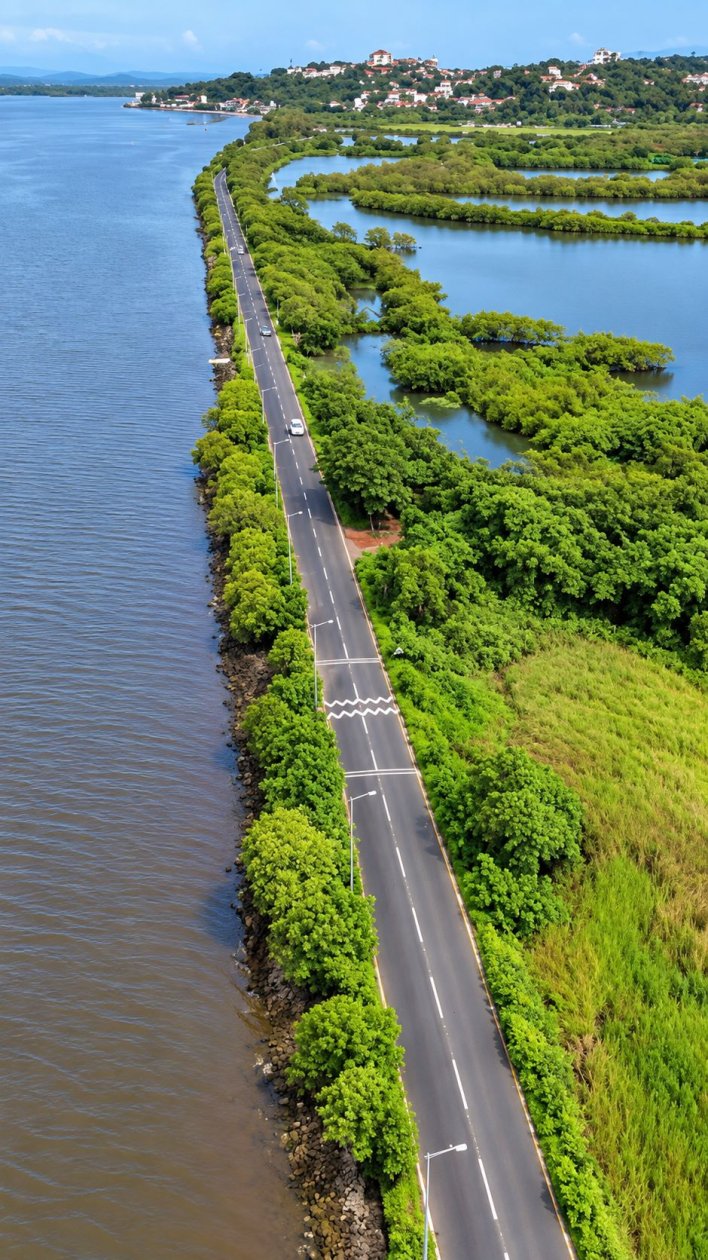
Causeway of Ribandar
The Ponte Conde de Linhares, commonly known as Ponte de Linhares, is a 3.2-km-long causeway linking Ribandar with the city of Panaji. Built in 1633–34 under the Portuguese Viceroy Miguel de Noronha, 4th Count of Linhares, after whom it was named, the bridge was reportedly the longest in the world when completed in 1634. Ducts incorporated into the structure help regulate tidal flow. Three arches support the causeway on its eastern side and thirty-eight on the western side.
The original bridge is said to have been designed and constructed by the Jesuits of the College of St Paul in Old Goa. Built over soft alluvial soil, its foundations were stabilised using trunks of Iliadola briformis, locally known as Zambo, while laterite stone formed the superstructure. Designed originally to bear horse-drawn carriages, the centuries-old causeway later adapted remarkably to the passage of heavy motor vehicles.
Popular tradition credits the Jesuits with supernatural powers, claiming they built the entire causeway in a single night, illuminated by the light of just one lamp. Over the centuries, the historic causeway underwent several repairs. It was renovated in 1771 during the tenure of Governor and Captain General D João José de Mello, and again in 1859 under Viscount of Torres Novas.
Church of Nossa Senhora da Ajuda
The Church of Nossa Senhora da Ajuda traces its origins to a divine intervention at sea. According to legend, a Portuguese ship sailing to India encountered a violent storm near the Cape of Good Hope, leaving its captain unable to control the vessel. Fearing for their lives, the captain and crew prayed to Our Lady for protection and help.
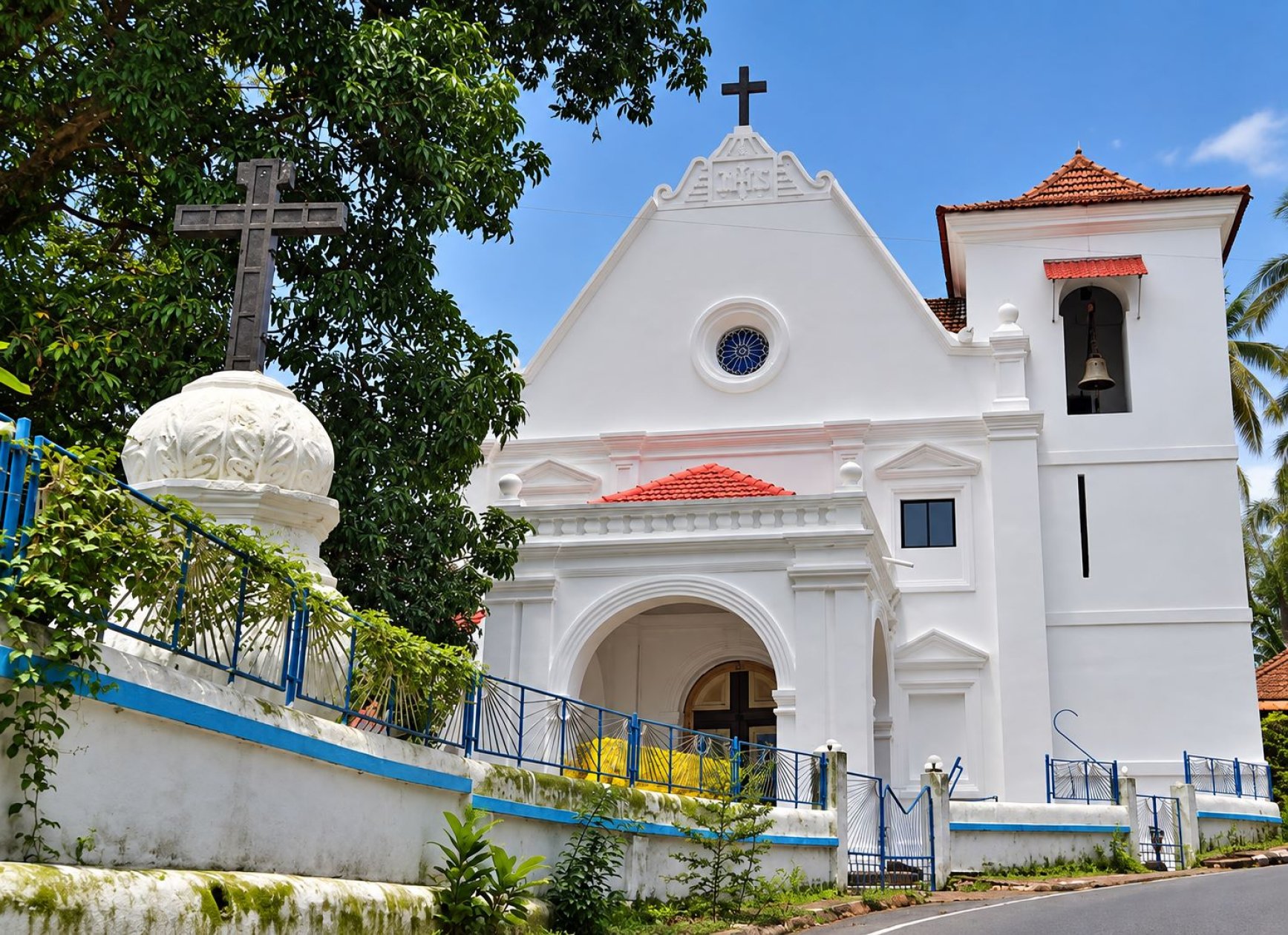
The Virgin Mary is said to have stood on the forecastle throughout the night, guiding the ship safely through the tempest. By morning, the astonished crew found that the ship had reached the destination safely. In gratitude for their miraculous deliverance, a church was reportedly erected at the spot, traditionally said to correspond in length, breadth and height to the ship.
Originally a chapel dedicated to Our Lady of the Immaculate Conception, it was under the ecclesiastical jurisdiction of the Church of Our Lady of Livra Febres at Chimbel. The three-storeyed church has four bays and a peaked gable with a central oculus, crowned by a cross with the IHSinscription below. A large cross from the former Chorao Seminary stands outside, while a model of the legendary ship is displayed inside. The interior features paintings of saints and four altars. Historically, the body of St Francis Xavier, brought from Malacca, was temporarily kept here in March 1554.
Hospital of the poor
Located near the riverside on the outskirts of Ribandar, the Hospital of the Poor or Hospital da Misericórdia was an attractive but modest institution with limited accommodation. Santa Casa de Misericordia, a charitable institution, was established to assist the poor, sick, orphans, and other vulnerable people. According to José Nicolau da Fonseca’s 1878 account, they established the hospital here in 1851. Crucifixes adorned both the male and female wards, reflecting its strong religious character, while a chapel served the hospital and was overseen by a resident chaplain. By the late nineteenth century, however, the hospital was described as in declining condition and was used mainly by residents of the neighboring villages of the Ilhas.
Retreats houses at Chimbel
About 3 kms south of Ribandar, in the village of Chimbel, stood the retreats of Nossa Senhora de Serra and Santa Maria Magdalena. The more imposing of the two, Nossa Senhora de Serra, had originally served as a convent of the Third Order Carmelites. Construction began in 1747, and the friars occupied the residence three years later, although their rules received papal approval only in 1790. The complex included a church dedicated to Our Lady of Mount Carmel. The convent’s religious life ended in 1835, when the Government ordered its closure. Twenty-three friars departed, and the public treasury took over its movable and immovable property.
In 1841, the building acquired a new role when the retreats were transferred there. Administered by the Santa Casa de Misericordia, the retreats provided accommodation and care for women and girls, some supported through charity and others at their own expense. Female supervisors oversaw the institution and maintained strict discipline: inmates required permission to leave, while men were generally not admitted. Contemporary accounts also record that prospective suitors could visit women of marriageable age.
The outer room had portraits of three prominent patrons: Salvador Antão, a native of Rachol who died in 1647; João Pero Morato, a Portuguese priest who died in 1653; and Portuguese nobleman Christovão Luiz Andrade, who died in 1756.
(The author is a scientist, freelancer, and son of the soil from Taleigão, has explored some of the world’s remotest frontiers, spending 30 days each in Antarctica and Svalbard in the Arctic, besides sailing across the fiery Southern Ocean during India’s polar scientific expeditions)