


What is science and what is spirituality? Can we separate them or define them? Do they contradict each other or are they complementary to each other, are some of the questions that have haunted mankind since ancient times and many have tried to find answers in their own way - the search is still on even in modern times and yet no one has arrived to a definite answer. However, one thing that's common in both - is the seeking of truth. While science analyses the fundamental principles underlying the physical universe in all its diverse forms, spirituality is the urge to know the existential truth beyond physicality and earthly dimensions.
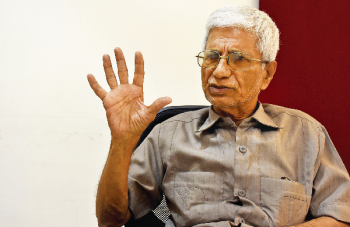
"I have been trying to understand the science, mathematics and spirituality as part of the universal knowledge manifested in the universal existence in infinite norms," states Dr Pramod Pathak who looks at spirituality and science from theistic point of view. He points out that the major theories in science were the outcome of intuitive flashes and not always logical derivations.
"It is also to be noted that certain hymns from the Rigveda and other ancient texts go parallel to the modern scientific theories. It is because these are outcome of the individual soul tuning to the universal iota of knowledge. That is how the science and spirituality goes hand in hand," he asserts.
Dr Pathak began writing four decades ago, in 1975. Agreeing that his personality was shaped by his mentors at IIT Mumbai, he offers the credit to Prof A W Date, Prof C P Marathe and Prof S K De, Dr Pathak recalls, "My mentors have directed my search for knowledge in multi-fold directions. I have come to a firm conclusion that the original definition of science is quantification. Nobody can beat this definition of science and I first quoted it in one of my articles published in Science Reporter." His first book ‘Ramayanache Vastav Darshan' was published in 1979 and he gave his first lecture in 1980. Four decades after, both of these things continue - writing and speaking.
Speaking of the complex numbers, Dr Pathak points out to the Mandelbrot set, which is a famous example of a fraction in mathematics. "Named after inventor of fractal, Benoit Mandelbrot, a Polish born French-American mathematician, who called himself the physicist, economist and an artist of all sorts - his Mandelbrot set is important for the chaos theory," briefs Dr Pathak.
He also mentions of the Fibonacci sequence - where a series of numbers is found by adding up the two numbers before it. Starting with O and 1, the sequence goes o, 1, 1, 2, 3, 5, 8, 13, 21, 34 and so forth. "The nature is full of examples of such accurate mathematical equations and fine-tuned sequences. I am trying to synthesise that the spiritual knowledge that our forefathers gained through these mathematical equations runs equally with today's scientific knowledge. Science and mathematics was an inseparable part of the knowledge of universe as was manifested by the cause of the will of the supreme Brahman."
Citing the example of our influential ancient scholar, Pingala Acharya, the author of ‘Chandashatra' the earliest known treatise on Sanskrit prosody, Dr Pathak who has studied his works, points out that Pingala was the ancient mathematician while his brother Panini was the father of Sanskrit grammar and both these Indian scholars have contribute immensely to Maths and Sanskrit.
Looking at the science and maths from a theist point of view and that the ultimate supreme Brahman manifest itself in infinite forms through the mode of scientific laws and mathematical logic, Dr Pathak explains the two different diagnostically opposite theories - that of Monotheism (which speaks of single birth) and Polytheism (that talks of multiple births). While Monotheism propagates the concept of eternal hell and eternal heaven, the Polytheism believes that ultimately everything merges into the supreme Brahman, he states.
Orientalism (Eastern cultures) proposes that the world is expanding and Occidentalism, (the term often used to contradict the Orientalism set of beliefs) propagates that the universe is contradicting. Though these are two opposite and contradictory views, one cannot brush aside both completely, according to Dr Pathak. "Both are looking at the same universe from different angle of perception and hence both are, in themselves, correct," he states.
"The universe is expanding," says Dr Pathak. He speaks of Edwin Hubble, an American astronomer who played a crucial role in establishing the fields of extragalactic astronomy and observational cosmology. Hubble discovered in 1930 that many objects previously thought to be clouds of dust and gas and classified as ‘nebulae' were actually galaxies beyond the Milky Way. Hubble provided evidence that the recessional velocity of a galaxy increases with its distance from the earth. This law implies that the universe is expanding. In the expanding state of universe, the galaxies are seen red-shifted all over the universe as an isotopic phenomenon.
Dr Pathak adds, "What is expanding, will compress, at some point and so these contradictory theories of the expanding and collapsing universe are but, two sides of the same coin of spirituality and hence, in a way, both, Oriental and Occidental theories are not wrong."
It is dark out there, in the universe. Nothing can penetrate this darkness. Today science speaks of dark energy and black holes that are believed to be a patch where space and time does not exist. This is being studied by science. Spirituality is also the same search of the ultimate source of energy, the manufacturer of this energy and the creator of this universe and planet earth.
Dr Pathak will try to explain the difference in the spiritual world view prevailing in the Oriental and Occidental religions in two sessions - the scientific theories and spiritual theories - concentrating on the iota of the knowledge.


