Dr ALVARINHO J LUIS
Swachh Sagar, Surakshit Sagar 5.0 (SSSS 5.0), India’s flagship nationwide campaign for ocean conservation and coastal cleanliness, is currently underway and will culminate with the major nationwide coastal clean-up drive on September 19. Spearheaded by the Ministry of Earth Sciences (MoES), the fifth edition seeks to turn awareness of ocean conservation into meaningful public participation and collective action.
Dr Jitendra Singh, Union Minister of State (Independent Charge) for Earth Sciences, officially launched SSSS 5.0 on September 1, 2026. Building on the campaign's success over the past four years, SSSS 5.0 has evolved into a powerful Jan Bhagidari (people’s participation) movement, bringing together citizens, students, youth, coastal communities, volunteers, and NGOs to protect the marine environment and keep India’s beaches clean.
Highlighting the importance of collective action, Dr Jitendra Singh noted that India has one of the world’s longest coastlines, extending for more than 11,000 km along its eastern and western shores. Inspired by the vision of the Deep Ocean Mission, he said the MoES is bringing together people and organisations across the country to protect the oceans and keep beaches clean and healthy.
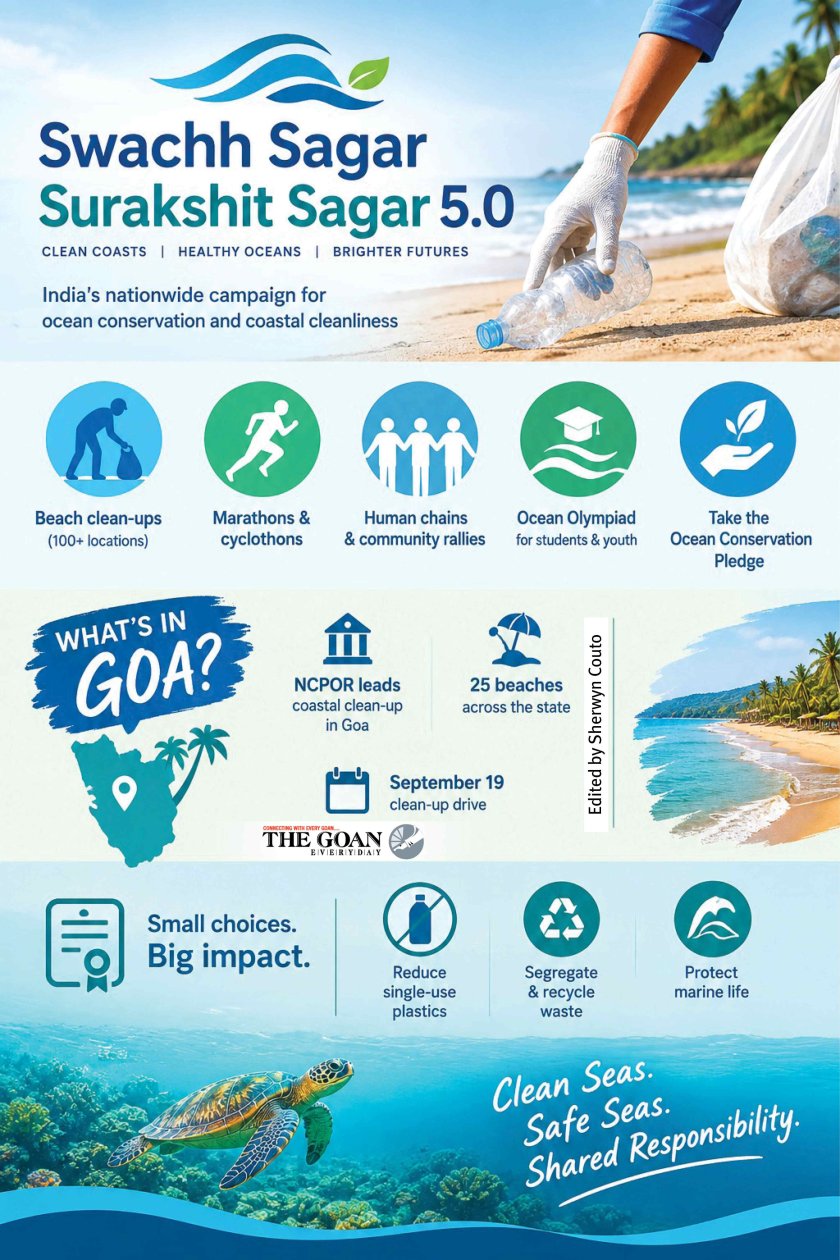
The week-long campaign will feature major beach clean-up drives at more than 100 locations, along with human chains, cycling rallies, marathons, youth activities and other citizen-engagement programs. A major new feature this year is the first-ever National Ocean Olympiad, aimed at encouraging students and young people to deepen their understanding of the oceans and marine conservation. Citizens are also being encouraged to take the Ocean Conservation Pledge and participate in the India Coastal Cleanup initiative.
The campaign reflects the growing recognition that protecting the ocean is not solely the responsibility of governments or scientific institutions. Clean beaches, healthy coastal ecosystems and a resilient ocean depend on the everyday choices and collective efforts of society. SSSS 5.0 therefore seeks to turn environmental awareness into sustained public action, making ocean conservation a shared responsibility and a lasting people’s movement.
Objectives
The SSSS 5.0 campaign aims to raise public awareness about marine pollution and the growing threat of plastic and other litter to oceans and coastal ecosystems. It encourages citizens to reduce plastic consumption, particularly single-use plastics, and adopt environmentally responsible alternatives.
The campaign promotes waste segregation, recycling, and responsible disposal to keep waste out of beaches, rivers, and the sea. It also seeks to foster active participation by citizens, students, youth, coastal communities, volunteers and organisations in beach-cleaning activities and other conservation initiatives.
Ocean conservation pledge
The Ocean Conservation Pledge is a key component of the SSSS 5.0 campaign, inviting citizens and institutions to commit to reducing marine litter, avoiding single-use plastics, and protecting marine ecosystems. Anyone can take the official digital pledge online and receive a personalised certificate of participation (https://niot.res.in/SSSS/pledge.php).
For those participating in beach-cleaning activities, offline and collective pledges are being organised throughout the campaign week at more than 100 locations along India’s coastline. Today, Mega Unity Day will feature mass pledges, human chains and community rallies nationwide. From the Arctic frontier to India’s coastal shores, the message remains clear: Clean Seas. Safe Seas. Shared Responsibility.
Marathon, cyclothon, human chain, and ocean olympiad
As part of SSSS 5.0, a range of public-participation activities such as marathons, cyclothons, human chains, and the Ocean Olympiad are being organised to spread awareness about marine pollution and the need to protect India’s coastal environment. Marathon mobilises citizens and youth to promote the message of clean and healthy oceans. Cyclothon encourages sustainable mobility while carrying the campaign’s message of ocean conservation to communities. Human Chain brings people together in a powerful display of unity and collective responsibility for protecting beaches and marine ecosystems. The Ocean Olympiad aims to engage students and young people in understanding the importance of oceans and marine conservation. Through an educational and competitive platform, it encourages young minds to explore ocean science, marine biodiversity, pollution, climate change, and sustainable use of marine resources.
What's in Goa?
Goa's participation also has a scientific dimension. The National Centre for Polar and Ocean Research (NCPOR), Goa, a premier institution under MoES, has reaffirmed its commitment to cleaner oceans through the SSSS 5.0 Ocean Conservation Pledge. NCPOR staff took the pledge on September 9, while members of India's 17th Indian Arctic Expedition in Svalbard, Norway, also reaffirmed their commitment to protecting the marine environment.
NCPOR will coordinate a coastal clean-up drive on September 19 across 25 beaches in Goa, including Baina, Bogmalo, Varca, Mobor, Benaulim, Majorda, Utorda, Betalbatim, Colva, Betul, Velsao, Baga, Calangute, Miramar, Candolim, Arambol, Morjim, Vagator, Anjuna, Siridao, Carmona, Palolem, Vaddy (Trinity), St Regis and Old Anchor. The initiative is expected to draw the Chief Minister and other dignitaries to Miramar Beach, adding momentum and visibility to this noble cause of protecting Goa’s coastline and marine environment.
For a small hotel owner in a coastal state like Goa, a clean and beautiful beach is not merely an environmental concern—it can determine whether visitors return the following year. For countless coastal families, clean seas translate directly into livelihoods, food on the table, children’s education and better health. The Blue Economy, encompassing tourism, fisheries, trade and energy, is often described as a powerful engine for a Viksit Bharat. But its benefits are ultimately measured in real lives and everyday livelihoods. Protecting our oceans, therefore, means protecting coastal communities' economic security and future. Let us all do our bit to keep our beaches clean and our marine environment healthy. After all, a clean coast is a gift to future generations.
(The author is a Scientist & Nodal officer, National Centre for Polar and Ocean Research, for SSSS 5.0 for Goa region)