THE GOAN
PANAJI
For hundreds of millions of Indians, scanning a QR code and entering a UPI PIN is second nature. So when news broke that UPI payments above Rs 2,000 would attract new charges, it sparked widespread panic: Are consumers going to be taxed just for using UPI?
Let’s clear up the confusion upfront: Ordinary consumers will not pay a single rupee extra for using UPI, regardless of how much they spend.
Here is a straightforward breakdown of what the revised Merchant Discount Rate (MDR) framework actually entails, who pays, and how it impacts your daily transactions starting October 15, 2026.
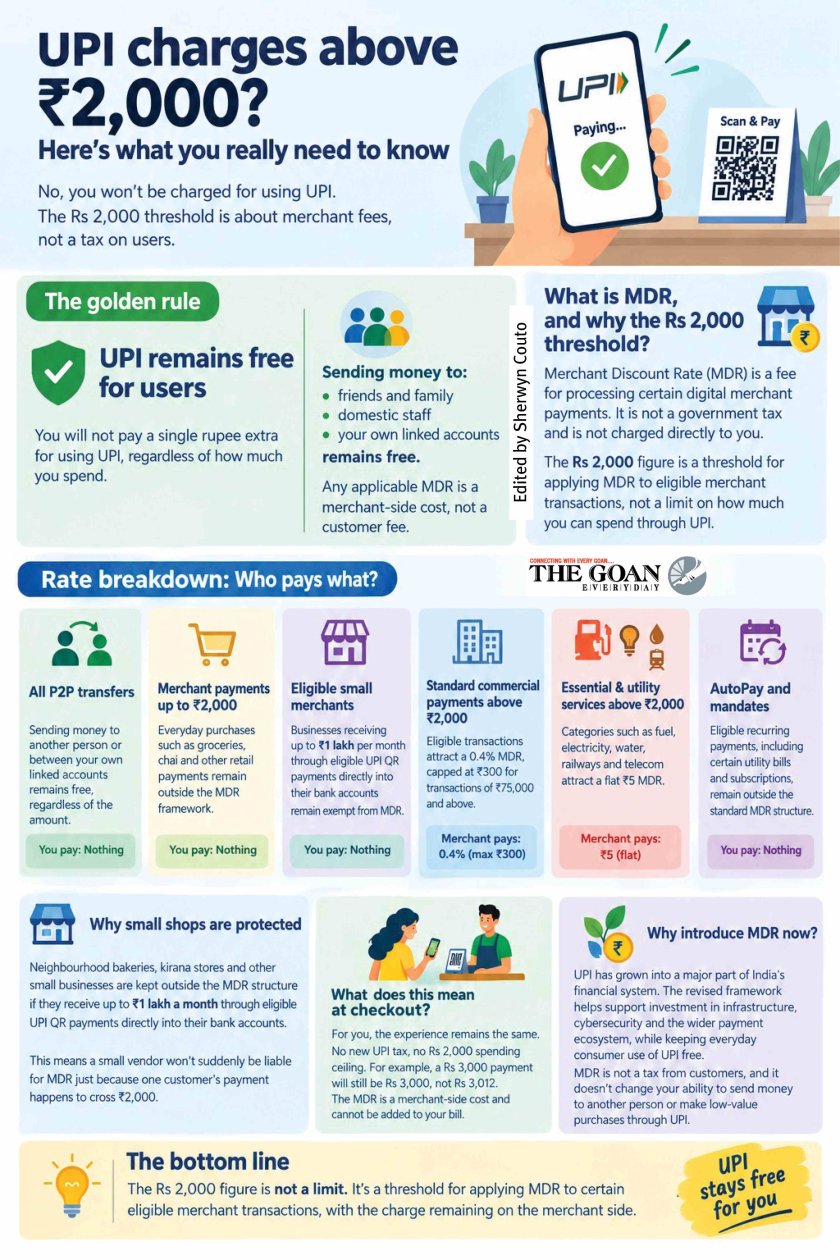
The golden rule: UPI remains free for users
The most important distinction is between a consumer fee and a merchant fee. The Rs 2,000 threshold does not mean users will be charged for spending more than Rs 2,000 through UPI. Instead, it determines when an MDR can apply to certain eligible merchant transactions.
Sending money to friends, family, domestic staff or between your own linked accounts will remain free. Customers also cannot be charged an additional convenience fee simply because they choose to pay through UPI. Any applicable MDR is a merchant-side cost.
What is MDR, and why the Rs 2,000 threshold?
Merchant Discount Rate, or MDR, is a fee associated with processing certain digital merchant payments. It is not a government tax charged directly to the customer. Under the revised framework, eligible commercial transactions above Rs 2,000 will attract an MDR, with different rates applying to certain categories.
The Rs 2,000 figure is therefore not a consumer spending limit. A customer can continue to make a UPI payment; the difference is that, for eligible transactions, the merchant may have to bear an MDR.
Rate breakdown: Who pays what?All P2P transfers: Sending money to another person or between your own linked accounts remains free, regardless of the amount. Merchant payments up to Rs 2,000: Everyday purchases such as groceries, chai and other retail payments remain outside the MDR framework. Eligible small merchants: Businesses receiving up to Rs 1 lakh per month through eligible UPI QR payments directly into their bank accounts remain exempt from MDR.Standard commercial payments above Rs 2,000: Eligible transactions attract a 0.4% MDR, capped at Rs 300 for transactions of Rs 75,000 and above. The merchant pays the fee. Essential and utility services above Rs 2,000: Eligible payments for categories such as fuel, electricity, water, railways and telecom attract a flat Rs 5 MDR. The merchant pays the fee. Capital-market transactions: Eligible payments involving mutual funds, stockbrokers and securities attract an MDR of 0.02%, subject to a Rs 300 cap. The merchant or broker pays the fee. AutoPay and mandates: Eligible recurring payments, including certain utility bills and subscriptions, remain outside the standard MDR structure.
Why small shops are protected
One concern is whether neighbourhood bakeries, kirana stores and other small businesses will stop accepting UPI because of the new charges. The framework specifically keeps smaller merchants outside the MDR structure if they receive up to Rs 1 lakh a month through eligible UPI QR payments directly into their bank accounts.
This means a small vendor who falls within the prescribed limit does not suddenly become liable for MDR simply because one customer's payment happens to cross Rs 2,000.
What does this mean at checkout?
For customers, the practical experience of making a UPI payment remains largely the same. There is no new UPI tax and no Rs 2,000 spending ceiling. For example, a customer paying Rs 3,000 for an eligible purchase will still pay Rs 3,000, not Rs 3,012. The applicable MDR is a merchant-side cost and cannot simply be added to the customer's bill as a UPI convenience charge. The distinction is important because the headlines around “UPI charges above Rs 2,000” can make it sound as though users themselves are being charged.
Why introduce MDR now?
UPI has grown from a convenient payment option into a major part of India's everyday financial system. Supporting that scale requires continued investment in payment infrastructure, cybersecurity, technical systems and the wider payment ecosystem.
The revised framework is intended to create a more sustainable model for eligible merchant payments while keeping ordinary consumer use of UPI free. MDR is not a tax collected from customers, and the new structure does not change the basic ability to send money to another person or make everyday low-value purchases through UPI.
For users, the main thing to remember is simple: the Rs 2,000 figure is not a limit on how much you can spend through UPI. It is a threshold for applying MDR to certain eligible merchant transactions, with the charge remaining on the merchant side.