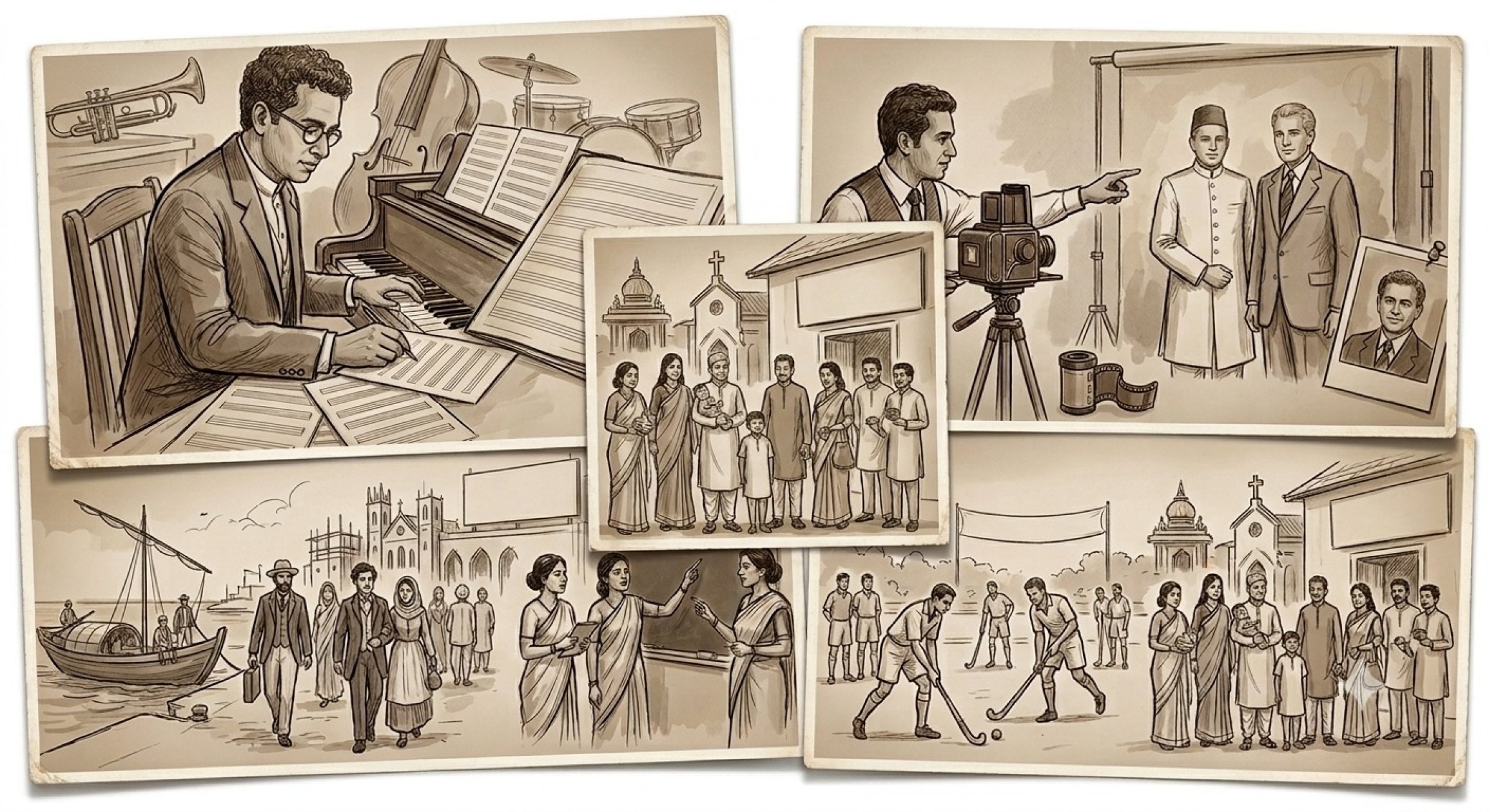
Few people realise that Pakistan’s national anthem and one of the most iconic photographs of Muhammad Ali Jinnah and the mayor of Karachi in 1946 share one hidden connection: Goa. A Goan musician arranged the anthem’s orchestration; a Goan photographer captured the famous portrait of Jinnah and Manuel Misquita, a Goan who once served as mayor of Karachi. At its peak, an estimated 12,000 Goans called the city home.
EARLY SETTLERS
Goans began arriving in Karachi in the late 1830s and early 1840s, following the British annexation of Sindh in 1839. At the time, Karachi was still a small town with a population estimated between 35,000 and 50,000. But the growing city offered opportunities. Menin Rodrigues, a Karachi Goenkar and author, mentions that they came out of Goa to seek economic opportunities. The schools were coming up, and the churches were being built around that time. They found opportunities and succeeded. In 1889, they had formed their own Goa Portuguese Association and, by 1894, set up the Indian Life Assurance Company, the largest in British India. “So this is very early; some of those seniors went into business. The Misquita set up a bakery in 1858, and here is a whole history behind this,” he adds.
Goan women, meanwhile, were among the first teachers in Karachi’s missionary schools, beginning a long tradition of education within the community. Between 1900 and Partition, more skilled and semi-skilled Goans arrived, particularly in the Saddar area. They formed village associations which provided support and helped preserve connections with their homeland.
MUSIC, PHOTOGRAPHY, LIFE
For decades, Goans were part of almost every aspect of Karachi’s civic and cultural life. They were involved in churches, schools, hospitals, courts, municipal offices, businesses, music and sport. Music formed an important part of the community’s identity. Rodrigues narrates the tale of Tolentine Fonseca, a master composer of regimental music during the 1920s. “When Pakistan held a national competition for its anthem, Ahmed Chagla’s melody was selected,” he says. Chagla, a close friend of Fonseca, asked him to score the piece, with parts written for every instrument so that it could be performed by bands and choirs.
Another Goan name connected to the city is Arthur Sequeira. As a young photographer at his family’s Sequeira Studio, he captured Jinnah’s now famous portrait in 1945. “The photograph was later hand-coloured and appeared on Pakistan’s first passport and early currency notes,” Rodrigues adds.
GOANS LEAVE THEIR MARK
Karachi’s Goan community also made its mark in sport. Peter Paul Fernandes became the first Goan Olympian to represent India, playing forward in the gold-medal-winning hockey team. In cricket, Wallis Mathias and Antao D’Souza became the first Goans from India or Pakistan to play Test cricket.
Hockey also produced Olympians Jack Britto and Milton D’Mello, who represented Pakistan at the 1952 and 1948 Olympics respectively.
For those who grew up there, Karachi was simply home. Dr Celsa Pinto, born in 1951, lived in the city until she was 13. She remembers a Karachi that was safe, clean and orderly: “I have very fond memories of that place, the then capital of Pakistan”. Her family lived at 8 Lyari Mansion near St Patrick’s Cathedral and the historic Empress Market, in a neighbourhood shared by Catholic and Hindu Goans. She attended St Joseph’s, one of two schools near the cathedral. The school was run by Irish nuns but largely staffed by Goan teachers.
COMMUNITY SCATTERED
Food, language and faith kept the community closely connected to its roots. The Karachi Goan Association and Goan Union organised feast-day celebrations, Christmas festivities, carol singing and dances. Pilgrimages back to Goa, particularly for the St Francis Xavier expositions, were organised for decades. Peter Mendes and Father Robert D’Silva led groups of hundreds during the 1980s and again in the 2000s.
Partition in 1947 changed life for many families. Sunanda Damodar Lotlikar, who was taken to Karachi as a three-year-old in 1946, experienced those changes firsthand. “My father went there alone initially; after a year, he took us as well. Everyone, including my grandparents,” remarks Sunanda Damodar Lotliker. She remembers her mother telling her that life was good. Having witnessed the tense moments of being told to stay locked in the house to avoid any danger to life, she narrates the incident, “We were very worried during the riots, since we are a Hindu family, but they told us to keep quiet, locked us from outside, and Mr Motiwala told them to go away and that there is No Hindu, that’s how we were saved.”
Yet, many Goan families who had built their lives in the city believed Karachi would remain their home. Children continued to be born and raised there. Emigration began quietly in the early 1950s.
The community scattered, but it never completely disappeared. The Goans of Karachi may be scattered across countries today, but their connection to the city remains part of Goa’s own history.
They carried the language, food, faith and memories of home with them, while also helping build a city far from the place they came from. It is a reminder that while a Goan may leave Goa, a part of Goa often travels with them.