CHRISTINE MACHADO
#TGLIFE: How did the idea of the zero waste store come about?
Eldridge : I’ve been in the restaurant business for 3 years now, and I’ve seen how much waste a restaurant can produce. I wanted to try and do my shopping waste free, but realised that it is a lot harder than it should be. This was when we came up with the concept of creating a zero waste store, where anyone could conveniently shop for everything under one roof, without wasteful packaging.
You first began with a demo model at Eldou’s in Siolim? Tell us more about this and what was the response like?
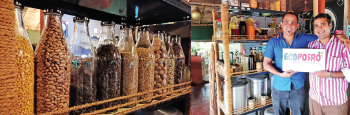
Eldridge : As one of us already had a business space, we decided to open Ecoposro there. We’ve been working on the model for a few months and have been building our sources and product list over time. However, we did not want to wait too long, and just wanted to start with whatever we were ready with. Which is why we began with one shelf at Eldou’s restaurant and the response has been great! People are well aware of the plastic problem we face today and the concept of shopping waste free really appealed to them.
When do you plan to open the stand alone store?
Jonah : Our first store in Parra should be up and running by mid April. But EcoPosro is open for home deliveries already.
Where are these products being sourced from and how are they stored?
Jonah : Our products come from different sources, some from local vendors in Mapusa market, rice from the fields in Siolim or Moira and some items even from outside Goa. We’ve spoken to vendor after vendor until we found the one who uses reusable containers such as bamboo baskets, or jute sacks instead of plastic, and made our decision based on this. We store our products in stainless steel containers and other airtight bins. We will be getting wall mounted dispensers soon which will make storing and pouring of products much easier.
Your store uses products by Saahas, an NGO which has been working towards waste management. Who else are you collaborating with at the moment?
Eldridge : We have not partnered with Saahas, not yet at least. But the founder of Saahas, Mrs. Wilma Rodrigues has been a big support and help from the beginning. We would love to collaborate with organisations such as Saahas, Live Happy and Green Goa in the near future.
People are pretty attached to particular brands today. How do you plan to tackle this issue?
Jonah : It’s true that the concept of zero waste is not for everybody. People are attached to brands and some find it hard to change. Others are not even aware of the harmfulness of ‘single use plastic’ altogether. But for those who want to make a difference, we provide the option. Having said this, there are basic products such and pulses, grains, sugar etc which people don’t mind switching brands. Even if we help one household reduce their plastic waste by half, we will feel like we made a difference.
You’ve mentioned that you also intend to keep your products at different cafes or stores. Have you already begun doing this and if yes how open have people been to this concept?
Eldridge : We haven’t yet started this as our company registration has just come through. However, people are attracted to the concept of going waste free and we have already been contacted by stores and cafes in North and South Goa to keep a shelf with our products. More than anything else, we are so happy to see that more and more people are willing to make the change.
Where do you home deliver as of now?
Jonah : As of now, anywhere. We will speak to the customer and ask them if they are open to waiting a day or two for their delivery as we do not have delivery boys yet. We don’t want to rule out anyone based on the distance. Every household we deliver to, would thus use one less plastic bag, and that is reward enough for us.
A lot of people prefer plastic as opposed to glass to avoid breakage. Do you have a solution in place for this?
Eldridge : Plastic is probably the most convenient packaging material on the planet and for many reasons. Durability being one of them. Alternatives such as glass and paper both have restrictions such as weight and strength respectively, but it is time we make some sacrifices for our planet. If we are not ready to carry home a heavier bag for the sake of the environment, then we need to seriously reconsider our priorities. According to statistics, by 2050, which is in 32 years, it has been predicted that there will be more plastic in the sea than fish. We will be 60 years old when this happens. We don’t want this to become a reality.
What are some of the most common queries you have gotten so far?
Jonah : Most people mix up zero waste with organic, although we do have an organic section in our store, all of our products are not organic. Our battle is against wasteful packaging for the moment.
What are some more products and ideas that you hope to incorporate in the store once things get going?
Eldridge : We want EcoPosro to become more than just a shop, we want it to be the base of a community, where people can bring items for recycling or come to learn how to make your own products such as cleaners and shampoo. We would love to revive age old traditions amongst the locals, of making their own products at home, such as toothpaste etc.
There have been plenty of clean up drives and waste management talks given time and again. Yet the problem of waste generation persists. Why do you feel this is the case?
Jonah : We have to realise that ‘single use plastic’ is a disastrous thing. We produce, use and discard plastic a thousand times faster than we can clean it up. And even if do cleanup drives, it ultimately goes into a land fill, or in an incinerator, both of which are extremely harmful to the environment. Single use plastic should be banned by every government in the world, effective immediately. But we all know that the consumer goods sector has a lot of money, and money is power.