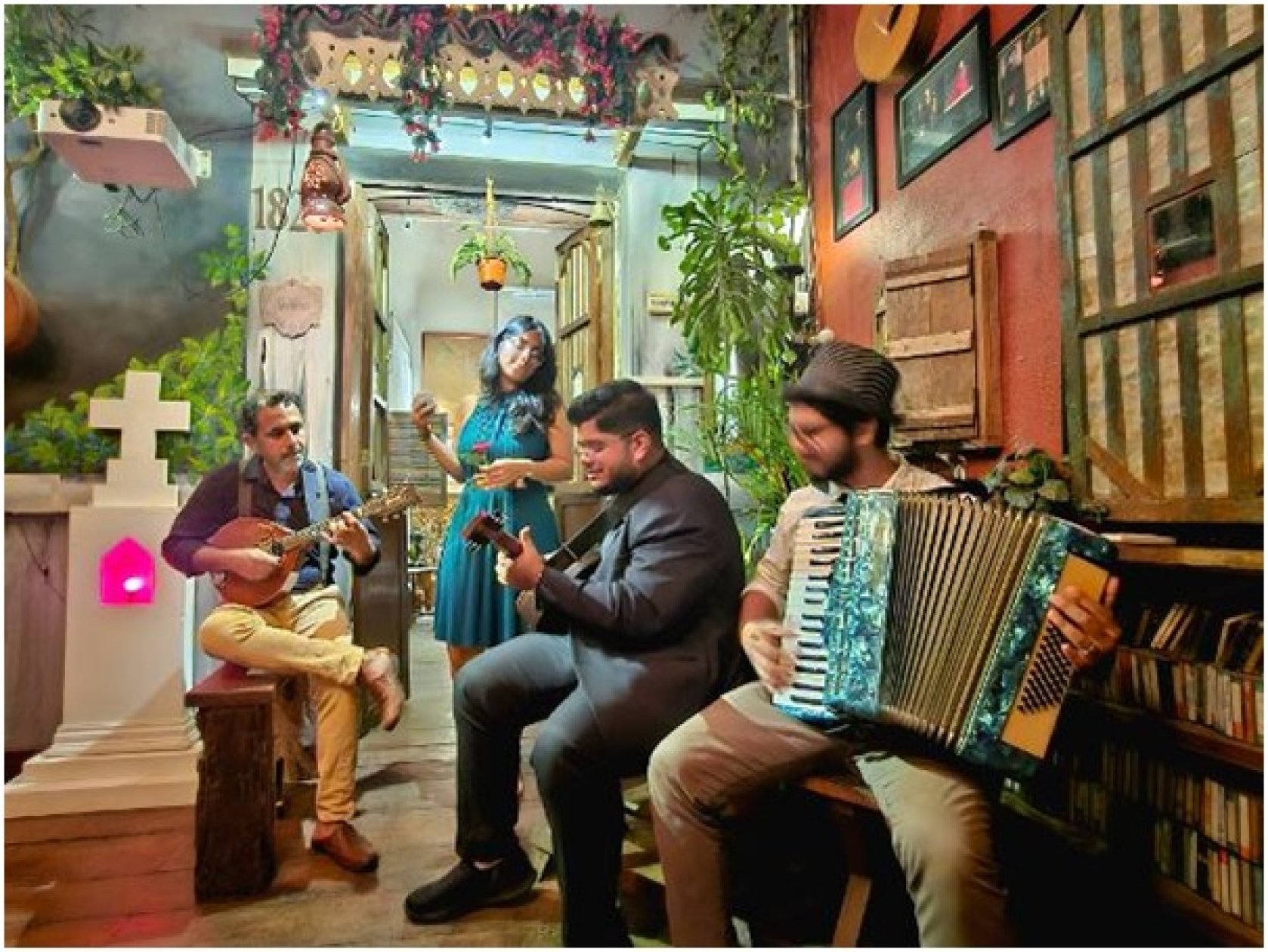
 A serenata enactment at CIPA, Goa.
Atika Modassir (Oxon)
For The Goan
A promising crack of light streams through the shutters of her Juliet balcony. Flowers dangle from the railing, their soft fragrance wafting across the gentle breeze. The moonlight dances with shadows in the narrow lanes, revealing the likenesses of three men striding towards the balcony. Their expectant footsteps echo on stone with a clarity unlike the muffled thud of their heartbeats beneath the folds of their silken shirts. As one cocks his hat back a notch, another snuffs out his cigarette, its dying glimmer revealing gleams of metal in their hands. As they keenly gaze upwards, a latch clicks shut on the balcony, hinting that someone waits behind it. Breaths betraying their nerves, they shatter the silence of the night… as music hits the air. This could be a night unravelling in Brazil, Mexico, Italy, Spain, Portugal, the Philippines or a few streets away from me in Panjim’s Latin Quarter, Fontainhas. The charm of a serenade wraps itself around continents, with confessions escaping the lips of lovers to land on the balcãos of their beloveds. Long before it was associated with courting, serenading was a declaration celebrating occasions at imperial courts and town squares. The word serenade dates back to the 17th century, deriving from the French ‘sérénade’, which in turn originated from the Italian ‘serenata’. By the 18th century, it had become a recognised form of European music marking regal births, marriages, military triumphs and redemptions. With time, family members replaced the courtiers. What stayed steadfast, though, was the gallantry of professing one’s admiration aloud and elevating it to a devotion that bore witness before her near and dear ones.
The 16th century in Spain saw the nocturnal ritual of ‘ronda’ bringing serenaders onto Madrid’s streets, not only to profess love but also to convey other social missives. It became a firm part of ‘galanteo’, chivalrous courtship distinguished by theatrical patience and musical courtesy. The medieval tuna, with its travelling bands of student musicians, was one more expression of this tradition. Around the same time, another branch of this university culture took root in Portugal, at Coimbra, as the ‘Serenata ao Luar’. This custom of moonlight serenading became a cherished part of the city’s student culture. In Portuguese Goa, serenatas were sung in Panjim by the Lyceum students. Gathering with friends on moonlit nights, cradling string instruments such as violins, Portuguese and Spanish guitars, they performed at the thresholds of those they prized. If their impromptu concerto of fados worked its magic, the window would fling open with an invitation to join the family for a midnight cuppa. It became a regular feature of Fontainhas, where music was a cornerstone of the neighbourhood’s social and cultural fabric. In Mexico, the serenata is all about surprise and the revelation it brings in the hush of the night. Mariachi trios arrive on silent nights at their señorita’s balcony, wooing with proclamations of love, begging for their pardon or seeking another chance. From twinkling hamlets, the sounds of the serenade floated across warm oceans to find yet another amorous abode – on the islands of the Philippines, where it tantalises as the harana. Inspired by Spanish musicality but embedded in Filipino poetry, the harana became a courtship tradition in which a suitor approaches his dalaga’s window at night to sing her praises, while companions strum along. Serenaders who are scorned receive an equally loud chorus of disapproval, while the triumphant are welcomed by the family with food and drink.
Orlando de Norohna was one such lucky serenader I recently encountered in Panjim. With the guitarra portuguesa in his arms, he strolled into the alley with his amigos holding an accordion and a guitar. What unfurled was an enchanting evening of melodious singing laced with suspense – would the light of her lamp signal her acceptance? Would she open the window? Would her family accede and invite them in? And invite they did – not just the lovestruck, but the rest of us in the neighbourhood who cheered along. We celebrated in the family’s parlour, adorned with their handmade azulejos (traditional painted, glazed ceramic tiles). We quaffed sangria and lemonade, accompanied by homemade Indo-Portuguese delicacies, before going back to being regaled with more music. As the evening drew to a close, we left spellbound by the power of music and love that the family had shown us. The family concern at the Centre for Indo-Portuguese Arts intends for people to experience Goa’s culture through facets of art, music, literature and cuisine. That evening reminded me that old-world enchantment still lingers in Panjim. On select evenings, their serenata still romances audiences into the night, captivating them with the spell of a city that honours its traditions and values. Perhaps it is in the values that the allure of a serenata lies for me. When one could have slipped a love letter under the door or, nowadays, just sent a message, along comes the serenader – like the moon, accompanied by his musical galaxy. Relishing uncertainty while chancing a public refusal. Vulnerable yet respectable, with his heart at her doorstep. Close, yet far. Partly veiled but somewhat open. Some of the best moments of life are like that.
With four PG degrees and a career spanning education and global HR leadership, Atika has followed one enduring question through Oxford lecture halls, global boardrooms and her Goan homestead: what helps people and societies grow, flourish and find meaning?