


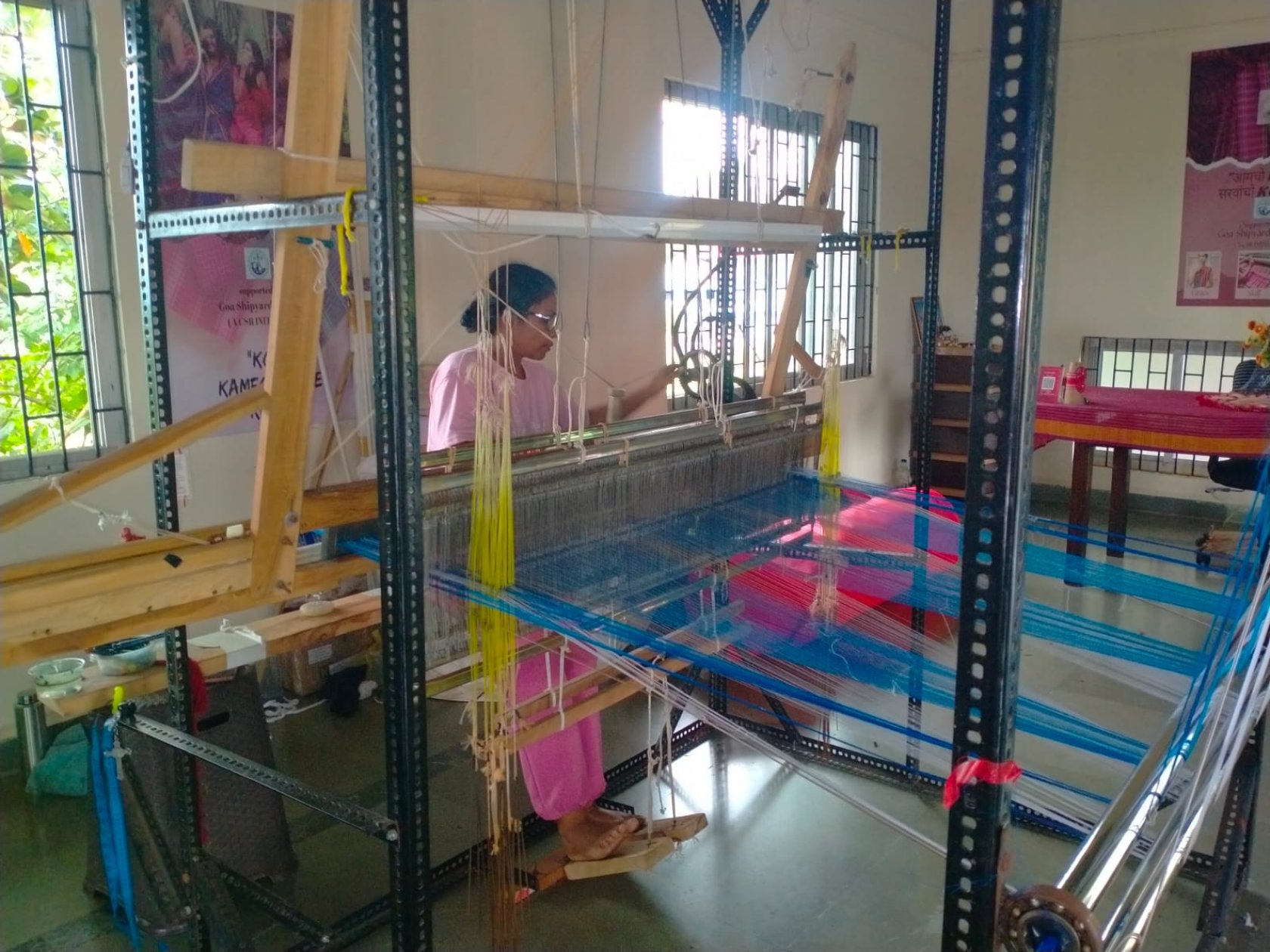
The rhythm of a wooden loom fills the room as cotton threads are pulled taut, crossing over and under each other with practised precision. Slowly, a familiar pattern begins to emerge: bold red checks. What starts as individual strands gradually becomes a Kunbi saree. This textile has wrapped generations of Goan women and quietly carried the story of one of the state's oldest communities.
A WEAVE WITH HISTORY
Worn for generations by Goa's Kunbi and Gawda communities, the Kunbi saree was designed with practicality in mind. Its short length let women move freely while working in paddy fields and carrying out daily household chores. What began as functional workwear has, over time, evolved into one of Goa's most recognisable symbols of indigenous heritage.
BEHIND EVERY SAREE
The Mandrem Handloom Unit consists of 6 women, namely, Sangita Sitaram Harmalkar, Pushpa Sahadev Mandrekar, Anita Krishna Vardaker, Samidha, Rasika and Surabhi. Their process for weaving sarees, towels and shawls begins right from procuring the right thread. Then the bobbin has to be removed, taking the fabric to the loom, and then the handloom weaving commences. “It takes around three days for us to complete weaving one saree,” they explain. The process is not without its complications. After selecting the thread, dyeing it, and then warping and beaming, it is time to set up the loom. “Setting up the loom takes several days. Once it is done, a skilled artisan takes 3 to 5 days to complete a single, standard Kunbi saree. Overall, the full process can take anywhere between 30-35 days,” remarks Netra Adkonkar, Manager at Parampara.
Reflecting on the importance of Goa's handlooms, particularly the Kunbi weave, Adkonkar notes that it is very important to preserve it. “It is very crucial to protect it as I believe there is a need to save our ancient heritage from going extinct,” she says. The women at Mandrem Handloom unit share similar opinions: “It has been worn by our ancestors for generations; thus preserving and protecting it as a part of Goa’s identity and passing it on to the next generation is very important.”
Even though fewer people are using it as compared to earlier years, the legacy of Kunbi weave continues. “Now, more people are learning about our traditional Kunbi weave, and there is a very good demand for the Kunbi sarees,” remarks Adkonkar.
CHALLENGES OF HANDLOOM
But preserving tradition is not without its challenges. Every Kunbi saree demands days of painstaking labour, making it difficult to compete with cheaper, machine-made alternatives. “We take 3-5 days to make 1 saree; the power loom, on the other hand, makes around 10-15 sarees within this same time frame,” Adkonkar remarks. Thus, their pricing causes a disadvantage. “Power looms sell it at a very lower price. We cannot do that as each saree is woven by hand; thus, selling at a low price becomes difficult for us,” she shares, stating that the customers prefer sarees at lower rates, making it all the more challenging.
KEEPING TRADITION ALIVE
Despite these challenges, both the Mandrem Handloom Unit and Adkonkar acknowledge the efforts being made to promote Goa's handloom heritage. Alongside the traditional Kunbi saree, artisans have expanded the weave into products such as shawls, towels, durries and pouches to appeal to a wider market.
With its iconic red and white checkered pattern, the Kunbi weave has stood the test of time; generations later, it still continues to be widely worn. Today, on National Handloom Day, that same saree stands as a reminder that some of Goa's most enduring traditions continue to survive not because they have remained unchanged, but because the hands that weave them have refused to let them disappear.
Fashion show honours the Kunbi saree
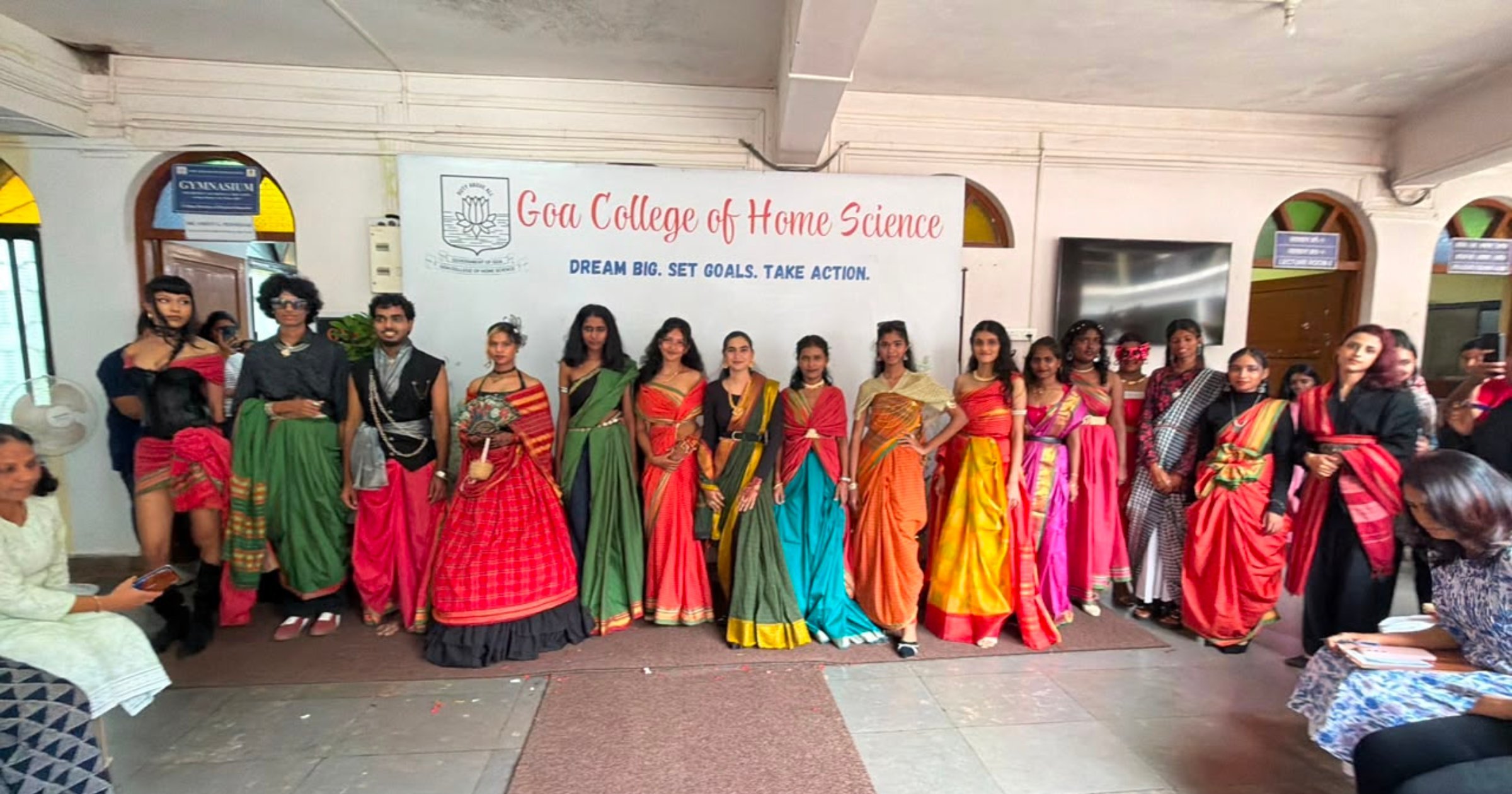
The Department of Textiles and Fashion Studies, in collaboration with Club Campus Threads at Goa College of Home Science, commemorated National Handloom Day with a series of activities celebrating the Kunbi saree under the theme "Weaving Heritage, Draping the Future." The highlight was a fashion show competition where 17 student teams showcased contemporary draping styles of the traditional handloom Kunbi saree while preserving its cultural identity. A photography competition capturing the elegance of the Kunbi saree was also held for students and staff. The event promoted awareness of India's handloom heritage, sustainable fashion, and appreciation for Goa's indigenous textile traditions.


