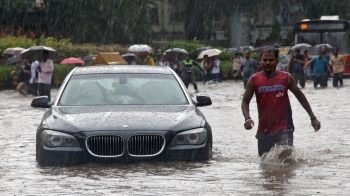
Three million people in India are at risk of flooding caused by glacial lakes, the highest number of those exposed in the world, according to a new study.
The study by an international team led by scientists at UK's Newcastle University, UK is the first global assessment of areas at greatest risk of Glacial Lake Outburst Floods (GLOF). Published in the journal Nature Communications, it estimates that 15 million people around the world are at risk from flooding caused by glacial lakes.
The researchers, which also identified priority areas for mitigation, said more than half the globally exposed populations are found in just four countries: India, Pakistan, Peru, and China.
India and Pakistan contain the highest number of exposed people -- nearly three million and two million people respectively, or one-third of the global total combined -- while Iceland contains the least (260 people), they said.
As the climate gets warmer, glaciers retreat and meltwater collects at the front of the glacier, forming a lake.
These lakes can suddenly burst and create a fast-flowing GLOF that can spread over a large distance from the original site -- more than 120 kilometres in some cases.
GLOFs can be highly destructive and damage property, infrastructure, and agricultural land and can lead to significant loss of life.
Flash floods potentially triggered by a GLOF event in Uttarakhand's Chamoli district in February 2021 left nearly 80 people dead and many more missing.
The number of glacial lakes has grown rapidly since 1990 as a result of climate change. At the same time, the number of people living in these catchments has also increased significantly.
The research team looked at 1,089 glacial lake basins worldwide and the number of people living within 50 kilometres of them, as well as the level of development in those areas and other societal indicators as markers of vulnerability to GLOFs.
They then used this information to quantify and rank the potential for damage from GLOFs at a global scale and assess communities' ability to respond effectively to a flood.
The results highlighted that 15 million people live within 50 km of a glacial lake and that High Mountain Asia -- which encompasses the Tibetan Plateau, from Kyrgyzstan to China -- has the highest GLOF danger, with 9.3 million people potentially at risk.
“This work highlights that it's not the areas with the largest number or most rapidly growing lakes that are most dangerous... Instead, it is the number of people, their proximity to a glacial lake and importantly, their ability to cope with a flood that determines the potential danger from a GLOF event,” lead researcher Caroline Taylor, a doctoral student at Newcastle University, said in a statement.
The researchers point to the relative lack of research on the danger from glacial lakes in the Andes, which runs along South America's western side, and is among the world's longest mountain ranges.
They noted that further research is urgently needed to better understand the potential GLOF danger on a local level in this area due to the high number of people living in proximity to glacial lakes and their reduced capacity to cope with the impact of a GLOF.
“Understanding which areas face the greatest danger from glacial flooding will allow for more targeted and effective risk management actions which in turn will help minimise loss of life and damage to infrastructure downstream as a result of this significant natural hazard,” said Rachel Carr, head of physical geography at Newcastle University and a co-author of the study.