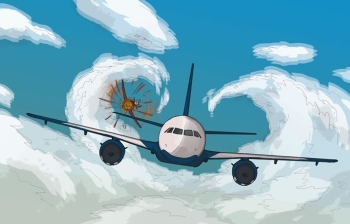
Don’t say you haven’t been warned, especially if you’re a nervous flyer, but due to the effects of climate change, turbulence has become much more frequent over the last 40 years. The need to buckle up has never been greater.
In 2023, airlines plan to carry 4.35 billion passengers worldwide, almost as many as in 2019, at the dawn of the pandemic, reports the International Air Transport Association, IATA. But how many of these trips will be smooth? With summer vacation departures around the corner, it’s worth remembering that it’s essential to fasten your seatbelt on the plane and keep it fastened throughout the flight. This advice is all the more important as turbulence becomes more frequent with global warming.
In a study published in Geographical Research Letters, Mark Prosser, a PhD researcher at the University of Reading in the UK, highlights the increase in this type of in-flight phenomenon, especially of instances classed as severe. At a typical point on one of the world’s busiest routes, across the North Atlantic, the total annual duration of severe turbulence increased by 55% between 1979 and 2020, rising from 17.7 hours in 1979 to 27.4 hours in 2020. The increase is less marked for moderate turbulence (+37%) and light turbulence (+17%). These results, obtained by analysing turbulence recorded over the last four decades, are all the more interesting given that they focus specifically on clear-air turbulence, ie, turbulence that takes pilots by surprise because there are no thunderstorms or heavy clouds nearby.
In this study, the scientist confirms the role of global warming in the frequency of these stomach-churning moments. Specifically, it’s the increase in greenhouse gases that disrupts flights, with warmer air causing more windshear in the jet streams.
While the United States and the North Atlantic are the places where turbulence has increased most, the University of Reading reports that Europe and the Middle East have also seen significant increases.
Last year, the same British research centre unveiled its first hypotheses on the effects of climate change on airplane turbulence. Although reassuring, underscoring that this does not mean there will be more accidents, it notes that airlines will have to take appropriate precautions, since this kind of phenomenon has an impact on aircraft wear and tear, and increases the risk of injury. The scientists suggested that in-flight rules could be changed to prohibit, for example, children under the age of two from travelling on adults’ laps.