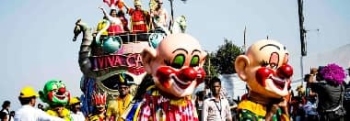
It's Carnival season once more. Parades, tourists, colour, music and dance is there, for all to see. So, things should be great, right? Not really. Even if this government-touted, orphaned-festival spells money and revenue for those in the business, how much of a fun festival is this really today?
In recent years, it has become increasingly clear that the festival is almost entirely in the hands of the government, and those controlling it. For that matter, it is even obvious that the smiles have largely vanished from the faces of many of the participants "celebrating" it.
In our times, there are two kinds of commentaries appearing about the Carnival, and how it has morphed. One is the uncritically laudatory kind -- a people's festival, smiles and joy, the rule of king Momo, and the like. The other perspective is to talk of a festival that old timers remember from the past. This latter approach suggests the 'pure' Carnival of the 1960s and thereabouts is now no more. That it lives mainly in our memories, and nostalgia. Both of these miss the point.
There is, of course, more than an element of truth in saying that the Carnival parade has got increasingly commercialised over time. Today, this is a festival propped up by the State, crafted to create spectacle for visiting tourists, and maybe a few self-interested sponsors or performers.
Like the Carnival, the Shigmo too has seen its basic structure changed, maybe less drastically. From being celebrated across the villages, both festivals have become urban-centric events (the Shigmo more decentralised). It impacts how the festivals are celebrated, who calls the shots, and the "politics" of a festival.
Understanding the morphing of Goa's carnival however needs to be understood in a somewhat different perspective. To understand the changes, in media discussions, often the early promoters of the Carnival of the 1960s are interviewed, quoted and relied on. They paint a picture of a steady loss of innocence of a festival.
Till the 1960s, the Carnival was very much in vogue in Goa. (Late journalist Norman Dantas would draw a distinction between the current 'Carnival' and the 'Carnaval' of another era, spelt differently and meaning different things.) In those times, its context was Lent, which was then far more strictly observed. It was a largely rural festival, celebrated by pranks and mischievousness, the throwing of coloured powders, and inverting the balance of power. The festival of those times was also one where the powerless were allowed to mock those in power. Even if only for just three days.
There are hints of the something going wrong when a handful of protesters in Panjim get accosted, allegedly roughed up and taken to the police station. This happened just a few days back, when they dare to challenge the powers that be and question the pattern of "development" that Goa's "smart-city" capital is following.
What has happened is that a scattered, rural festival has been re-purposed, re-shaped and taken-over in recent decades. The goal is not just commercial but also political.
A case could be made that post-1961 Goa administrations were rather conscious about perceptions. They therefore went to great length to ensure that the right "signals" went out from a Goa which was under the global spotlight, just after Liberation, to use the officially-preferred term.
The Carnival was one such political tool to show that the people of Goa were in a celebratory and joyous mood.
Together with this came official support for the Expositions (particularly in 1964), the rushing down of all and sundry Christian officers to Goa from various parts of the country, and the creation of a new set of backers for the new regime. These all were important signals that went out from Goa, following the Congress-style of secularism (the MGP agenda being something else, but tolerated).
Village development came under the hands of party-affiliated politicians. Culture and literature needed official godfathers and departmental support to make their dent. Politicians (including highly educated ones like Dr Wilfred de Souza, FRCS) would warn against drinking water from village wells, or eating salt from local pans (instead of Tata's iodised salt).
On the Carnival front, in the 1990s and 2000s, there were brief news reports of youth being arrested for flinging water or powder during the festival -- as Carnival would be celebrated.
Later on too, the festival showed signs of getting alienated from the community it supposedly represents. In the 1980s and 1990s, things came to a boil. Threats of protests virtually disrupted the Carnival. In order to restore it, in one year, even a less-controversial "junk car rally" had to be organised.
We have handed over so many of traditions and parts of life to our political class. Sports is another interesting example. Look at the number of sports organisations that have politicians and their lackeys at their helm; then we wonder why India as a nation and Goa as a State continue to perform so badly! Education, culture and even environmental campaigns have been, in some cases, taken over by those who control our politics.
It might seem a great idea to get someone "powerful" and well connected at the helm of some sporting body or the other. This could give the organisation the wind under its sails, that it so badly needs. Except that, together with this, comes the politicisation of the sports and its destruction too.
In a word, if one wants to understand how the Carnival has changed, one has to also understand who controls it. What happens when a decentralised, rural celebration gets taken to the cities, and becomes a top-down controlled 'festival'?