It was a lazy weekend afternoon when a message flashed on my mobile. Giving in to my cyber-anxiety, I opened the message to view a video and a typed message from one of my ex-student’s brother. In the video clip were seen, what seemed to be sparrows foraging; and the message read ‘check this new bird between the sparrows, I’ve not seen it before’.
I carefully watched the video and noticed that among the house sparrows there indeed was a bird that matched with characters of a non-native finch. I immediately reached the site about 4 km away from my home. Krishna accompanied by his five year old son Urjeet Komarpant was waiting for me with a lot of anticipation. As I took position to observe the flock that was busy foraging barely some ten feet away, little Urjeet whose paternal aunt Dr Neelam Komarpant was my first research assistant at the Biodiversity Research Cell decades ago, shared his innocent observations and impressions on birds. He told me how from his balcony he spotted a ‘different sparrow with a red beak and missing dark bands’ and conveyed this novelty to his father.
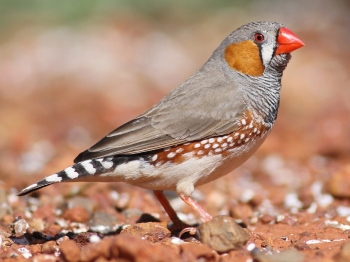
As I focused on that flock of about six birds that kept flying away and returning intermittently, two things struck me. Indeed amidst the house sparrows was a solitary finch that prima fascia appeared to be the Zebra Finch, a native of Australia with another population on Timor island of Indonesia.
I waited until I could observe its distinctive bright orange beak, black-and-white ‘moustache’ mark and rusty white-spotted flanks, confirming that what I was seeing in Fatorda area of Margao was indeed the Australian bird. The solitary bird was quite bold in its mingling with the sparrows and even challenged them to grab the scraps of feed. The male zebra Finch was also collecting dry grass strands from a broken broom on the road, apparently to build nest. That the bird was solitary, with no mate in sight and yet investing in a nest was to me a bit of an unusual behaviour; but then nidification being an innate behaviour, the bird had it programmed in its genes.
Just as good practice of peer validation, I thought of consulting Parag Rangnekar of Goa Bird Conservation Network and shared my observations only to confirm that the bird was very much exotic. Of course he too was astonished at this sighting and opined that the bird I was seeing could be a ‘cage escapee’.
This curious sighting made me reflect on a few critical issues of public health relevance and also realize a few gaps in our biodiversity databases and the need to address these deficiencies.
First of all, had this little boy from Fatorda who has just secured admission in higher KG not been observant and curious about a ‘different looking sparrow’ that he saw from his balcony; our state avian database would have missed an important input. Sensitizing children of impressionable age to our natural world is a good investment towards building an eco-sensitive and eco-conscientious citizenry. As the law and policy makers of future will emerge from the same stock for environment- friendly conduct and decisions.
As per the e-Bird entries for Goa, an online database of bird observations made by scientist, researchers and amateurs; thus far only one bird Budgerigar has been reported as Exotic -‘Escapee’ in 2017 at Goa University campus.
This observation of a Zebra Finch feeding along with house sparrows on a street in Fatorda is a new record and only second species in Goa’s bird inventory that gets classified as exotic-escapee, a view confirmed by Prasanna Parab, another senior birder and GBCN functionary.
This also goes to show that casual observation of hobbyists and citizens can complement more rigorous efforts of the scientific community in compiling bird lists for the State. These supplemental data comes at no cost, but is very useful not only in assessing the species diversity but also monitoring our ‘feathered endowments’. While ‘Lifers’ (first sighting of a species by a birder) are exciting, new reports expand the inventory and open new vistas in our understanding of dynamics of bird movements.
Finches have found favour with Biologists since Charles Darwin took fascination for them on Galapagos Islands. Currently, there are about 240 species of true finches across the globe. The birds have a good price tag in pet trade globally; on account of their small sizes, attractive colours, endurance in captivity and
melodious songs.
However, there is one dimension of this ‘finch euphoria’ that presents as a potential bio-security risk for native birds and humans. Cage escape or willful abandonment of pets is not as uncommon as is thought. While escape is just a ‘chance freedom’ that the bird gets due to lapse in captive handling, there have been instances of determined release of some pets (including birds) by owners who being tired or bored with their pets, choose to ‘free’ (abandon) them. This should be criminalized not only for ethical reasons but also on grounds of risk to public health and threat to native biodiversity.
Finches are known to carry zoonotic pathogens and parasites that not only threaten native wild birds, commercial poultry and cattle farms; but also heighten the chances of bird-human transmission. The pathogenic load reservoired in smuggled birds can easily bypass the mandatory scrutiny of legal pet trade. It is crucial to trace the origin of the birds in pet trade, examine recent disease outbreaks and mandate necessary quarantine protocols
This sighting of the cage escapee Zebra Finch in Margao also puts focus on the need to collate data on species of exotic pet birds being sold in Goa, regulate cage environments, and introduce a system of certifying ‘health status’ of these pet birds.
It is said that ‘a caged bird stands on a grave of dreams’, but the one freed from a cage shouldn’t be the reason to dig more graves!