


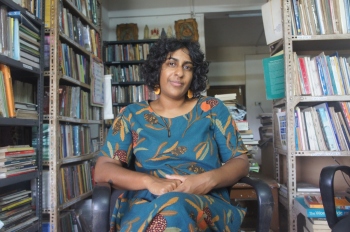
The other day, a young visitor dropped in. Her dad and me were friends in our time, and grew up together in our teens. Karen (D’Souza) Wright is currently an elected Councillor of her Local Government Area (LGA), which something like a Municipal Council in Goa.
Tracing her family roots to Goa (Saligao) and Kenya, where her parents grew up, she was the youngest at 28 (when elected), first woman, first multi-ethnic (Indian, Goan, immigrant, coloured) councillor in the nine who form her council.
During the 2021 (pandemic-midst) elections which she contested, Karen got the second highest number of votes, among 20+ candidates in the fray. She has been involved in public interest work even before her election. She is today “Cr Karen Wright” of the Bega Valley Shire Council.
Wikipedia tells us that The Bega Valley Shire is a local government area located adjacent to the south-eastern coastline of New South Wales, Australia. The Shire was formed in 1981 with the amalgamation of the Municipality of Bega, Imlay Shire and Mumbulla Shire, with its name deriving from the town of Bega. The shire is also known as the Sapphire Coast for tourism and marketing purposes.
In the 2019“20 Australian bushfire season, the area was devastated by fire. Some 448 houses were destroyed by fire and approximately 365,000 hectares burned, which is 58% of the Shire’s total land mass. Its population (2016) was was 33,253. Its area is roughly twice that of Goa.
Councillors in Australia, like here, look after issues such as the supply of water, and roads. Beyond that, if a community member is unhappy with some civic issue, or if they have an idea they want to get passed through the council, they have a right to approach councillors.
Karen has another life beyond politics. She is a mental health advocate and is the South-East NSW Regional Coordinator at Standby Support After Suicide. She has worked in community organisations and groups -- including OzHarvest and the Bega Valley Suicide Prevention Action Network (SPAN).
She has also been President of Pambula Community Garden and a board member of Sapphire Community Pantry. She sits as a Councillor representative on the board of South East Arts. She sees herself as being passionate about the arts, affordable housing, sustainability and youth. As noted, she contested elections in the midst of the pandemic, and “ran it by myself”.
But this is not meant to be discussion on Australian council politics or her role there. For more on that, you can visit http://t.ly/Go0Pd
In this column, one thing which Karen said really struck home strongly. She was talking about how she got elected as a councillor in a mainly White, elderly, affluent community in a very touristic area of Australia. It is near the Tasman Sea, named after a 17th century Dutch explorer, or the tongue-in-cheek named ‘the Ditch’ that lies between Australia and New Zealand.
Australia, like many other parts of the world today, is concerned about insufficient women’s participation in politics. When they talk about the lack of women, they are talking of a situation where “39% of federal parliamentarians and 39% of state and territory parliamentarians” are women!
A quick search online will take you to discussions on women being “underrepresented in leadership and decision making” Down Under. They are referring not only to politics, but also to industry (particularly “mining, construction, utilities and manufacturing”). The point being made there is that “even in female-dominated industries, men are still more likely to occupy more senior positions”.
Be that as it may, while talking, Karen made a rather interesting point about promoting women in politics. In an Indian context (Goan too), we think in terms of reservations. This is not a case against reservations, or not even sidelining that idea. But, there are indeed options to that way of thinking alone.
She mentioned the group called Women for Election Australia [wfe.org.au]. “They teach women to put their message out there, to refine their message. How to walk into a room and be heard, amidst a group of men. How to cope with backlash within a community,” Karen adds.
These were all things that she didn’t know, till she did a brief course with them. She also picked up other skills: budgets tips you’d need. Where to get media contacts from. How to talk to people on radio and TV. The course helped her run the “whole campaign by myself”, thus making it cheaper and more accessible.
The Women for Election is also offering “highly practical non-partisan workshop that provides women with the key knowledge of how to campaign at all levels of government”. This teaches “tools and techniques” of how to run for office, or to assist a woman in her political campaign.
This seems like an interesting approach. One gets an insight into how training can help deserving women to get ahead.
Of course, it would be premature to argue that Australian women participation in politics is solely to such initiatives. Other social, historical, political and economic factors have shaped the evolution of the Australian society over past decades and centuries. So, we don’t know if such efforts have themselves changed the situation, and by how much.
But such well thought out initiatives surely can’t hurt.
Reservations have their limitations too. Reservations might somewhat change the situation (for women, deprived caste groups, or whatever). But it can also create myths and false hopes.
Look at politics in Goa. Reserved seats are often taken up by wives, daughters, family and friends. (This is true even in unreserved seats!) So, who benefits?
In the case of OBC, SC and ST reservations (especially the latter two sections), the reservations can create an illusion. It offers some seats to a handful of members of these neglected communities, but doesn’t change their overall situation.
What’s more, reservations can also create a tiny, self-serving elite. They are cut off from the rest of their community, and might not do much for its wider interest, apart from grabbing as many benefits as possible for themselves.
Obviously, such thinking needs to spreads to other fields too. Deprived and marginalised sections of society could take up such mentoring, training and informal education.
After years of soft or hard-core communal politics, minority participation in government service is at an all-time low. Many sections of society don’t seem to have a toehold in government jobs, business initiatives, and especially politics where majoritarian headcounts matter. The same is true of state-funded cultural institutions.
Complex issues, which cannot be ignored...


