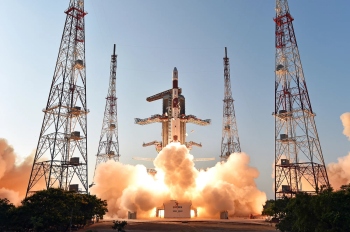
At precisely 6:03 pm, Wednesday evening, the Lander Module of the Indian Space Research Organisation (ISRO) made a gentle touchdown on the moon’s surface. Cheers erupted not only from the ISRO command centre, broadcasting the event live, but also across the country. People paused work meetings to proclaim, “We have landed on the moon!” The euphoria was reminiscent of India's triumphant 1983 cricket World Cup victory, a moment when the entire nation seemed to float on a cloud of pure joy and achievement.
India’s third moon mission, Chandrayaan-3, represents the culmination of a long, uninterrupted policy of investing in science and technology since our Independence. Regardless of the governing party's ideology, investment in science and technology has remained a cornerstone of government policy.
India's first Prime Minister, Jawaharlal Nehru, held a fervent belief that India's susceptibilities to invasions and subsequent colonisation were largely due to its stagnation in science and technology. He makes this point in the Discovery of India. And he was not the only one who believed that. A number of luminaries from Swami Vivekananda to Homi Bhabha, from Vikram Sarabhai to Subhash Chandra Bose all believed that India needed to have an independent and vibrant science policy. Industrial houses like the Tata and Birla groups put their money where their mouth was and set up funds for science. Institutes like the Tata Institute of Fundamental Research ” which is also funded by the Government ” and Birla Institute of Technology are testament to their faith in the ability of India and Indians.
They believed that the only way we could remain free, independent, and could prosper was by investing in science and technology. When India achieved Independence, we were desperately poor. The British plundered us for the best part of 200 years and left a once proud and great people in tatters. Investment in science was seen as a way of ensuring we never ever had to go through something like that again. When questioned about it, Vikram Sarabhai famously said, “There are some who question the relevance of space activities in a developing nation. To us, there is no ambiguity of purpose. We do not have the fantasy of competing with economically advanced nations in the exploration of the moon or the planets, or manned spaceflight. But we are convinced that if we are to play a meaningful role nationally, and in the community of nations, we must be second to none in the application of advanced technologies to the real problems of man and society.”
From the early establishment of institutions like the Indian Institutes of Technology (IITs) and the Council of Scientific and Industrial Research (CSIR) to the formation of ISRO in 1969, India's policymakers have consistently acknowledged the transformative power of science and technology. This commitment underscores the belief that, beyond geopolitical tactics and fiscal policies, knowledge and innovation form the foundation of a nation's progress.
Narendra Modi’s government has followed this tradition of bold scientific policy. It has introduced a series of nine scientific missions, marking the next step in our progress. With objectives ranging from natural language translation to quantum computing and from deep sea missions to deep space endeavours, the ambitions are high, and the requisite funds substantial. Given India's various developmental priorities, the need for alternative sources of funding research, apart from government funds, is high. Furthermore, the number of ministries and departments involved in funding and decision-making are numerous, slowing down progress.
To champion these missions and to streamline R&D in India, the Government has instituted the National Research Foundation (NRF). Its core objective? To steer and fund scientific research in India, spanning fields from science and engineering to humanities and arts. The NRF is set on bolstering funding, cultivating elite research establishments, and transforming groundbreaking research into tangible products and services. The government has pledged that the NRF will allocate Rs 50,000 crore to research over the next five years. However, they expect the private sector to contribute Rs 36,000 crore, a challenging prospect given the sector's traditional hesitance towards R&D funding.
For the past 76 years, it has been primarily the government, supported by taxpayers, that has funded science and technology in India. While the Gross Domestic Expenditure on Research and Development (GERD) in India has steadily increased, the private sector's contribution remained modest at around 36%. In developed markets like Japan or South Korea, the private sector's share of research expenditure touches nearly 70%. In contrast, India's figures linger just above half that mark.
India's journey from the nascent days of Independence to the triumphant landing of Chandrayaan-3 illustrates our unwavering commitment to scientific progress. This trajectory, carved by visionaries and buttressed by institutions, consistently places science and technology at its epicentre. The inception of the National Research Foundation (NRF) signifies the next chapter of this dedication. Yet, for India to truly realise its potential in research and innovation, the private sector must shoulder some of the burden. With the Chandrayaan-3 mission standing as a beacon, a combined effort in research investment will sketch our path ahead.
-- FPJ