


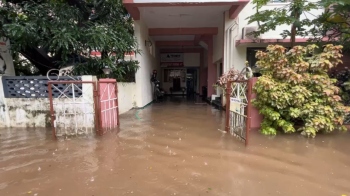
There has been a flood of rain and a drought of information in Goa. We often can't control nature's fury. But it only gets so much worse compounded with a lack of information, preparedness, or forewarning.
Home to the new airport and lot of land speculation, Mopa, and videos of some other areas of Goa, dramatically brought home questions of what 'development' means, how hurriedly or hastily it is being carried out, and the price it exacts on traditional systems. More so in times of climate change and extreme weather events.
But there is one more issue here. It's a very important one. That is, what happens when a society lacks the information it needs to manage itself efficiently?
By now, the failure of the Goa Met Office (India Meteorological Department, Goa, if you want its formal name), to predict the heavy rains on last Sunday has been fairly widely commented on.
On that day itself, after the deluge reduced, we saw journalist Niraj Naik's video, asking "Why IMD's forecast[s] go wrong?" There was no answer in the video, but it did a good job in speedily reminding us about the weekend weather fiasco.
Naik reminded us that there was absolutely no advance warning or hint about the rough weather that was coming up on Sunday, despite all the sophisticated equipment the Met Office uses. In fact, as he noted, IMD-Goa had first issued a yellow status ("be updated") for Goa on that day. Once the rains started falling heavy, sometime on Sunday morning, it upgraded this to an orange status ("be prepared"). Very late in the day, after much of the heavy deluge had already descended, a red ("take action") alert was finally issued. Too little and too late. Things do not end there.
I'm looking at the weather update of Monday, July 8, 2024, issued at 1415 hrs IST. It says that on July 8 itself there was a "red" colour code for Goa. The forecast was "moderate to heavy rain very likely at most places over North Goa and South Goa". Oddly enough: we had a largely dry day.
Earlier, on Sunday, given the heavy rain being witnessed, the Chief Minister declared a school holiday for students up to Std XII. Ironically, as noted, Monday was quite dry.
Some suggest the weatherman is everyone's favourite punching bag. Others criticise the IMD, and ask why forecast at all if it's going to get it so wrong? But then, there are also voices which stress caution, and point out that weather predictions can be accurate "50-90 per cent of the time", but such predictions are based on many variables so we can't expect 100% accurate forecasting (quotes from the Goa STEM WhatsApp group).
Nobody will ask questions about whether we can depend on the Met services. What is the impact of roads and huge concrete flyovers, that act as dams on our floodwater drainage system. How do we cope with climate change. Plus the issues of clogged drains, drains covered by footpaths, uncontrolled plastics, etc.
(Looks like we have forgotten about drains, in our quest for broader roads. As a child growing up in the 1960s and early 1970s, I recall the comunidades doing a fairly good job of drain clean-ups before each monsoon.)
If a society, institution or government wants to undertake some action, whose advice does it depend on? What is the quality of that advice?
It's hard to forget how an entire country the size of India (almost 1.4 billion then) was sent into lockdown mode in early 2020, when there were hardly seven Covid 19 patients across the entire country. It could be argued that a step in time saved a worse situation. Yet, till date, the jury is out whether lockdowns really made the difference, and whether countries like Sweden (with very mild controls) were any worse off after the pandemic. Politicians like to come across as 'strongmen' and show that they are taking stringent action on such issues.
When it comes to evaluating the recent major policy decisions taken in India, the issue of demonetisation will always be to the fore. We all know what impact this, together with the much-hailed GST, had on the business life of the country. On whose advice were such decisions, which proved very costly for a nation, taken?
In the past, some other governmental initiatives were hastily pushed through too. From Aadhar to the overhauled laws which govern our criminal justice system, preventive detention laws which can be misused for ordinary law and order problems... Unless these are done with a lot of thought, and even public consultation, we could end up with a lot we have not bargained for.
As we dry ourselves from the deluge, flooded roads and collapsed trees (some iconic ones too, like that at Divar), let's spare some thought about our weather forecasts. Or, what could be done to improve the same.
To be fair, one was impressed how right the Goa Met office got their predictions on the mid-May 2021 Cyclone Tauktae. That was one of the most severe weather events to affect Goa in recent times. But, on a wider scale of time, online services seem to be getting it far more accurate. In the pre-dawn hours of Monday (yesterday), at about 3 am one site mentioned that the rain would stop in 41 minutes in Goa...and it did!
To sum up, global climate change is a huge issue, which we may feel helpless about. Still, we need to keep it on our mind; at least it will help us to plan better, and take wiser decisions than those that block our waterways, flood our towns and villages, destroy our green cover and open spaces, and neglect our drains so that they are not able to cope with moderate to extreme weather developments.
But we can surely at least work to get our information right. That would be a great start. It could influence how we manage to cope.


