


Festivals across the country are generally steeped in traditions and bring to fore the vibrant culture of the festivities. The spirit of celebration is an indication of the diverse culture of the country and ‘festivals become a tool to see through the wide spectrum of religions, occupations, and faiths’.
While nature has had a predominant role to play in the observation of many festivals, the tinge of religious connotation being lent to most of them fortifies the belief that we Indians celebrate nature.
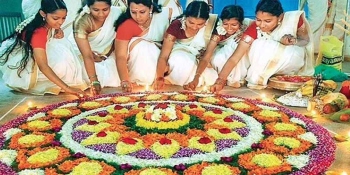
Last week, Malayalees across the globe celebrated ‘Onam’, widely recognized as a celebration of harvest, prosperity, and the rich cultural heritage of Kerala. The spirit of homecoming of King Mahabali gives Onam the religious aura which is an inevitable aspect of every festival in the country.
Moreover, the manner in which festivals are correlated with seasons make it all the more evident that our respect for nature as a divine entity that bestows on humankind all its blessings through its varied forms gives us a cause for celebration, which is nothing but a thanksgiving, a gratitude for all that nature has bequeathed us.
The mysteries of the unknown and the resultant fear has inevitably seen humans conferring divinity on various elements of nature and bowing down before them in deep reverence.
However, a comment on a question and answer forum mentions about the belief that nature is essential for spiritual purpose and that humans could find God more easily through nature than they do sitting inside a concrete jungle.
Hindus hold great reverence towards nature and believe trees are the origin of life. Understanding this, the ancient Hindus chose to include plants and animals into their worship to promote the safeguards of these natural resources so humans could benefit from nature.
Trees in this sense are held sacred. Trees hold high religious significance in Hinduism.
“Do not trouble trees. Do not uproot or cut them. They provide protection to animals, birds, and other living beings.” (Rig Veda)
‘Tree worship’ or ‘tree veneration’ is a common part of Hindu culture and religious rituals. Tree-worship, in India, has been common since the earliest time. It was a regular feature in both Hinduism and Buddhism. It is interesting to note that over a period of time people began to feel that the trees were sensitive and animate.
Embarking on a natural heritage tour, the governor of Goa who visited ancient and heritage trees of Goa last year observed that these trees reflect the deep spiritual and cultural bond of local communities with nature and have been worshipped and protected by people over the centuries.
A feature article appearing in a leading national daily spoke about tribal populations in Jharkhand, West Bengal, Bihar, Madhya Pradesh, Chhattisgarh, Assam and Odisha celebrating the harvest festival of ‘Karma’ or ‘Karam Parv’ last week.
It spoke of the ‘Karam’ tree which is at the heart of the Karma festival. This tree is traditionally seen as a symbol of ‘Karam Devta’ or ‘Karamsani’, the God of strength, youth and vitality, and the object from which the festival takes its name. It symbolizes everything that is auspicious.
With various myths associated with the tribal harvest festival holding good to this day, it becomes easy to believe that mankind will continue to look up to nature for its sustenance.
What then prompts mankind to engage in wanton destruction of nature! Determined efforts by concerned individuals nevertheless compel one to acknowledge the fact that trees are once again gaining an exalted status.
Much has been written about afforestation and reforestation practices playing vital parts in our sustainable future. As two essential tactics in a world where environmental preservation and the fight against climate change have taken centre stage, their importance in increasing the amount of greenery on Earth and reducing the effects of deforestation is quite significant.
Unfortunately, the pace of afforestation and reforestation essays attempted is not keeping pace with the rapidity with which deforestations are happening.
Tree-plantation drives have become a very common activity for publicity-savvy leaders who just like to bask in the glory of their ‘achievements’ without actually understanding the magnitude of their ‘accomplishments’. This has been the undoing of the modern generation! They just revel in the glory of their leaders. Victims of ‘sheep herd’ syndrome, many are not even aware of the momentousness of the occasion “ or refuse to be overly exuberant about such insignificant matters.
It is however observed that the protection and preservation of trees has not gained the sort of importance that it actually deserves. With innumerable factors augmenting its endearing attributes, preserving trees becomes extremely essential in today’s world.
In this context, the recent initiative launched by the Goa Raj Bhavan to protect and preserve ancient trees across the state thus assumes significance.
Under this initiative, seven fruit-bearing trees which are over a hundred-years old and steadily decaying due to infections have been identified for Ayurvedic treatment to restore their health and extend their lifespan. The traditional method of rejuvenating trees is widely dealt with in our ancient texts.
As part of an effort to save and preserve old trees through traditional methods, this endeavour by the Governor of Goa should inspire people, especially the younger generation, towards protecting and preserving our natural heritage and unique traditions.
This initiative is not only inspiring when envisioning the preservation of ancient trees facing extinction, but is also a motivating factor for the younger generation which needs to come up with out-of-the-box ideas to counter the challenges thrown up by the development juggernaut in modern times.
While we have all the reasons to celebrate nature by observing them as festivals, the manner in which development has sought the sacrifice of nature’s assets speaks for the devastation that we have brought upon ourselves.


