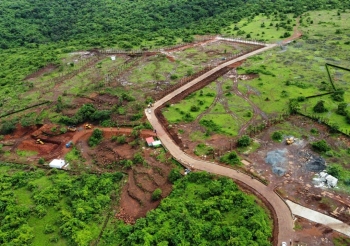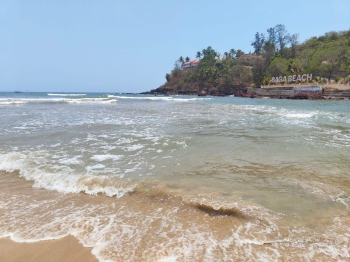
When plans for a Christ the Redeemer statue atop Baga Hill first appeared in public discourse, concerned citizens raised objections not only to the symbolism but to the opaque and irregular means by which the project appeared to progress. These apprehensions have since been substantiated through a pattern of zoning inconsistencies, historical title infringements, and questionable assertions of authority by institutional actors, all of which require immediate public scrutiny.
Forest converted
into settlement
The Regional Plan for Goa 2021 reflects a clear departure from ecological rationality in the case of Baga Hill. Land which had historically been mapped as private forest based on forest department surveys and ecological parameters was later reclassified as settlement zones, marked in yellow on RP 2021. This transition from a conservation-oriented classification to one that permits construction and development cannot be justified by any scientific review or participatory planning process placed on public record.
As per the Supreme Court’s continuing directions in the T.N. Godavarman Thirumulpad case, any land meeting the dictionary definition of a forest, regardless of ownership, must be treated as such under the Forest (Conservation) Act, 1980. The arbitrary change in zoning on Baga Hill appears to contravene this doctrine.
A disputed road and
a historical deed
A key parcel of land central to the Christ the Redeemer project is Survey No. 267, Sub Division 1. Through this land, the road providing access to the proposed statue site has been constructed. However, a Deed of Division and Partition dated 6 March 1925 reveals that the said property had been inscribed in favour of Clarimundo Heitor Carmo de Souza. Presently, the designated co-heirs of the said owner, represented through his niece Ivone Souza, continue to enjoy legal rights to this parcel.
Despite the deed’s legal validity and continuity of ownership, the Comunidade of Calangute has continued to interfere with the said property. This interference, without lawful title or court order, appears to be driven by the development potential of the land higher up on the Baga Hill slope. By asserting dominion over a lower-lying access route, the Comunidade positions itself to exert control over the larger hill stretch, where the statue and its tourist infrastructure are anticipated.
Comunidade label
used selectively
Across Goa, the term ‘Comunidade land’ has increasingly been invoked to claim control over land parcels that are historically documented under individual ownership or held jointly by heirs through documented inheritance. In the case of Baga Hill, such claims are not based on updated Records of Rights or legal partition orders, but on administrative notings in Forms I and XIV that lack judicial scrutiny.
This selective invocation of Comunidade status enables the bypassing of due process and facilitates a streamlined route for high-stakes real estate development or religious tourism projects. It also silences legitimate title-holders, as seen in the present instance that is the heirs of Clarimundo de Souza.
PILWP 32/2019
and judicial delay
The issues now manifest on Baga Hill closely reflect the concerns raised in PILWP 32/2019, which remains pending before the High Court of Bombay at Goa. That petition seeks to compel the State to finalise and notify private forests, in compliance with longstanding judicial orders and expert committee reports. The State’s delay has enabled land previously surveyed as forest to be selectively converted, often into settlement zones, for purposes of development.
The Christ the Redeemer project typifies this breakdown in lawful classification. By enabling the conversion of forest land into a settlement without scientific review, environmental clearance, or community consultation, the Regional Plan 2021 has legitimised an act that should otherwise invite penal consequences under forest law.
Ecological and legal
consequences
The project also risks long-term environmental damage. Baga Hill forms part of the coastal lateritic plateau and contributes to the hill slope stability and biodiversity of the Calangute“Baga region. Its transformation into a tourism hub not only threatens the local ecosystem but may accelerate illegal construction, slope destabilisation, and increased vehicular pressure on narrow hill access roads.
Legally, the continued failure to recognise the property rights of documented title-holders, such as the heirs of Clarimundo de Souza, sets a precedent for other such dismissals of historical title under the guise of development.
Corrective actions
required
The Town and Country Planning Department must release the documentary basis upon which Survey No. 267/1 was reclassified. The Directorate of Settlement and Land Records must verify and publicly affirm the standing of the 1925 Deed of Partition and Division. Most importantly, the High Court must be invited through appropriate interlocutory applications in PILWP 32/2019 to take judicial notice of the inconsistency between ecological classification and zoning decisions in such contested zones.
A monument of
contention
The Christ the Redeemer project atop Baga Hill, rather than standing as a symbol of faith, now resembles a monument to planning impropriety. It draws together the failures of ecological governance, the erosion of private title, and the instrumental misuse of the Comunidade system. If left unchecked, it will embolden further circumventions of law and erase what remains of Goa’s fragile hilltop ecology.