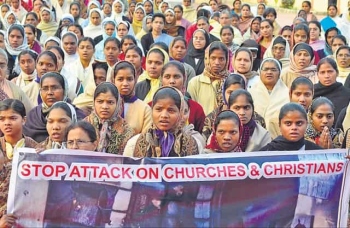
For the last three years, the country has ranked as the tenth most dangerous for Christians across the world. Christians have traditionally adopted a posture of servanthood to the wider community in multiple ways. Education, medical care, social services, rural development, services to the hungry and poor, vocational training, community development, and a host of other development models were introduced by the church and its lay affiliates. In point of fact, the post-independence model of community development adopted by the government in 1952 when Five Year Plans were inaugurated by the Government had its origins in YMCA philosophy and ideology. One could reel off unending and vibrant specifics about Christian contribution to Indian society; the facts would be astounding. Christians have imbibed the notion of 'Antodya’ - welfare of the people at the bottom of the socio-economic pyramid.
In 2014 the Ministry of Home Affairs reported a "steep 30 per cent rise in the number of communal violence incidents in 2013 as compared to 2012. Reported incidents of abuse carried out against Christians in India went up to 177 in 2015, and have, since, steadily escalated. Those figures have sharply risen and today the escalation is full-fledged.
The Pew Research Centre has noted that conversion is now a dangerously contentious issue in India. Nine states have enacted laws against proselytism as of early 2021. While Christianity is a proselytizing religion, many other religions in India are non-proselytizing, and religious conversion is rare in the country. Overall, just 2% of respondents report a different religion than the one in which they were raised, including 0.4% who are converts to Christianity. Christian converts in India are former Hindus and tend to belong to lower castes “ that is, they identify with Dalits, Scheduled Tribes or Other Backward Classes. Most converts also come from poor backgrounds.
In the past, there were random incidents of violence against Christians. It was during and after the Kandhamal riots in August 2008, which left 39 Christians dead, over 395 churches vandalized, 600 villages ransacked; over 5,600 houses were looted and over 54,000 people left homeless, that it became clear to Christians that communalism did not draw boundaries among minorities.
Anti-Christian hate crimes have doubled since 2014. Catholic churches in New Delhi, have faced vandalism. Christian leaders pleaded with Prime Minister Narendra Modi for intervention only to be rebuffed. The United Christian Forum reports that growth in recorded incidents is increasing “not just year-on-year, but even month-on-month.” UCF counts a total of 511 incidents reported as of November 21 last year as against 505 in 2021. PM Modi’s promise of “inclusive growth” has gone astray.
In almost all incidents of Christian persecution, reported from across the country, vigilante mobs comprising extremist elements were involved. They construct allegations of religious conversion, attack prayer gatherings, attack individuals or small groups of Christians. Mob crimes are carried out with impunity as the police turned a blind eye. Police even arrested Christians under charges of forced conversions. UCF’s President A C Michael further observes: “This is despite a slew of directions to the government from the Supreme Court of India to stop the horrendous acts of ‘mobocracy.” There are 79 cases registered against pastors in the country alleging their involvement in religious conversion activities, though not a single case has been proved in court so far, he added. Several lay people are languishing in jail as they are denied bail by courts.
Human Rights Watch has classified violence against Christians in India as a tactic used by the Sangh Parivar organizations to encourage and exploit communal violence to advance their political ends. Types of persecution include: arson of churches, conversion of Christians by force, physical violence, sexual assaults, murders, rapes, and the destruction of Christian schools, colleges, and cemeteries.
Multiple sources have reported an increase in the number of incidents of violence against Christians after the new BJP government under Narendra Modi came to power after the general election in April“May 2014. In 2016, India was ranked 15th in the world in terms of danger to Christians, a sharp surge from rank 31 in 2012. A church was burnt down or a cleric beaten on average 10 times a week in India in the year to October 31, 2016, a threefold increase on the previous year. The All India Christian Council testified to an attack on Christians recorded every 40 hours in India in 2016. Persecution Relief reported from its study that crimes against Christians increased by 60% from 2016 to 2019.
Upper-caste Hindu nationalists, fear that with the arrival of non-Hindus, higher fertility rates among minority groups and conversions to Christianity, will leave the Hindu majority becoming a minority. They assume that only if they integrate a larger section of middle castes, Adivasis and Dalits that the upper-caste nationalists can pretend to represent a majority. Christians have remained 2.3 per cent of the population since the 1951 census. So the fear is absurd, to say the least. Yet, Christian communities exceed on indicators of human development such as literacy, education, pre-natal treatment, pre-natal deaths owing to their advanced medical and educational institutions. Therefore, schools, including those where the major percentage of students are non-Christian, are frequently attacked in anti-Christian riots.
It is obvious that if only the Centre declares a zero-tolerance policy to any form of persecution, things would abruptly change. 93 former Civil Servants wrote in an Open letter to the PM about the ‘Climate of Fear among Christians’, that despite the "increasing incidents of outright discrimination against Christians", the Union government is inert and doing little to protect religious minorities. It called on the PM to reassure the community that it will get equal and unbiased treatment from the executive and the law.