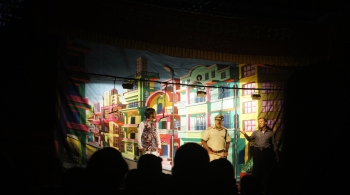
It's the peak of summer here, and the fruit in middle-class backyards and village hillsides are just about ripening. Together with that, it's also the peak season for the tiatr, Goa's tradition and popular Konkani theatre form.
Thirteen decades after it was first performed in the nearby Goan expat destination of Bombaim, Bombay or Mumbai, the tiatr continues to have its following here. It draws good audiences. It also has attracted a hardworking set of enthusiasts, who put up shows across the State, often in trying and tough circumstances. Recent times have seen the tiatr being staged outside Goa, and even abroad. But, we take the tiatr so much for granted.
Since sometime in the 1980s (this is my hunch), the epicentre of the tiatr moved over to Goa. after it was born on Easter Sunday, 1892, it had been a Bombay-based product for long. The halls were there, the artistes lived nearby, and the audiences there loved it. But, over the last four decades or so, there have been undeniably more tiatrs happening in Goa than anywhere else. Now, tiatrs from Goa even get 'exported' to Mumbai.
It is a fact that the Konkani tiatr is extremely slapstick. It is also true that the audiences and even actors from the tiatr stage are often drawn from the common folk. Which is why the "elite" sections of Goan society probably don't understand it or look down on it, or both. Hindu 'elites' tend to reject it as it is seen as the alien culture of someone else; Catholic 'elites' too sadly tend to judge it as downmarket. Yet, its successes, entertaining potential and the (sometimes) positive messages emerging from this art form cannot be denied.
Indeed, the tiatr does get mostly step-motherly treatment. We have a Tiatr Academy of Goa, but how effective such (government-supported) institutions can hope to be is entirely a different question. Look at the language academies for Konkani and Marathi, and you'll get an idea.
Dr Pramod K. Kale wrote (EPW, 1986) wrote: "Among the numerous cultural performances of Goa partaking of both indigenous and European transplanted traditions, the most popular and vibrantly alive is the Konkani language Tiatr. It is a form which is rooted in the working class and lower middle class Goan Catholic population living in Goa or outside expressing their trials and tribulations, hopes and aspirations. The very fact that 'Tiatr' is the most vibrantly alive and commercially successful theatrical entertainment of the Goans demands serious attention and inquiry into what makes it so. In order to understand 'Tiatr' as an expression of popular culture, it is necessary to relate it to the historical processes which have shaped Goan Catholic society and Goan cultural ethos."
Who was Dr Kale (1934-2013)? Interestingly, he was the eldest son of the illustrious theatre scholar, film and theatre director, and thinker K. Narayan Kale of Prabhat Film Company and the Natya Manwanter. He did a PhD on the Natya Shastra from the University of Wisconsin. A Sanskrit scholar, he studied theatre at Yale University in the early 1960s and his book 'Threatric Universe' is well respected in the field of theatre teaching.
Few local studies have been done on the tiatr in Goa. The other work that stands out, and is entirely home grown, is by Andre Rafael Fernandes, incidentally my former guide, who wrote his PhD thesis on the tiatr, and is now available for download online via the Internet.
Tiatrists have been complaining about the lack of support they get from the government. Leave aside support, they even get a whole lot of roadblocks placed in their path. The latest is requiring the mainly-South Goa (or Salcete) based tiatrists go to Saligao to get permissions over "noise pollution".
Many have raised the issue of a lack of decent halls to stage their shows. Booking a government hall is such a headache, all the Ravindra Bhavans notwithstanding. This leaves few suitable options for them at which they can put up their shows.
Maybe non-profit institutions who realise the importance that culture has in the life of a society can offer some solution over the lack of halls.
Critics of the tiatr (and Romi Konkani writing in general, read this as the literary output of a section of Catholic Goan society) tend to dismiss it as preachy and morality-driven. This, I'd think, misses the point of how subtle value-driven messages are delivered, often in the guise of 'entertainment'.
Genders wars are depicted adeptly, though others might disagree. Men are shown as bossy and insecure (as they can be), but women get their way and can also be scheming and prone to nagging.
In between the many songs, comedy sub-plots, and story line, a whole lot of issues relevant to the lives of the common man are taken up in the tiatr. In just an hour of trying to list some issues at the Roseferns' 102nd tiatr 'Hem Oxench Choltelem?' (Will it Always Work This Way?) tiatr the other day, these figured on my list:
Where is Goa headed; bars, tourism; spousal out-migration from Goa; politicians and their misbehaving children; petty corruption; the politics of division; killer road accidents; violent and do-nothing husbands; arrogant and nagging wives; death and mourning; tiatrists themselves; defectors in politics; Goa's beauty; blood donations; fake rape charges; ludicrous laws; terminal illnesses (cancer); travails of life; struggles of the poor; and many more.
As the season gets over, and tiatrists look at the forthcoming September fair-weather shows, here's hoping that Goa can give this form of entertainment a better deal. One which it truly deserves.