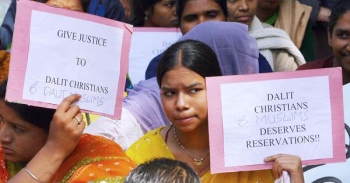
We're in that season of the year, when the otherwise ignored topic of 'caste' gets discussed, debated and dissected all over again. This time, it's specifically about caste within Christianity (and Islam). So, let's look at the former.
Recently, the Supreme Court of India ruled that only persons professing Hinduism, Sikhism or Buddhism can be legally recognised as members of the Scheduled Castes (SC) and thus claim reservation benefits. If a person born into an SC converts to Christianity or Islam (or any other religion outside those three), they immediately lose their SC status. With it goes access to associated reservation protections and benefits under the Constitution and related laws such as the SC/ST (Prevention of Atrocities) Act.
ST (and OBC) benefits continue though. This is inconsistent and unfair. It ties social justice benefits to religion, not the persistence of caste-based disadvantage. For two of India's largest minorities, it is also doubly (or triply) unfair.
Conversion to these religions, it has long been said, doesn't end caste-based discrimination. Yet, social justice benefits are denied to those who choose these faiths.
Either, these faiths are discriminatory (in which case, reservation protection and benefits are deserved). Or, these faiths are indeed not caste-bound (so, then, why the brouhaha against those wanting to opt for them, via conversions?).
Thus, the state implicitly acknowledges caste as a social reality but selectively recognises its impact. This is a case of unequal treatment under the principle of secularism and equality before law.
It could be said that the courts are only interpreting the law, as it stands. But there's inconsistency upstream.
Under the Constitution (Scheduled Castes) Order, 1950, Scheduled Caste (or, SC) status was originally restricted to Hindus. It was later extended to Sikhs (in 1956) and Buddhists (only in 1990 Buddhists).
The underlying assumption--rightly or wrongly--was that caste-based “untouchability” was specific to Hindu social structure, and that conversion to religions like Christianity or Islam (which theologically reject caste) would remove that stigma. This is discriminatory to some, and insulting to others; for untouchability is also banned in India (Art 17, and the Civil Rights Act of 1955 and Prevention of Atrocities Act 1989).
In contrast, Islam and Christianity are doctrinally non-caste religions. So, the Indian state took the position that conversion to these faiths should, in principle, remove caste-based disabilities. However, facts---and several commissions---have pointed out that social discrimination doesn't end after conversions.
Caste is an issue which seldom gets acknowledged or discussed. It is true that theologically, Christianity (Catholics, Protestants, Syrian Christian, etc) do not sanction caste. Core teaching emphasises spiritual equality, and all are considered equal before God. This, contrasts, in important ways with texts like the Manusmriti (though even within Hinduism, practices and interpretations vary today).
Socially, however, caste persists in practice. Economically, caste overlaps with class significantly; pre-conversion dominant castes also tend to be more affluent. Groups who converted from marginalised castes still face economic disadvantages. Historically privileged caste have far better access to education, land and networks. This reinforces disparities.
In marriage patterns, endogamy (marrying within one's own caste) is common among Christians in India.
In terms of 'opportunity' and 'advancement', the record is mixed. Many formerly Dalit Christians have benefited from schooling and social reform movements. But, compared to Dalits who remain within religions eligible for Scheduled Caste protections, Dalit Christians face disadvantages. They are denied reservation policies, limiting their access to government jobs and higher education quotas.
So, caste in Indian Christianity is generally less theologically rigid but still socially resilient. Less, formally codified, in everyday life (especially in marriage and community status) it is influential. No doubt it is weakening gradually among urban and younger populations.
While denied SC benefits, Christianity in India is often criticised for being "casteist". Routinely, a few specific examples are pointed out. For instance: conflict in some Tamil Nadu church between Dalits and "upper" castes. Or "caste-based" cemeteries... How true are these charges?
While real, they are neither universal nor something affecting all Christians. They reflect localised, socially rooted caste dynamics within Indian Christianity, not official church doctrine.
Conflicts have been documented in parts of TN and Andhra where Dalit Christians and dominant-caste Christians had clashed over access to main church buildings, participation in festivals or processions, and leadership roles in parish councils. In a few cases, churches were temporarily closed by authorities to prevent violence. But they not the norm across all of India.
"Separate cemeteries" but needs nuance. They might have been some historically rare separate burial sections. However, the reasons can be mixed. Caste-based social separation is a controversial explanation. Historical parish divisions or even economic factors (family plots, fees, land ownership for 'special' graves) could be a more rational explanation.
Not every separation is purely caste-driven. In our village church, we had a social segregation, not based on caste. Boys sat in front of the church, on one side of the altar; girls, also in front, on the other side. Families and mixed people sat across later pews. The back end was 'reserved' for elderly males (of whatever background), and latecomers. Those more adventurous opted for the choir loft; mostly young men.
Yet, this is not to trivialise the persistence of caste despite a change of religion.