


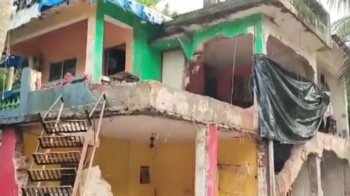
It has been getting curiouser and curiouser. The Assagao Agarwadekar home demolition case has come a full circle -- and more! What is is the hapless reader to make of the same? Who's telling the truth? Who's hiding the truth? Who's diverting from the main issues? Is justice being done at all?
Ten days ago, on a Saturday, the story first broke. It emerged bizarrely. A home belonging to the Agarwadekars was demolished, in broad daylight, by some outstation private party, a Pooja Sharma who claimed to have bought it over. The police took no action, and obviously were acting under pressure. Later, it appeared to all that it was the small fry who was getting caught. Naturally, there was outrage.
The first to respond in public (at least going by what one saw) were the social-media fuelled activists. Next, the media jumped on the bandwagon. Soon later, or somewhere in between, politicians jumped into the fray. The CM and others promised to rebuild the Agarwadekar's home. Some rightly pointed out that the role of the State was to uphold the law and order.
If you closely watched what the politicos said, they seemed to be eager to drag in their rivals' names into the matter. For instance, the CM dropped the name of Fatorda's legislator Vijai Sardesai. Calangute ex-MLA Agnelo pointed to the involvement of someone who he said was the Man Friday of incumbent BJP-turned-Congress-turned-BJP MLA Michael Lobo.
Somehow, something didn't seem to match. The story didn't make sense.... It was shocking in the first place. How could such a case occur? What was the role of our political class (from State to village level), and bureaucrats (official, police, and the powerful petty officials at the village level)?
The first round came a full circle when the Agarwadekar family, and their legal advisors, began suggesting that they had no dispute with the persons who were earlier named for having demolished their home. This after all their anger, irritation and allegations of just a few days earlier.
Naturally, both politicians the media were furious. They accused the 'victims' of having taken them for a ride, with hints and insinuations of settlements. Things did not stop there. A letter purportedly written by an Anjuna police official at the grassroots, against his senior-most boss, alleged about what he had been "forced" to do. This gave quite another spin on the issue.
Sometime in the mid-1980s, the author Elwyn M. Chamberlain wrote a novel called 'Gates of Fire'. In it, he describes the scene where cops and thugs cross-pollinate among themselves on Goa's coastal belt. In an area not far from the area Assagao-Anjuna is located in. It would seem like life imitates art. Either that, or Chamberlain was willing to write about something that was an open secret then. However, most of the time, nothing much surfaces in the media in Goa itself, until there is some crisis. Like now.
Of course, all this cannot be seen in isolation. Villages like Anjuna and Assagao were the very places which produced a significant section of the "upper caste" Goan elite of the past. It was this class which moved on to greater opportunity in other parts of the globe, accelerated as the political situation turned hostile to them after the 1960s. The many empty homes and lands belongs to these folk. Now our state is talking about taking over "no man's lands".
Incidentally, another issue that came up in recent months was related to Britain's former Home Secretary Suella Braverman (Fernandes). The debate over her ancestral property in the same area was wrapped up in controversy and promptly forgotten. These are high profile cases, but definitely not the only ones.
In the Agarwadekar case, that was not all. The third denouement (and one doesn't even know if this is the final one) came last weekend. A gram sabha erupted with allegations that the panchayat had illegally allotted a house number to the Agarwadekars (The Goan, July 1). It's definitely far, far, far more complex than it seems.
In a Goa which likes to reduce issues to black and white, there are many shades of grey showing up here. For a long time into the debate, nobody used the word 'tenant'. Yet, the fact of the matter is that Goa's highly politicised and biased tenancy laws have been playing havoc with parts of our State since the 1960s and 1970s. This is particularly true in a largely out-migration oriented Goa, including Bardez, from which people departed in large numbers for well over a hundred years now.
If you were politically connected, you could get away with gigantic land holdings, in a State which implemented no land ceiling Act. On the other hand, those who were reduced to being without political godfathers saw their land and even homes being snatched away from them. The law was neutral only on paper.
In the 1990s, the 'solution' to this problem came in the form of underground and semi-legal groups like The Goa Protectors. They offered their form of instant justice, at a price. Today, the option comes by way of selling out to any controversial party, taking the money (any way one gets it) and simply fleeing. It is no surprise that Goa's land is going into the hands of the most crooked and the most controversial. One day generations unborn could well ask how we did nothing while this situation was coming about.
Today, even politicians (especially those who are out of power, or in the Opposition) are willing to lament that there has been a huge loss of Goan land in recent years. Even in colonial times, the land alienation was definitely not so severe.
Land has a crucial role in both economic and cultural as well as social activities, as geeksforgeeks.org explains it aptly. "The land is often associated with a sense of identity, belonging, and history, and it is often used to mark cultural and political boundaries." But, Goa itself remains a divided society. One section mistrusts the other, thanks to the politics we have inherited from the 1960s. This could be based on religion or caste.
Is it surprising then, that just about anyone can play on these differences, and attempt to take over the place -- metaphorically and literally? Only if people are willing to work on their rifts, not be in a tearing hurry to take undue advantage of the situation, and be honest with what is theirs and what isn't, there is hope that some justice can be done.


