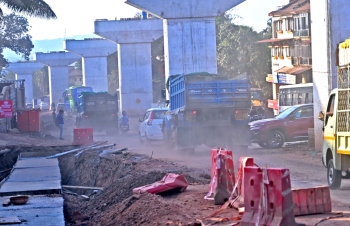
Road Safety Week has been a fixture in Goa’s public calendar, filled with rallies, seminars, and slogans. Its declared purpose is to reduce accidents, instil discipline, and protect lives. Yet the impact of such symbolic weeks is limited unless paired with structural reform. The state’s most pressing test is visible along the NH-66 elevated corridor, where breaches in planning and execution have converted a flagship infrastructure project into a corridor of hazards rather than of safety.
Statutory expectations
Road safety is not merely aspirational; it is anchored in statutory duties. The Motor Vehicles Act 1988 empowers enforcement authorities to regulate traffic, mandate safety devices, and penalise violations. The Indian Roads Congress guidelines and Ministry of Road Transport and Highways circulars prescribe standards for signage, lane demarcation, and protective barriers. The Supreme Court Committee on Road Safety has repeatedly emphasised the four-E formula ” engineering, enforcement, education, and emergency care (S. Rajaseekaran v Union of India, SC). When any one element fails, as in the engineering lapses on NH-66, the result is predictable: loss of life and erosion of public trust.
The case of NH-66
The NH-66 elevated corridor was projected as an artery to ease congestion and provide safer passage along Goa’s coast. Instead, observations during recent petitions before the High Court revealed unfinished crash barriers, poorly marked diversions, and unsafe pedestrian access. Reports highlighted stretches without functional lighting and drainage, contributing to collisions during monsoon months. The paradox of holding Road Safety Week while allowing such a corridor to operate exemplifies a governance gap between awareness campaigns and ground realities.
The irony deepens when potholes dominate everyday travel even during the very week dedicated to safety. Editorials in the Goan press have pointed out that road users are instructed to practise discipline while authorities themselves permit surfaces to deteriorate. The citizen is penalised for not wearing a helmet, but the agency responsible for road maintenance faces little accountability when potholes cause accidents. This imbalance undermines the moral authority of awareness drives.
Seasonal transition
Goa’s road conditions change dramatically between the monsoon and summer months. Heavy rainfall leaves behind potholes, eroded shoulders, and weakened crash barriers. When the rain subsides, motorists suddenly face altered road geometry: temporary puddles give way to hidden craters, loose gravel emerges, and faded markings are not immediately restored. The transition period is therefore a time of heightened risk. Vehicles that adjust to monsoon caution often accelerate into summer speed, unaware that the roads remain compromised. A genuine Road Safety Week must explicitly address this seasonal hazard by mandating post-monsoon safety audits, immediate resurfacing of highways, and repainting of lane markings before summer traffic peaks. Without this bridging exercise, accident rates will continue to spike during the seasonal shift.
The state has announced plans to install AI-powered traffic cameras to detect violations automatically. Technology can indeed deter rash driving and red-light jumping. Yet cameras cannot compensate for missing crash barriers or sudden lane drops. Artificial intelligence will record the last seconds of a violation but cannot reverse the structural negligence that led to it. Road safety in Goa requires integration: engineering integrity first, supported by technological enforcement.
Pedestrians and
cyclists neglected
The Global Road Safety Week theme earlier this year was protection of pedestrians and cyclists. Goa’s elevated highway project has failed to incorporate adequate pedestrian crossings, cycling lanes, or refuge points. The absence of grade-separated safe passages forces vulnerable users into motorised lanes. This contradicts both international best practice and the state’s own stated objective of inclusive mobility. Road Safety Week must not remain confined to drivers and riders; it must centre the most vulnerable road users.
The doctrine of constitutional tort places liability upon state authorities where negligence results in violation of the right to life under Article 21 (see Nilabati Behera v State of Orissa, SC). In the context of NH-66, accidents traceable to absence of safety features could attract such liability. Judicial review remains the corrective mechanism when administrative assurances are not met. The High Court of Bombay at Goa has been moved in public interest petitions, reflecting the citizen’s last resort to enforce accountability.
If Road Safety Week is to be more than ceremonial, it must be linked with measurable deliverables. These include:
Completion of all crash barriers and pedestrian underpasses before any further inauguration of NH-66 stretches;
Independent safety audits by accredited engineers, with reports placed in the public domain. A binding timeline for pothole rectification across state and national highways; Integration of emergency medical response units along accident-prone zones of the corridor; Without such benchmarks, public campaigns risk becoming empty ritual.
Community engagement
through discipline
Civil society groups such as MARG in Goa have long demonstrated that road sense can be cultivated through school programmes. The innovative concept of Traffic Yoga ” treating discipline on the road as a daily practice akin to breathing exercises ” can serve as a soft-power complement to hard infrastructure. By embedding mindfulness into pedestrian, rider, and driver behaviour, campaigns can create a culture where enforcement is supported by self-discipline.
Goa’s global image as a tourism destination suffers when headlines report fatal accidents on highways and unsafe roads. Visitors expect not only scenic beauty but also safe mobility. Ensuring that the elevated corridor is genuinely safe will reinforce the credibility of state institutions. Tourism policy and road safety are therefore not separate silos but mutually reinforcing obligations.
The essence of Road Safety Week must evolve from mere symbolism to structural responsibility. NH-66 has become the litmus test. If authorities can ensure that the elevated corridor adheres to the standards prescribed by law, public faith will be restored. If not, every slogan raised during awareness rallies will ring hollow. Road safety is not a week-long observance; it is a daily constitutional duty.