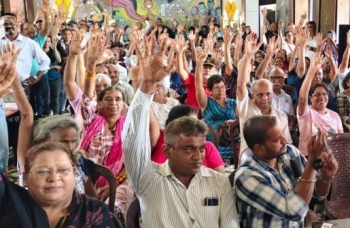
So, Moira has spoken. On Sunday, the village gram sabha vowed to reject the government plan to convert the village into an urban area. Moira has a charm of its own. It may be close to Mapusa, and the eye of real estate speculators might be cast on it. Yet, the villagers are clear in their approach. Why?
First, what does urbanisation mean to Goa? Many have seen the changes that have come about in recent decades. It would have been fine if this was to mean only better infrastructure, facilities and benefits for the area. But it means something quite different.
Urbanisation in Goa has been rather chaotic, let’s admit it. It has hardly meant better services and jobs, but more of dense and uncontrolled constructions. Villagers understand that, intuitively. Goa incidentally is unusual in itself; many villages already have urban characteristics. Including high literacy, a growth of the service sector employment, and helpful commuting patterns (that could be better). At the same time, it has also retained its rural structure.
We are being sold the urban dreams. This includes better roads, drainage, sewage treatment, public transport, street lighting and waste management. But, ironically, the rural areas of Goa seem to be faring in better ways on these fronts already.
Without saying so in as many words, we are given the chimera that urban areas will spell more funding for local bodies, improved water supply, utility networks that can scale, and greater employment opportunities. The average citizen knows that higher land values can be a double-edged sword too. For some it would mean a bonanza, but for most it would also mean unaffordable housing as families grow and land supply remains constant.
Urban planning regulations can be clearer than ad hoc village-level decisions; but the former are also heartless and don’t take into account the common man’s needs. Yes, the urban life promises us better access to hospitals, colleges, entertainment and public spaces. But what exactly is there in it that we can’t already attain in Goa’s rural lifestyles?
There is little excuse for the government to wait for urbanisation to happen before our public transport improves too.
On the other hand, it is also true that village after Goan village has already faced the problems that come with urban life. There has been a loss of village character and its cultural identity in many places. Traditional settlements, local architecture and even the village commons have weakened. So have community networks.
In their book Goa Found and Imagined, a group of Swedish students from the Royal Institute of Art in Stockholm argued that Goa’s urban-rural network holds unique qualities. They said it could be the basis of Goa’s urban structure. They found the experience of life in Goa to be “distinctive”.
“Although 62% urban, it is nothing like the cities of Mumbai or Delhi. Goa’s network of villages, interlaced by farmland and wilderness, creates a unique weave of urban and rural. The experience of this urban-rural overlap is extraordinary, offering in a single environment both the urban and the rural possibilities of life, where elsewhere they might seem in opposition.”
They found a urban-rural “overlap” on many levels. “On a large scale in the network of towns, villages and land, down to the Goan single-family house with its urban façade and rural backyard. This relationship between the urban and the rural holds the potential for an alternative urban way of life”connected to the land and at the same time to all the knowledge, lifestyles and opportunities fo the wider world.”
Well said, indeed. Sometimes it takes the person from a distant land to tell us some home truths about ourselves.
Goa’s loss from mindless urbanisation has been worse too. The loss of green cover, paddy fields, wetlands and even biodiversity. Pollution in our rivers, estuaries and coastal ecosystems. Waste generation and a strain on natural resources.
Even people are paying the price. Property prices, fuelled by speculation, have shot through the roofs. Rents are unaffordable for most sons and daughters of the soil. Speculation in land has severely altered land ownership patterns.
We face the pressures of urbanisation in our daily lives too. Traffic congestion and infrastructure stress is the price the average citizen pays on a daily basis. Urban growth without strong planning (or a corrupted one) is producing bottlenecks, parking shortages and flooding problems. After all, Goa’s narrow roads are not meant for high vehicle volumes.
Disputes over taxes, zoning and local control is one more outcome of the bumpy transition from village areas to municipal structures. Residents feel, and not without reason, that the decision-making process gets taken out of their hands and made more centralised. Not community-driven.
Goa’s dilemma
In Goa, the debate is often not simply village versus city. Many settlements are already functionally urban, it could be argued: people commute, work in services and tourism, use digital infrastructure and depend on regional transport networks. The real policy question is whether Goa can achieve urban-level services while preserving environmental and cultural assets?
The fear that blanket urbanisation could accelerate real-estate-driven growth, the loss of agricultural land, and pressure on fragile ecosystems is not without reason.
But our experience suggests that it’s too much to expect our planners and “people’s representatives” to think of pro-people urbanisation along with environmental zoning that protects wetlands, paddy fields, forests and coastal zones. Mere grandstanding on such issues, for the sake of capturing the headlines, doesn’t make any sense.
Traditional village cores need to be preserved, with their architectural character. Infrastructure (sewage, drainage, water supply, and public transport) should precede major growth. Community participation is a must.
It is time to look at what urbanisation has really meant to Goa, what we have lost because of it, and how much of the gains have gone to the land and its people.