


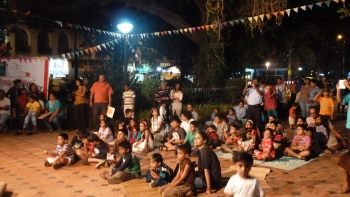
It's the season for lit fests. Literary festivals are being organised both within and outside Goa these days. We've had GALF. A school like Sunshine (at Bainguinim) has its own festival. If you add Serendipity (from Munjal of Hero Enterprise) in art and IFFI in film, plus VivaVaddo (Jan 27-Feb 5 around Moira), one gets a wider view of Goa's festival season.
In Goa, the new generation of lit festivals started over a decade ago, in 2010. One remembers Nandini Sahai, then the Director of the International Centre Goa, coming up with the idea of a lit fest in Goa. Obviously, hugely successful ones (in numerical terms) like Jaipur's was the inspiration for tiny Goa too. Since then, the festivals have been held mostly in December. It came a bit late this year, with the exception of the pandemic years.
In a way, lit fests are not all that new. After 1990, and the liberalisation of the Indian economy, we have seen such fests take on new shape. But, regional language groups have been holding their own literary conferences, festivals and "sammelans" for quite some time now.
Put briefly, the point is this: however much of money and resources are spent on organising literary festivals, specially the more lavish ones, it's unlikely to change the ground situation of the lack of a book culture in places like Goa.
Goa is lacking in libraries. It doesn't have funds to support building libraries in aided schools. Virtually no efforts have been made to build a literary and library movement, unlike in States like Kerala. If this has come about, it has been due to private or volunteer effort. There has been no consistent policy to promote reading as such.
Festivals held along more simpler lines, with grassroots participation, might offer higher chances of success. But that doesn't seem to be happening now.
At one time, especially just after the language agitation in Goa (1985-87), the Konkani and Marathi literary sammelans were held with a lot of enthusiasm.
Unfortunately, that seems to have died down or run out of steam. One of the reason for that could be the influx of government funding. This could even spread further infighting among language and script groups.
Together with this, some of these events were used to play politics or push controversial agendas. For instance, some of the push towards one-script-only, Devanagari-alone approaches grew out of such events decades ago.
Caste politics were pushed at other such events. Even the contentious plunge towards "regional languages"-alone approaches in primary schools were fuelled by resolutions passed at such events. This could be held responsible for actually driving away many from officially-sanctioned Konkani force-fed to them in schools..
In Feb 2022, questions were being raised over the Bangalore Literature Festival (BFL) and the closeness of those organising it to the ideology of our current rulers. (Outlook, Feb 04, 2022).
Business Standard wrote a piece (Oct 2022), titled 'The contested terrains of lit fests'. It questioned whether lit festivals promote elitism, build bridges or enable access.
In Goa too, the temptation is to get "big names" to the event. This is seen to offer the best chance to make a splash. But, in reality, it keeps out and excludes smaller and more deserving names.
This causes problems of its own. Either the same names get invited year after year, or the smaller player is unfairly ignored, to benefit the bigger. So a work published by a big(er) publisher in a big city is more likely to get big play at the event, rather than something locally produced, or even self-published.
In August 2022, ThePrint.in calculated that there were "at least 65 lit fests in India now, a growing testament to decades of neglect of smaller cities, regional languages, and appetite for cultural events." Others put the number of lit fests at 100 or even 200 per year in India alone.
This may help to reflect more diversity. But in Goa's case, getting numbers to take note of new books (rather than waiting for them to go out-of-print before appreciating the same) has been a real challenge. Even booksellers like engineer Leonard Fernandes, who runs DogEarsEtc in Margao, has been rueing how difficult it is to get audience for literary and book events.
In November 2016, Deccan Herald asked whether lit fests were becoming "commercial circuses". Or if they could serve "the cause of literature by focusing on good books, offering a platform to a variety of voices and artistic perspectives, and drawing in new readers to books they would otherwise never have known?"
There are other issues too. Questions have been raised -- and forgotten -- over who has sponsored some lit fests, including Jaipur. Not all events can sustain.
The children's lit fest Bookaroo came to Goa once, in 2015, but didn't return, apparently due to the small numbers that greeted it. The Writers and Readers Festival in Goa could also not survive for more than one season, in 2014.
The lobbying to get space in a lit fest is also another distasteful side of such events.
Writing in Scroll.in in 2020, Ahsan Akbar of the Dhaka Lit Fest wrote: "Literary festivals are like dog shows for the educated classes, where literary and not-so-serious minded folks turn up for high voltage conversations or just plain entertainment, or both.The writers on show, perhaps dragged out of their studies, are placed on corporate-sponsored stages because they now need to moonlight as performers. They also need to pose for selfies with apparent fans, some of whom will never read their books."
Yes, lit fests might need to morph, adapt and improve, before they are worth the money spent on crafting them.


