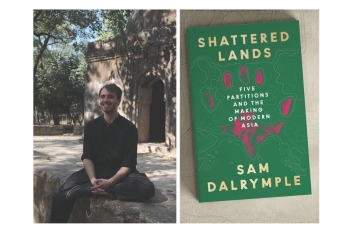
Over the weekend, a discussion caught my attention. One writer who had written a book related to Goa (way back in 2007) had recently been quoted by another upcoming writer, who might be prominent sometime soon. The writer doing the quoting was Sam Dalrymple, whose recent work 'Shattered Lands: Five Partitions and the Making of Modern Asia' (2025) is drawing quite some attention.
I was happy for Yvonne Vaz-Ezdani, though not because her first book on the Burma-Goans was a work that kicked off my own publishing endeavour so many moons ago. (That work of hers was followed up by a book on the Burma-Indians, brought out from the Metropole of Delhi, and obviously much more noticed.)
Yvonne mentioned that many quotes from her book had been cited and duly credited by Sam Dalrymple, the historian-son of the widely known William Dalrymple (and artist Olivia Fraser). It's seldom that writing from Goa gets noticed the way it should.
Yet, when it happens, it's sometimes easy to have rather mixed feelings on the same. Sad but true: writing from Goa needs to be accepted and acknowledged by writers and publishers in big cities (like Delhi) before the work is adequately appreciated locally. Even then, it might not be.
So are we saying that Goan writing has little or no value until it is validated by metropolitan centres of power? Or those who are acknowledged by such centres of power.
This way of thinking creates a hierarchy that feels almost colonial. Writing from smaller places like Goa is often ignored unless it first gets a stamp of approval from the big centres.
It downplays the originality and talent of local writers, making them seem dependent on outside recognition instead of being valued on their own terms.
Goan voices are often noticed late, not at all -- or even misunderstood -- because their work is filtered through publishers and critics in metropolitan hubs, rather than being celebrated as part of Goa’s own vibrant literary life.
And, are those doing the quoting appreciating the work of the author, or just buttressing their own work?
In the world of ideas, information and knowledge, someone quoting you can be a mixed blessing. Over the years of being a journalist, I've quoted hundreds of persons. But when it comes to my own turn to be quoted, it's scary....
There's the chance of being misquoted. To avoid this, make your point in writing. Sometimes, you just don't wish to be quoted... at least not on a particular subject.
Unfair ways of dealing with the work of others include copying ideas or text without acknowledgement (plagiarism), selectively citing only sources that support one’s argument while ignoring others, misquoting or taking material out of context to distort meaning.
Then, there's also giving undue credit to influential names while sidelining more original (but less prominent) contributors. Or presenting secondhand references as if one has directly consulted the original. At times, people lift ideas, or borrow some information, without acknowledging.
It also depends where one in writing.
When looking back on our earlier days in journalism, it strikes me that we often cited very loosely. On the other hand, academia expects (on paper) one to be more strict in what one is citing.
Journalists and authors from a bigger centre often swoop down on information collate by their colleagues in smaller towns, and freely help themselves to it. As journalists working for outstation publications, we were guilty of this ourselves too at times.
Some prominent journalists were also accused of winning awards after basing their work on what some local, "small time" journalist had dug up.
Not every casual discussion -- especially in informal spaces like WhatsApp groups -- requires the rigour of academic citations. People often share generic opinions shaped by common knowledge, their experience or widely available information. It would be unrealistic to demand formal references for every such exchange.
Copyright law is a different cup of tea though. Copyright law protects the expression of an idea (the specific words, images,or form), but not the idea itself. So rephrasing in different words may avoid copyright infringement.
Plagiarism, meanwhile, is about intellectual honesty and requires acknowledging the source of ideas, not just words. With AI, the boundaries blur further. Generated text may draw on countless unseen sources without attribution. This makes it harder to trace origins or ensure proper acknowledgement.
Somewhere along the way, you realise that copyright helped a number of Western scholars to collate information from across the seas (in the 16th century and later) without acknowledging where it came from, or respecting its origins.
It is a fact that early modern European scholars often gathered knowledge or texts and ideas from colonised or distant regions and published them under their own names. They offered little or no acknowledgment of local sources.
Copyright, developed in Europe from the 16th“18th centuries, largely enabled publishers and authors with continuing such work, not the communities or traditions from which knowledge was drawn. It would not be wrong to say it helped consolidate Western ownership over global knowledge flows while sidelining or erasing non-European contributors, with few exceptions.
Once more, we see a conflict between technology and the law. Now, technology is moving ahead of what copyright envisaged. Let's see how the change goes.