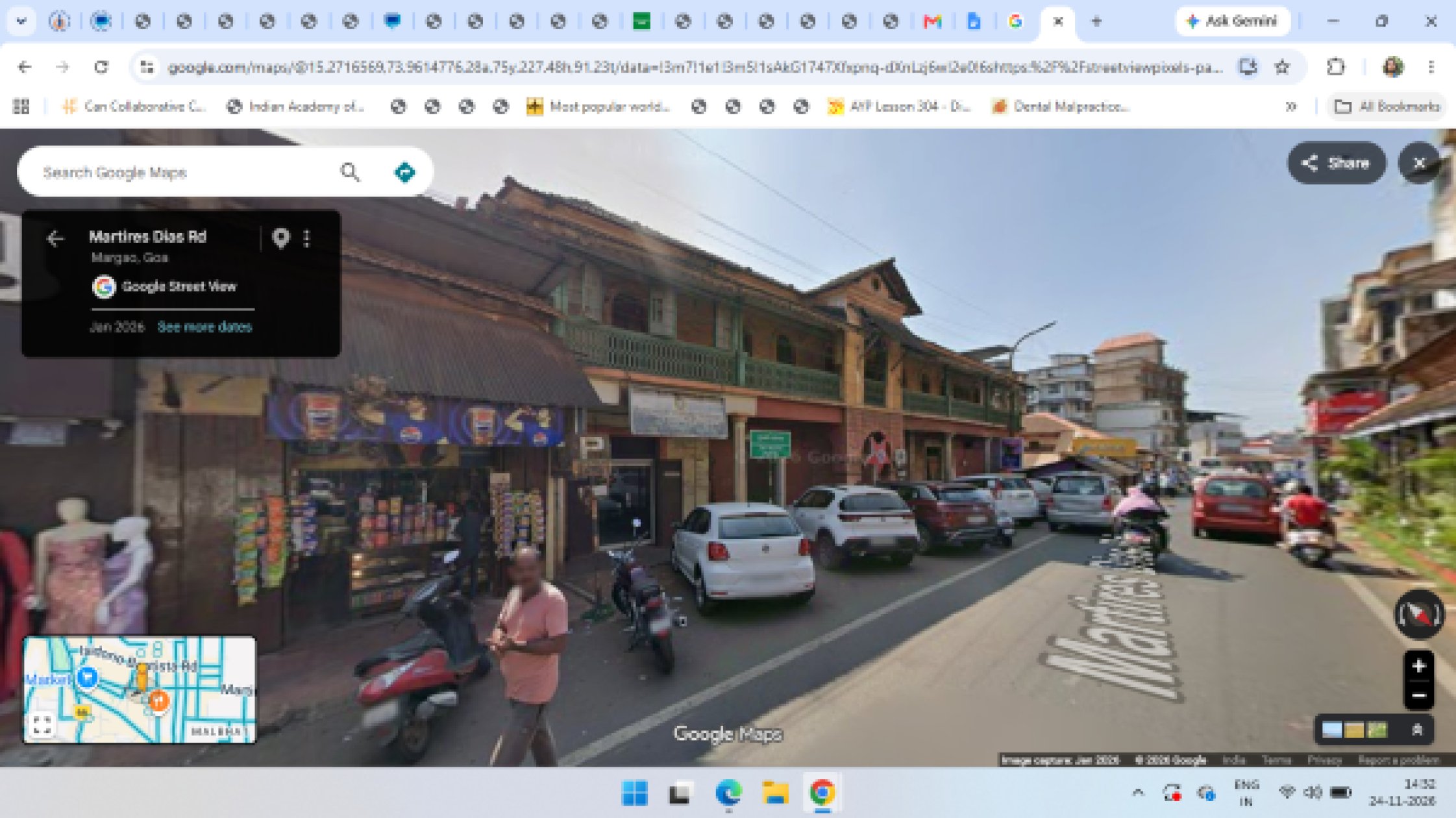
A drive through Margao after several months reveals more than the familiar bustle of a commercial town. Along the road from Aquem towards Pajifond, the changing relationship between inherited property, family enterprise and modern development becomes increasingly apparent.
Near Carmelite Monastery Road, the Caro family’s property presents an interesting example. A contemporary, glass-fronted commercial structure has emerged within the family’s established surroundings. Rather than being displaced by development, an existing commercial identity appears to have been extended into another generation.
Such continuity deserves recognition. Where ancestral property is retained and productively utilised, opportunities for intergenerational enterprise are preserved without necessarily sacrificing ownership to speculative pressures. Yet a short distance away, a contrasting reality is encountered.
The absent families
At Pajifond, an ageing residential structure - Old Hari Mandir recalls an earlier Margao. Beneath its common Mangaluru-tiled roof, several modest dwellings once accommodated families whose everyday interactions contributed to the neighbourhood’s social character.
An elevated veranda, approached through steps from the roadside, offered residents a shared connection with the passing town. A nearby temple further reinforced the locality’s traditional associations.
Today, several doors appear closed, while visible deterioration suggests diminishing residential activity. Such changes cannot automatically be attributed to displacement. Migration, inheritance disputes, changing employment opportunities and declining maintenance may all contribute to residential abandonment.
Nevertheless, the gradual disappearance of established neighbourhood communities raises an important question: What remains of a town when its inherited social relationships are replaced by increasingly impersonal commercial arrangements?
Commerce and continuity
Further along, Lotlikar Electricals illustrates another dimension of Margao’s commercial inheritance. Its familiar display of remote controls recalls a time when repairing televisions, stereos and household appliances represented a dependable neighbourhood service.
Nearby, an established Christian household evokes memories of traditional herbal preparations offered generously to visitors. Such practices reflected a community-oriented understanding of enterprise, extending beyond immediate financial returns.
The history of Paulino Hardware offers a different perspective. Once associated with a prominent family enterprise, its commercial premises illustrate how successive generations may pursue redevelopment, restructuring and alternative uses of inherited property.
Family disagreements and changing business arrangements have altered commercial continuity.
Meanwhile, jewellery establishments such as Ullas, Raikar and Lotlikar continue to connect precious metals commerce with traditional occasions, including weddings and Dhanteras. Their activities demonstrate that profitability and cultural continuity need not be mutually exclusive.
Margao’s commercial heritage has therefore never been static. Its defining challenge lies in accommodating economic change without allowing longstanding local enterprises and neighbourhood identities to disappear unnoticed.
Concrete contradictions
Along the market stretch, newer establishments such as Noor Bridals and Devkar Jewellers introduce a visibly different architectural language. Modern commercial buildings increasingly stand alongside older structures, producing contrasts in height, frontage and construction. What was once characterised by modest elevations and traditional roofing is gradually being interrupted by reinforced-concrete floors and contemporary facades. This transformation becomes especially noticeable towards Aquem.
The redevelopment of the Janata Cooperative Housing Society building, together with newer commercial construction near Moti Dongor, illustrates the growing intensity of land utilisation along Margao’s developing fringes.
Multi-storey structures now rise near single-storey ancestral houses distinguished by Mangaluru-tiled roofs, courtyards and relatively generous open spaces. Architectural contrast is not inherently objectionable. Modernisation remains necessary for housing, commerce and economic expansion.
However, development should be accompanied by adequate parking, pedestrian access, drainage, road capacity and consideration for the surrounding streetscape. Where these requirements are inadequately addressed, private commercial gains may eventually impose substantial public costs.
Planning and influence
The transformation also invites examination of the relationship between commercial investment and municipal decision-making.
As centrally located land becomes increasingly valuable, incentives for redevelopment naturally intensify. Property owners may seek higher returns, while developers and incoming businesses pursue opportunities within an expanding marketplace.
Neither commercial ambition nor migration constitutes wrongdoing. Margao’s economic vitality has long depended upon exchange, entrepreneurship and the participation of diverse communities.
The concern arises when planning decisions appear inconsistent or when the public cannot readily establish whether permissions have been granted according to uniform standards.
Questions concerning building heights, setbacks, parking provisions and land-use permissions should therefore be answered through accessible records and transparent administrative procedures.
Professional relationships between municipal authorities, political representatives and property interests also warrant appropriate safeguards against conflicts of interest.
Such relationships cannot independently establish improper influence. Nevertheless, public confidence requires decisions to remain demonstrably impartial, irrespective of the standing enjoyed by applicants. Urban development should be governed by published standards rather than perceptions of political proximity.
The electoral question
Near Gomant Vidya Niketan, political banners provide a fitting conclusion to this journey. Images associated with Revolutionary Goans Party leader Manoj Parab appear within the same public landscape as those of Margao MLA Digambar Kamat. Other political aspirants also seek recognition as the 2027 Assembly elections approach.
The juxtaposition reflects competing political messages, although electoral outcomes cannot be inferred from the visibility of individual personalities. Margao’s longstanding political leadership and emerging challengers must ultimately be examined against questions extending beyond party affiliation.
Has commercial redevelopment been accompanied by coherent planning? Have traditional neighbourhoods received sufficient attention? Are building permissions transparent? Has infrastructure kept pace with increasing density? These questions concern every resident, irrespective of religion, regional origin or political preference.
The approaching election offers an opportunity for public scrutiny of development priorities rather than merely another contest between familiar personalities.
Margao’s future cannot be measured solely by the number of new buildings constructed or businesses established. It must also be assessed through the quality of public spaces, the preservation of community life and the consistency of civic administration.
For a town increasingly transformed by commercial ambition, the enduring question is whether political authority will remain accountable to the public interest that urban planning is intended to serve.