PANAJI
With just five months or so to go for the Assembly elections expected in early 2027, Goa's political landscape is already witnessing significant churn.
The 2022 election was marked by fragmented opposition forces and a multiplicity of contenders. But now, five years later, political parties in the run-up to 2027 are increasingly dabbling in political consolidation, and alliances are emerging, suggesting that the coming contest will be between political blocs rather than individual parties.
Ruling combine sees signs of strain
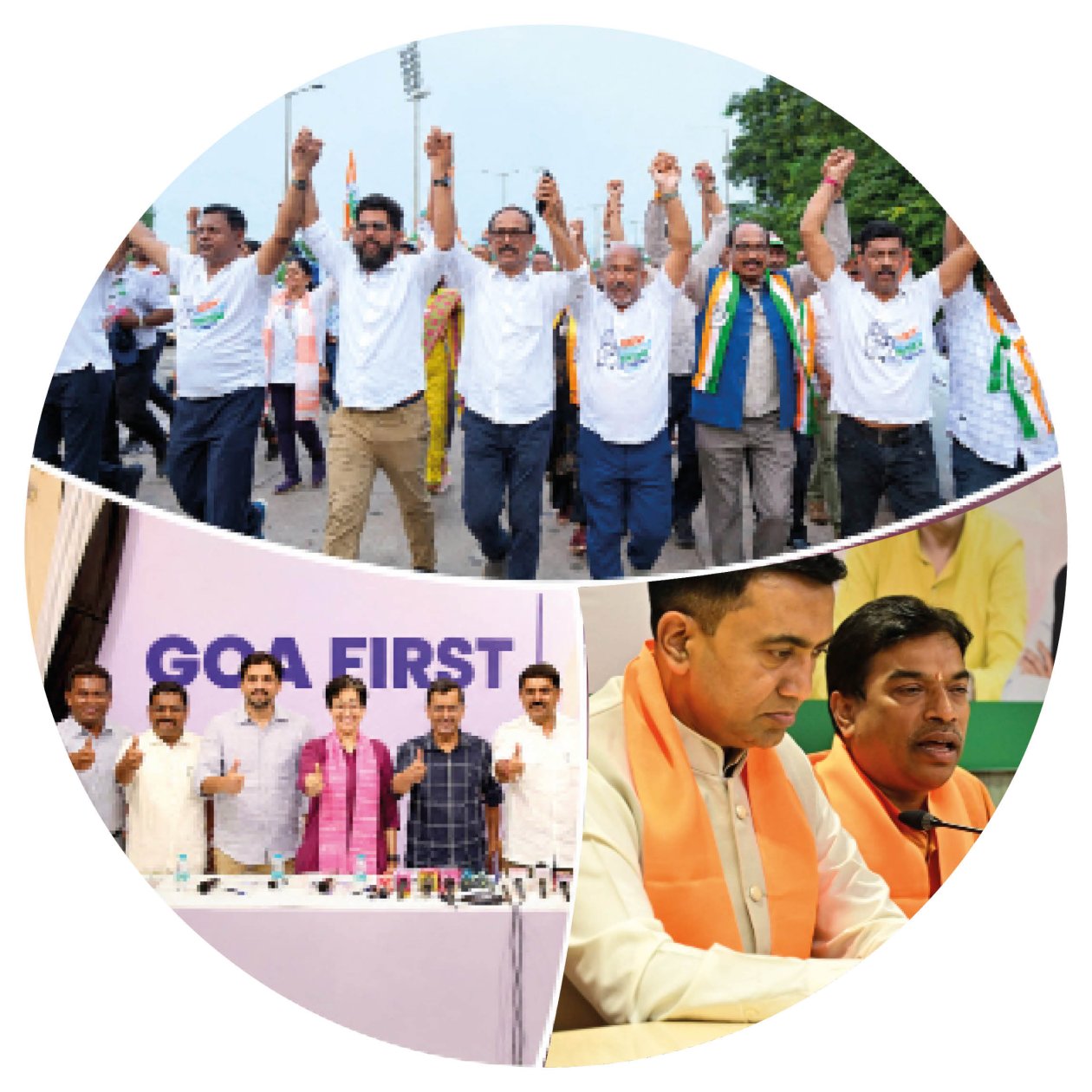
At present, the ruling Bharatiya Janata Party (BJP) remains firmly saddled, with Chief Minister Pramod Sawant steering the ruling alliance along with the Maharashtrawadi Gomantak Party (MGP) and Independents backing it. But this ruling formation too is seemingly under strain.
In the 2022 Assembly elections, the BJP had emerged as the single largest party with 20 seats in the 40-member House and secured 33.3 per cent of the popular vote. Although it fell just short of the majority mark of 21, it swiftly formed the government with the support of the MGP, which won two seats, and the independent legislators.
The alliance has since provided the government with a stable legislative base.
However, as the next election approaches now, subtle signs of stress have begun to emerge primarily within the BJP-MGP relationship. Recent public exchanges between Chief Minister Sawant and MGP leader Ramkrishna "Sudin" Dhavalikar have fuelled speculation about strains in the partnership.
While neither side appears interested in a formal rupture and both continue to remain partners in government, the episode has underlined an old reality of Goan politics: electoral allies often become competitors when seat-sharing negotiations begin.
MGP's bargaining power intact
The MGP, Goa's oldest regional party, remains influential in pockets of central Goa and elsewhere despite its diminished statewide footprint. Having secured victories in Marcaim and Mandrem in 2022, it retains bargaining power disproportionate to its numerical strength because of its social base and regional influence.
Whether the BJP accommodates MGP aspirations generously, particularly those of junior Dhavalikar, Deepak, or seeks to expand independently into traditional MGP strongholds could become a critical factor in negotiations and its fate going into the elections.
Goa First as third force
If the ruling camp is managing internal contradictions, the opposition camp is attempting something it failed to achieve in 2022: unity.
The most significant development recently has been the formal alliance between the Aam Aadmi Party (AAP) and the Goa Forward Party (GFP), launched under the banner of "Goa First". The alliance brings together two parties that have struggled to convert visibility into legislative strength when fighting separately.
In the 2022 election, AAP registered a breakthrough of sorts by winning two seats, Benaulim and Velim, marking its first meaningful presence in the Goa Assembly. Although its overall vote share of 6.77 per cent fell short of expectations, the party established itself as a credible player in selected constituencies.
The GFP, meanwhile, won one seat, with party chief Vijai Sardesai retaining Fatorda. While the party's influence has remained largely regional and leader-centric, it continues to punch above its weight in Goan political discourse, riding primarily on Sardesai's legislative acumen and political experience.
The logic behind the Goa First alliance is straightforward. Both parties recognise the limitations of contesting independently in a first-past-the-post electoral system. In 2022, opposition votes were split among Congress, AAP, GFP, Revolutionary Goans Party (RGP), Trinamool Congress and various independents, indirectly benefiting the BJP in the electoral maths in several constituencies. The AAP-GFP combine hopes that a united regional-opposition platform can consolidate anti-BJP voters while also projecting a distinct Goan identity narrative.
Beyond arithmetic, the alliance is seemingly positioning itself as a third pole distinct from both the BJP and the Congress. Whether voters embrace that proposition remains an open question.
Goa's electoral history suggests that while alliances can prevent vote-splitting, they do not automatically create vote transferability. The challenge for AAP's and GFP's 'Goa First' will be convincing supporters of each party that the alliance serves a larger political purpose rather than merely an electoral convenience.
Congress-RGP talks add another dimension
Equally noteworthy in the Opposition space is the growing proximity between the Congress and the Revolutionary Goans Party (RGP).
Congress State President Girish Chodankar and the RGP's lone MLA, Viresh Borkar, are both on record as saying that they are already in formal talks for an electoral alliance.
The Congress remains the principal opposition force in Goa despite a difficult decade marked by defections and organisational setbacks. In 2022, it won 11 seats and secured 23.5 per cent of the vote, emerging as the second-largest party. Yet those numbers also reflect a decline in the electoral strength of the grand old party from its earlier stature as the dominant force in Goa's politics.
Three-pole contest?
As of now, the political scenario on both sides of the aisle can at best be described as fluid, with more changes and realignments, both by political parties as well as individual politicians, very likely.
Nonetheless, the current political canvass of the State is shaping up into three poles — one represented by the ruling BJP-led alliance, another by the AAP-GFP Goa First tie-up and a third led by the Congress and RGP.