PANAJI
Every major scrapyard fire in Goa leaves behind more than charred metal and damaged premises. Along with this, it also brings back the very uncomfortable question: how long will these high-risk establishments continue to operate without a comprehensive regulatory framework?
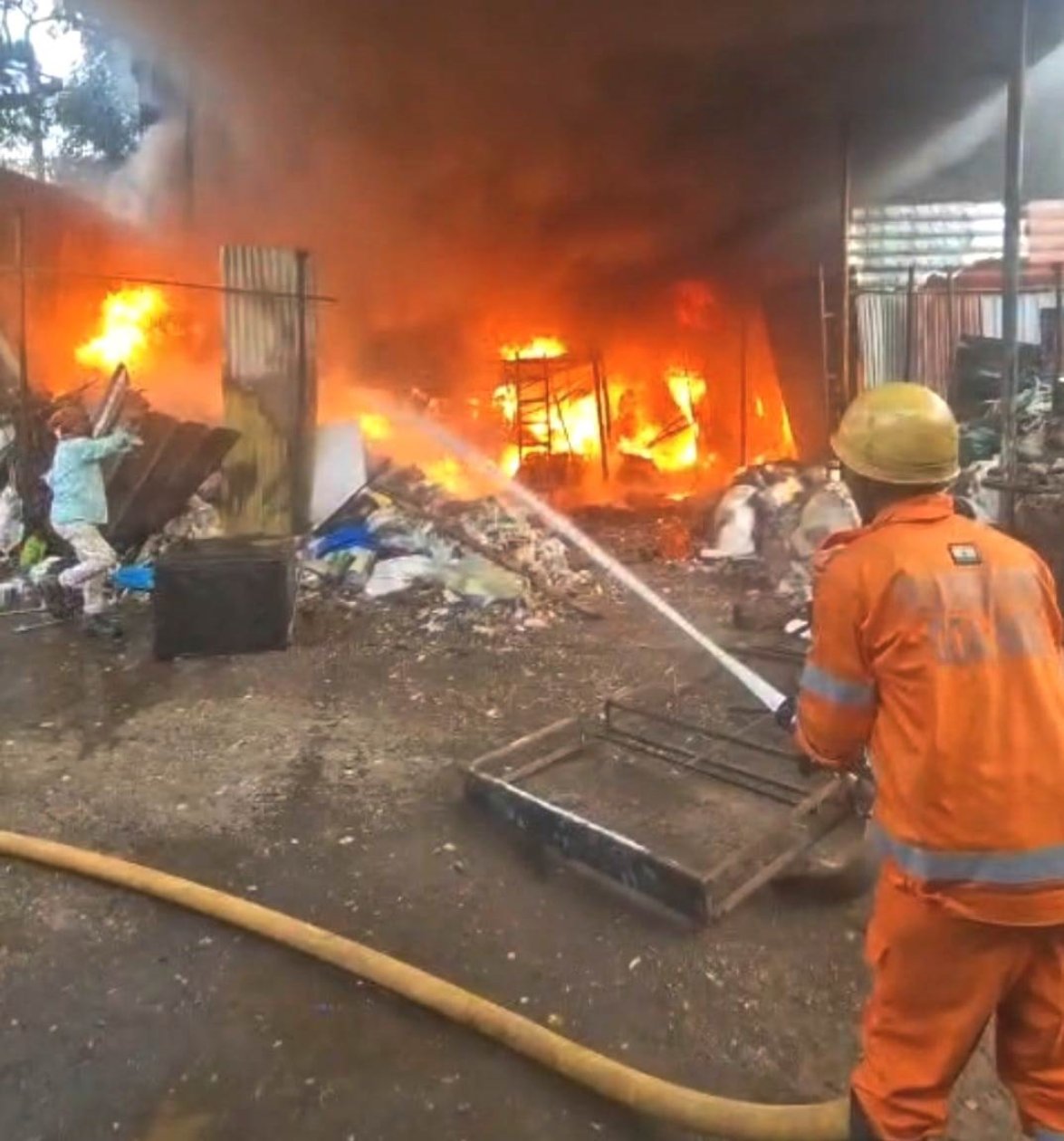
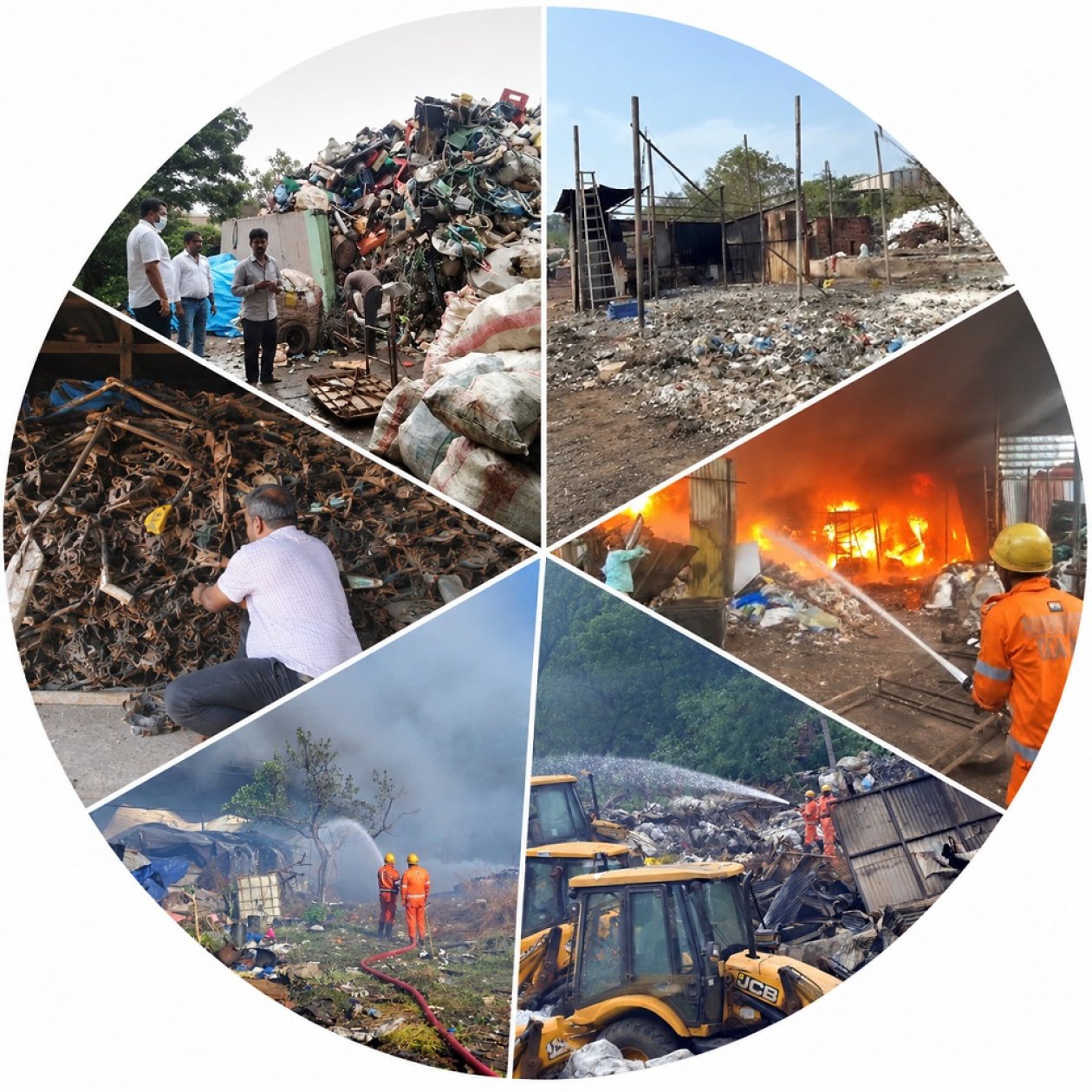
The latest reminder came in the early hours when a massive fire engulfed Saba Scrap Traders’ scrapyard at Kundaim. More than 12 fire tenders rushed to the site as firefighters battled the blaze, which gutted the premises and threatened to spread to neighbouring areas. The cause of the fire is still unknown.
The flames were eventually brought under control, but the larger problem remains untouched. Across Goa, scrapyards continue to operate in residential neighbourhoods, along busy roads and on agricultural plots, while successive fire incidents have exposed the safety risks of allowing such establishments to function without adequate oversight.
In March, a blaze completely gutted a scrapyard near Carvalho Petrol Pump in Mapusa. A month later, another massive fire broke out at Zuarinagar, sending thick black smoke across the skyline and requiring a major firefighting operation.
The Zuarinagar incident proved particularly challenging. With five to six scrapyards located close to one another, firefighters had to call for reinforcements as the blaze overwhelmed the capacity of a single fire station. Four fire tenders attended the incident, while traffic congestion, highway diversions and narrow approach roads further complicated access.
In fact, it was the third major scrapyard fire in six months, amid the absence of concrete measures to regulate or relocate these establishments. Colvale witnessed another scrapyard fire four months ago, prompting an emergency response from Fire and Emergency Services personnel.
GWMC cannot act against illegal scrapyards
While firefighters have repeatedly responded to these emergencies, the government’s regulatory response has moved at a considerably slower pace.
Hundreds of scrapyards operate across Goa, spread across villages, residential neighbourhoods, agricultural properties and industrial belts. Many lack the full range of statutory clearances, yet the State has not put in place a comprehensive framework to regulate their operations.
Government records accessed by The Goan have revealed the extent of these compliance gaps. Despite documenting widespread irregularities across talukas, the Goa Waste Management Corporation (GWMC) has acknowledged that it has no mandate to take action against illegal scrapyards.
The proposed Goa Scrapyards and Recycling Units Policy, which is expected to establish a regulatory framework for the sector, also remains under formulation. The government has not specified when it will complete the exercise.
“The GWMC is in the process of formulating the Goa Scrapyards and Recycling Units Policy,” an official said.
Relocation plans remain on paper
The idea of moving scrapyards away from populated areas is hardly new. Goa began discussing their relocation outside municipal limits more than a decade ago and proposed shifting these establishments under the Goa Waste (Scrap) Recycling Units Scheme, 2010. However, the policy decision has remained unimplemented since 2013 – 13 years.
The Director of Municipal Administration had also issued circulars in 2005 and 2008, directing municipalities to shut down unauthorised scrapyards and relocate legally operating units outside settlement areas, preferably beyond municipal limits, in the interest of public safety.
“Municipalities subsequently issued notices to scrapyard dealers, asking them to close their operations. However, they did not pass council resolutions to relocate scrapyards from their respective jurisdictions,” the official said.
The absence of those resolutions has left the relocation exercise largely on paper. Meanwhile, scrapyards continue to operate near residential areas, roads and other public spaces.
Salcete and Bardez account for major clusters
The geographical spread of these establishments offers another indication of the scale of the challenge. Government records have specifically identified scrapyards in almost every taluka, from Pernem and Sattari to Canacona, Quepem and Dharbandora.
Salcete accounts for around 230 identified illegal scrapyards, while Bardez has more than 80, making them the largest identified clusters in South and North Goa, respectively.
In Bardez, the listed establishments span Colvale, Mapusa, Nagoa, Arpora, Anjuna, Penha de Franca and Socorro. Mushirwado in Colvale has several operators, while other units occupy plots in residential and agricultural areas.
In Salcete, the spread covers Verna, Cuncolim, Loutolim, Raia, Fatorda, Margao, Benaulim, Seraulim, Colva, Davorlim, Aquem Baixo, Sao Jose de Areal, Dicarpale and Dramapur. Several units also operate in industrial areas, including Verna and Cuncolim, making it even more challenging for the authorities.
Ponda has identified scrapyards in Curti, Dhavali-Queula, Shapur-Bandora, Usgao, Bethora, Bhoma, Adcolna, Borim and Shiroda. The Mormugao belt, particularly Sancoale and Quelossim, also has multiple listed units on private or tenanted comunidade land.
The government records go beyond merely identifying locations. They list operators, survey numbers and land classifications, including private, rented, agricultural, industrial and comunidade properties. Several entries also indicate missing permissions from local bodies and other statutory authorities.
Safety assessment yet to be undertaken
The compliance concerns extend beyond the legality of the land on which these units operate.
Government records point to scrapyards functioning without the full range of approvals, including local-body permissions, pollution control clearances, fire safety approvals and health-related permissions. Yet, despite maintaining extensive listings of these establishments, the GWMC has not conducted a separate assessment of their cumulative environmental, traffic and public health impact.
Scrapyards handle discarded vehicles, machinery, industrial material and other waste, often in close proximity to residential properties and public roads. The absence of a dedicated assessment leaves the State without a consolidated picture of the risks arising from their storage and handling, particularly in densely populated areas.
“The GWMC cannot undertake the surveys until a policy is in place,” the official said, capturing the regulatory impasse.