


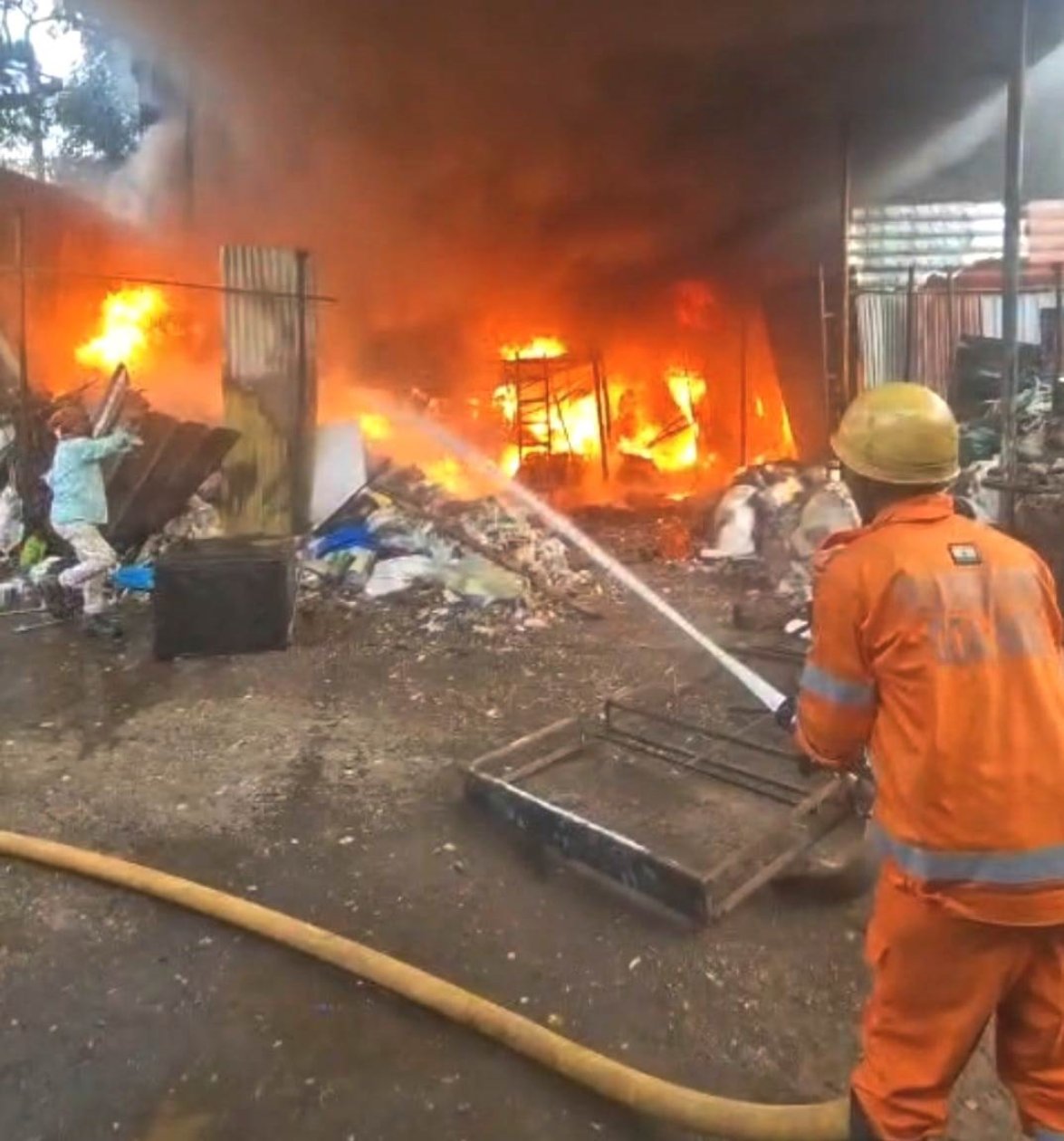
 Firefighters battle the blaze that engulfed a scrapyard at Dicarpale-Davorlim in May. File photo
MARGAO
Explosions, fires, hazardous leachate, dust and air and water pollution have, over the years, become synonymous with scrapyard operations in Goa’s commercial capital, Margao, and the surrounding villages of Salcete. The recurring incidents have triggered public protests, with citizens repeatedly demanding that these potentially hazardous activities be shifted away from densely populated residential areas and relocated to designated industrial zones.
Yet, despite mounting public opposition, the passage of time and sporadic enforcement action by the authorities, scrapyards continue to operate in the taluka. A significant number of these units are reportedly operating without the mandatory permissions and clearances from the Goa State Pollution Control Board (GSPCB) and the respective local authorities, raising questions over the effectiveness of regulatory oversight and enforcement.
The dangers associated with these operations are not new. The death of a worker in a scrapyard at Fatorda nearly a decade and a half ago, followed by the explosion at Chandrawado that left two workers injured, remain grim reminders of the risks posed by unregulated scrapyard activity. These incidents had brought the issue into sharp focus, with local residents even calling for a Fatorda bandh to demand the relocation of the scrapyards. In fact, citizens have intensified their demands for strict regulation and the relocation of such units away from residential neighbourhoods.
Lessons not learnt
However, the lessons from these tragedies appear to have had little lasting impact. Barring occasional demolition drives and action against individual units, there has been little tangible progress in addressing the larger problem.
The proposal to relocate scrapyards to designated trade zones, mooted during the Congress government headed by then Chief Minister Digambar Kamat, had raised hopes of a permanent solution. The Sub-Divisional Magistrate, Margao, had even set in motion the process to list the number of scrapyards operating in Margao and the Salcete countryside over a decade and a half ago.
However, the initiative failed to translate into a meaningful solution. Instead, the continued presence and proliferation of scrapyards suggest that the issue has been allowed to linger, with successive administrations seemingly unable to evolve a comprehensive policy.
The situation in Sao Jose de Areal village offers a telling example of the scale of the problem. On January 4, the Sao Jose de Areal village panchayat demolished two illegal scrapyards in an operation carried out in compliance with court orders. While the action was welcomed as a step towards enforcing the law, inquiries have revealed that as many as 30-odd illegal scrapyards may still be operating in the village, widely regarded as one of the major scrapyard hubs in Salcete.
Panchayat sources have indicated that proceedings have been initiated against the remaining units. However, the challenge before the local body is clearly much larger than the demolition of two unauthorised establishments.
Areal-based social activist Freddy Travasso cited numerous instances of scrapyard fires in the village in recent years, posing a danger as well as a health hazard to local residents. “When the scrapyards are operating illegally without permission from the local authorities, we fail to understand how the matters are pending in the courts,” he said.
The question that remains is whether the authorities will act before another tragedy forces them into action, or whether scrapyards will continue to operate with impunity in the heart of towns and villages.


