PANAJI
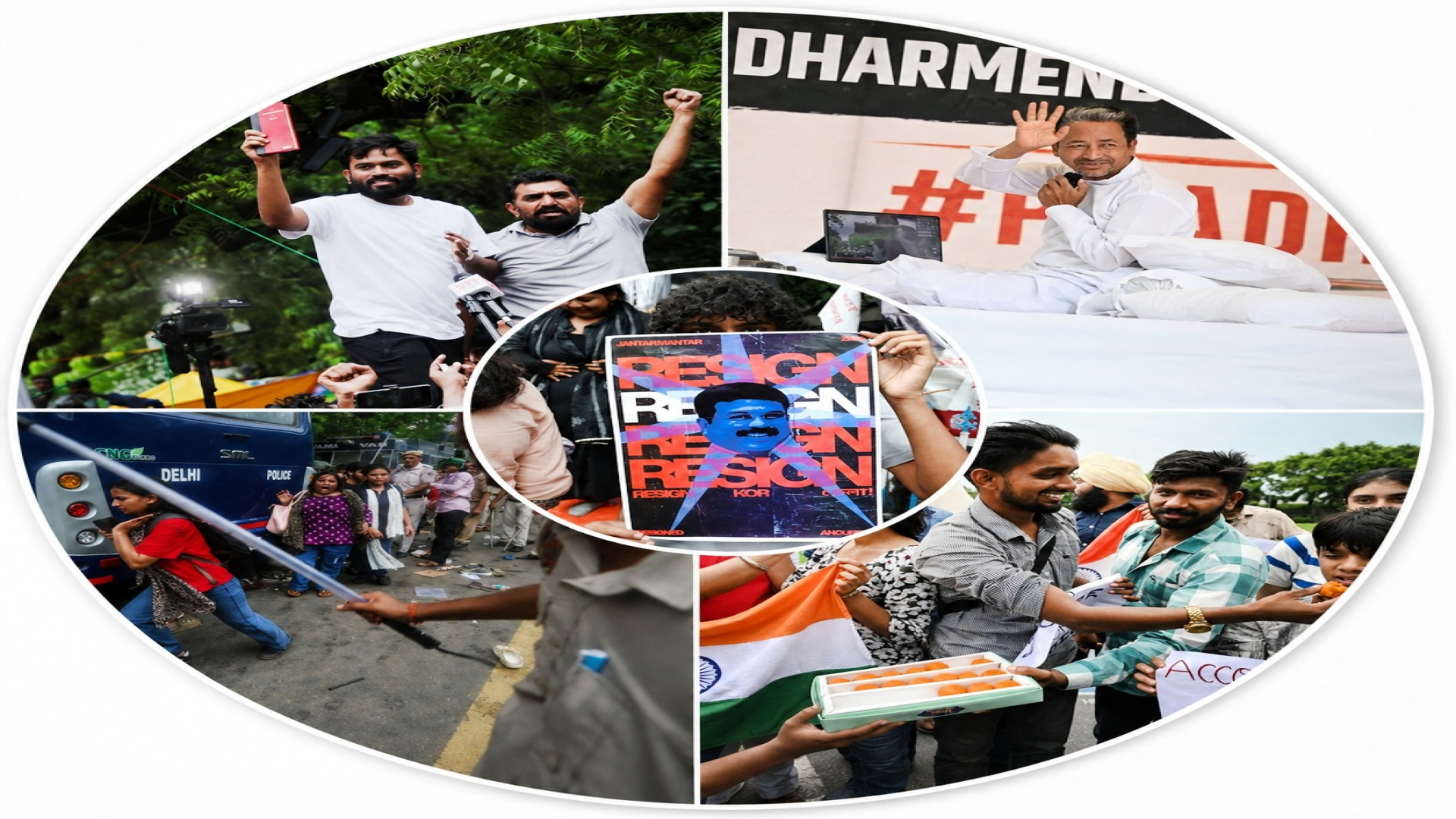
India's Education Minister, Dharmendra Pradhan, finally resigned on Saturday, and the country's youth claimed their first political scalp in a huge victory for their over-month-long protest, which began with the outrage over the leaked medical entrance (NEET) exam paper and eventually exploded into one of the largest student-led protest movements in recent history.
The Cockroach Janata Party (CJP), born of satire and defiance, is now a national banner with which millions of young people from across the country and from diverse backgrounds identify in the fight for accountability, education reform and respect. Going forward, observers say it will be a social and political force that no political party or authority can afford to ignore, be it in governance, the dispensation of justice, politics or even electoral arithmetic.
Earlier this week, on Monday, Delhi witnessed dramatic scenes as an estimated 75,000 students and young people poured into the streets, confronting barricades, batons and tear gas unleashed by a brutal force comprising the Delhi Police, the Rapid Action Force and other battalions of security personnel. The clashes left nearly 180 injured, according to Delhi Police, with both protesters and security personnel caught up in the melee. Videos showed students pushing over yellow barricades, climbing atop them and chanting slogans as riot police stood guard. The confrontation forced the movement to cancel a planned repeat march to Parliament the next day.
“We will not march again because the police will hurt the youth again,” CJP founder and president Abhijeet Dipke declared at a press conference after Monday's violence. But sit-ins continued at Jantar Mantar and outside Prime Minister Narendra Modi’s residence, where Opposition leader Rahul Gandhi was detained.
The spark: NEET paper leak
The trigger for the movement was the cancellation, nearly a week after it was held, of the May 3 NEET examination, the country's fiercely competitive medical entrance test. Authorities voided the results after finding that questions had been leaked, and more than two million NEET aspirants were told they would have to re-sit the examination on June 21, sparking outrage.
For many of these NEET aspirants, who were either teenagers or just out of their teens, it was the last straw in a series of leaks and irregularities. The scandal tapped into deeper emotions and frustrations: high unemployment, economic pressures and a general sense of helplessness in a system that was failing and stacked against them.
The virtual “Cockroach Janata Party” itself was born of insult, germinating and growing virally into the force it became after Chief Justice of India Surya Kant compared unemployed youth to “cockroaches” during proceedings in Court No. 1 of the Supreme Court of India.
In Boston at the time, Dipke’s viral response to that slur -- “What if all cockroaches came together?” -- struck a chord and broke the internet. Within weeks, millions followed the CJP, and its Instagram account had amassed 23 million followers.
The demands
The CJP articulated two sets of demands -- political and educational.
In its political reform agenda, it sought a ban on retired Chief Justices of India entering Parliament, reserving half of Cabinet positions for women, strengthening media independence and penalising lawmakers who switch parties.
In its education reform demands, it called for a new Public Examinations Act, a students’ rights charter, welfare funds for the families of students who had died by suicide, and consistent parliamentary oversight of examination authorities.
At the heart of both charters was a call for accountability.
“Stop normalising paper leaks.” “Save education, save the future,” read placards in Delhi as tens of thousands of students poured into Jantar Mantar, the epicentre of the protest, day after day.
Sonam Wangchuk’s fast
Climate activist and education reformer Sonam Wangchuk lent significant moral weight and momentum to the agitation. Beginning an indefinite hunger strike on June 28, he became the conscience of the movement and, for 27 days, refused food until police hospitalised him against his will on the eve of the planned July 20 march to Parliament.
On July 24, Wangchuk broke his fast after talks with government ministers, drawing criticism from a section of supporters and others, including media personalities and politicians, for giving in to the government. However, Wangchuk said he ended the fast only after receiving assurances from government interlocutors and dozens of Opposition MPs that no criminal action would be taken against the protesting students.
His fast and sacrifice, meanwhile, had galvanised the movement, giving the protesting students legitimacy and inspiring millions of young people across the country.
Political fallout
Monday’s march on Parliament culminated after weeks of growing momentum. The police response was swift and aggressive, prompting Dipke and the CJP's two spokespersons -- Saurav Das and Ashutosh Ranka -- to accuse the police and security personnel of brutality, assaulting female protesters and using illegal policing weapons.
“I don’t believe that Narendra Modi deserves to be called Prime Minister. He’s a dictator,” Dipke said, reacting to the scenes of violence and the force used by the security personnel.
Opposition leaders also seized the moment. Rahul Gandhi marched to Modi’s residence demanding accountability. He was detained, sparking further protests inside and outside Parliament, where proceedings were suspended as Opposition MPs waved placards calling for Education Minister Dharmendra Pradhan’s resignation.
Pradhan, meanwhile, remained undeterred throughout these dramatic developments and defended the government’s response, promising reforms and accountability.
“We owe our students more than outrage. We owe them answers, reforms and accountability,” he wrote on X on Monday night in his first response to the agitation, whose primary demand was his own resignation.
Goa joins movement
The wave of student protests sweeping Delhi and other parts of the country, meanwhile, found strong resonance in Goa as well. Hundreds, especially young people, mobilised in solidarity with Wangchuk and held impromptu demonstrations, adding their own strength to the national movement.
Two energetic demonstrations in Panaji and another on Friday in Mapusa, mostly dominated by Gen Z voices, were held at the historic Azad Maidan and Bodgeshwar Temple grounds.
Organic energy, Gen Z drive
The most striking feature that set these protests, including those in Goa, apart was their organic energy. Mobilisation happened through WhatsApp groups, Instagram stories and word of mouth. There was no central committee, no formal organisation or any single face working to bring about these protests.
Observers, meanwhile, note that the protests are tapping into broader frustrations among Goa’s youth: unemployment, governance concerns and even disillusionment with politics. The CJP banner has given them a vocabulary to express that anger.
Now, with the CJP calling off the protest in Delhi, the coming days and weeks will test the effectiveness of the movement and the resilience of the young, led by CJP and Dipke, in ensuring that the assurances given by the government actually translate into concrete action: whether the government will keep engaging with them meaningfully or whether they will be pushed and shoved back into agitation and protest mode, only time will tell.
But the protests have already achieved something significant: they have given students and young people, who until now had no space in the mainstream, a voice. They have shown that young people can mobilise, organise and demand accountability. They have reminded Goa, the country and its politicians that democracy is not merely about casting your vote in elections, but also about participation.
What next?
The CJP and the force of the uprising it brought about among students and young people are no longer just about exam leaks or derogatory remarks. It has become a national sentiment and a symbol of youth defiance and democratic resilience.
Whether from Delhi's Jantar Mantar, the epicentre of the protests, or from Goa’s Azad Maidan and other protest grounds, students and young people have demonstrated that they will not shy away from standing up and demanding to be heard.
As the weekend spotlight falls on this movement, one latent truth has been proved: India’s and Goa's youth are no longer content to be dismissed. They will demand accountability, assert their voices, and influence the State's and the country's politics and governance.