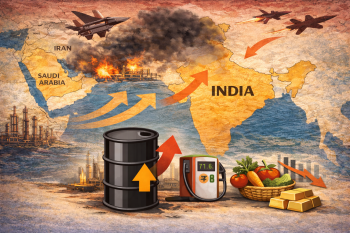
The ongoing war involving Iran, the United States and Israel may seem far removed from everyday life in India. Yet events unfolding thousands of kilometres away can quickly affect the finances of Indian households. In today’s interconnected global economy, conflicts in major energy-producing regions often push up oil prices, disturb financial markets and influence inflation.
The current conflict began after the United States and Israel launched strikes on Iranian targets, leading to retaliatory attacks and rising tensions across West Asia. As the war intensifies, global energy markets and shipping routes in the region are facing uncertainty. The Middle East plays a central role in global oil supply, and any disruption in the region tends to ripple through international markets.
When tensions rise in this part of the world, traders often expect supply disruptions. Even the possibility of such disruptions can drive oil prices higher. As prices move upward in global markets, countries that rely heavily on imported oil, including India, begin to feel the effects.
Oil prices and energy costs
The most immediate impact comes through oil. India imports a large share of the crude oil it consumes, much of it from the Middle East. When conflict threatens supply routes, oil production facilities or shipping lanes, global crude prices tend to rise.
Recent attacks have even targeted oil infrastructure, increasing concerns about supply disruptions. If shipping through important routes becomes risky or insurance costs for tankers rise, the price of transporting oil also increases. All these factors eventually feed into the price India pays for crude oil imports.
When crude becomes expensive internationally, it eventually affects domestic fuel prices and energy costs in India. Petrol and diesel prices may come under pressure, while industries that depend heavily on fuel face higher operating costs.
For households, the impact is already becoming visible. LPG prices have recently gone up, adding to monthly expenses for many families. Cooking gas is an essential household expense, and any increase in its price directly affects family budgets. Rising fuel costs also affect transportation, which can gradually push up the prices of goods across the economy.
From fuel to everyday expenses
Higher energy prices do not remain limited to petrol or cooking gas. Transport costs increase when fuel becomes expensive, and this raises the cost of moving goods across the country. Trucks carrying vegetables, grains, fruits and other essentials depend on diesel, and when fuel becomes costlier, those expenses are often passed on through higher prices.
Over time, this can lead to higher prices for vegetables, groceries and other daily necessities. Electricity generation costs may also rise in some cases, especially where fuel-based power generation is involved. Businesses dealing with logistics, manufacturing and distribution also face higher operational costs.
As companies try to manage these rising expenses, some of the costs may eventually reach consumers. This is one way in which global conflicts can contribute to inflation in countries far removed from the battlefield. What begins as a geopolitical crisis in West Asia can slowly translate into higher living costs for households in India.
Impact on investments
Global conflicts can influence financial markets. During periods of geopolitical tension, stock markets often become volatile as investors react to uncertainty. International investors may shift money between countries depending on how global risks develop. Some sectors are affected more than others. Industries that rely heavily on fuel, such as aviation and transportation, may face pressure when oil prices rise. In contrast, energy-related companies may benefit from higher oil prices.
Assets considered safe, such as gold, usually attract more investors during global crises. As a result, gold prices often rise when geopolitical tensions increase because many investors see gold as a hedge during uncertain times. For individual investors, the key lesson is to avoid reacting quickly to short-term market swings. Long-term financial plans should remain focused on steady savings, diversification and disciplined investing, even when global events create temporary market volatility.
(The writer has a keen interest in business and the dynamics of stock markets)