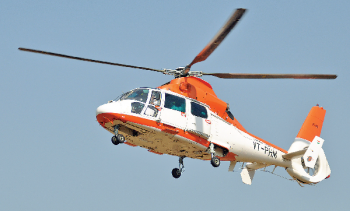
It was with much fanfare that Goa Tourism had launched Helicopter Joy-Rides on Republic Day last year (January 26, 2016). The then Chief Minister, Laxmikant Parsekar, had also taken the inaugural ride in a helicopter and had said that the joy-rides would give tourists an aerial view of Goa's greenery, temples, churches, beaches and waterfalls.
More than a year-and-half down the line, the helicopter joy-rides are not operational in the state. Nilesh Cabral, chairman, Goa Tourism Development Corporation (GTDC), said, "We are trying to find a site for making Helicopter Joy-Rides operational, which could be either in Dabolim or in Vagator. Pawan Hans is ready to operate this service. But, we will need a helipad for that. There is a helipad at Dabolim, but it needs repair. The helicopter services can be launched only after repairing the helipad."
Just like helicopter joy-rides, even amphibious buses and seaplanes have not been launched by the government even after conducting test runs. A source on the condition of anonymity said, "The government should have ascertained the viability of helicopter joy-rides, amphibious buses and seaplanes before announcing them. It doesn't bring a good name to a destination when we announce a certain initiative but don't launch it."
It appears that the government had not really ascertained the viability of these initiatives before going for test runs. Explaining why seaplanes are not yet launched, Cabral said, "The first company with which we had a tie-up for seaplanes went bankrupt. The second company with which we have a tie-up now is also finding it very tough to operate. It is difficult to get manpower for this service. Moreover, Directorate General of Civil Aviation (DGCA) says that it is mandatory to have 500 hours of seaplane flying experience for people willing to apply for the post of pilot. Due to these reasons, to get pilots from within India becomes difficult. And, getting pilot from US is very expensive."
The tourism industry is divided on whether not launching these initiatives has really dented Goa's image as a destination. However, it is true that these rides would have really helped in attracting a lot of tourists.
Savio Messias, president, Travel and Tourism Association of Goa (TTAG), said, "Most domestic tourists don't spend more than 2-3 days in Goa. After a trip to Old Goa or Dudhsagar Falls, there is not much for tourists to do in the state. Services like helicopter joy-ride and seaplanes would have allowed tourists to spend more time in Goa. Moreover, these services were aimed at high-end tourists, who we are trying to attract."
Tourism industry also maintains that baseless opposition to some of these initiatives also acted as a huge roadblock.
Messias further said, "Initially, helicopter joy-ride was launched from Sinquerim. But, it was opposed by a certain section of people for strange reasons. Even seaplane was being objected to because fishermen thought that it would affect fish in Mandovi River."
However, in both the cases, no credible logic or evidence was found to back the opposition. The state government can't be blamed for people objecting to tourism initiatives. However, factoring for any possible objection to a business proposal should be part of a viability report, which must be undertaken by company operating that particular service.
Take the case of helicopter joy-rides again. After facing opposition at Sinquerim, these rides were moved to Park Hyatt at Cansaulim. But, there as well, it was found that it wasn't viable to operate helicopter joy-rides.
All that the government needs for helicopter joy-rides is a helipad and some supporting infrastructure, which is not much to ask. But, there is definitely a need to hire experts in these areas to come out with a proper business-plan.
Atish Fernandes, director, business development, First Class Holidays, said, "You need to appoint professionals, who understand what a tourist wants. Take the case of ‘Hot Air Balloon', which was launched sometime back. For one trip, it can cost Rs 10,000 per person. A family of four would end up spending Rs 40,000 for a trip in hot air balloon, which is really expensive."
Apart from hot air balloon, the state government managed to launch ‘Hop-On Hop-Off Bus Tour', which has pleased the tourism industry. Jack Sukhija, member, TTAG, said, "Hop-On Hop-Off Bus Tour is a great concept. I have seen tourists using it. However, I think it has to be marketed better."
In the meanwhile, checking viability for some of these initiatives can be quite challenging. Take the case of amphibious buses, for example. These buses were meant to take tourists for a drive on the roads and also in Mandovi River.
To make them operational, one will have to co-ordinate with transport department and also with port authorities. Moreover, laws governing both transport on road and in water have to be aligned to launch amphibious buses.
As of now, the law in India doesn't permit the operation of amphibious buses. It is reported that the central government is yet to come out with a notification, which will pave the way for the launch of amphibious buses.
The road ahead for these initiatives appears rough. However, a proper strategy and professional approach will help putting these services into action.