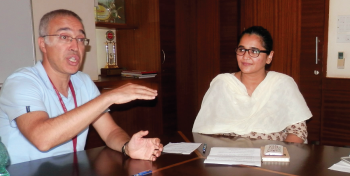
Q: What is the purpose of your visit to Goa?
Jorge: The purpose of my visit is to address students on a) Exchange rates and International Banking and b) Exchange Rate and International Resource Movement. I have also interacted with faculty of Economics to discuss about collaborative research in Economics.
Q: What was the nature of your discussions with the students and the faculty of Chowgule College?
Jorge: I disbursed information about the European context and the existence of several rate systems in Europe. This also encompassed some ideas of international banking and the role of international banks worldwide. Like India, Portugal is also host to many MNCs. I acclimatised them (students) about the European experience as well. The unfolding situation regarding migration of labour in the European hemisphere also figured at the interaction with students.
Q: Do you feel there is a potential for enhanced co-operation between Portugal and India in the fields of culture and tourism, which can have a multiplier effect on the Indian economy?
Jorge: In some sense, Portugal has not paid adequate attention to this sector. However, our PM has realised this and tried to correct it. Portugal has grown fast in the 90's and there is a lot of scope in the tourism sector. It is worth stimulating tourism. Many things can be done on the cultural front as well. The language and architecture of both are familiar. Goan food also is a plus factor.
Q: Will Brexit have an effect on Portugal's economy ?
Jorge: Yes. Brexit will have an impact.
Q: Should tourism be tapped for enhanced economic growth between the two countries?
Jorge: Yes. In fact, Portugal now invests a lot in tourism. In Goa, I also witness a lot of tourism activity, particularly, its beaches are wonderful. Portugal also remains full with tourists. We have undertaken restoration of old buildings and houses. Tourism is an opportunity to renovate the cities.
Q: What has been the effect of Brexit on Portugual's economy?
Jorge: Portugal faced a big crisis in the year 2011 and is now recovering. Brexit topic did figure in our interaction with the students. We talked about the experience of England, where there are various types of exchange rate systems. There are fixed and flexible exchange rate systems followed by countries. The system adopted by a country with whom you trade has effect on the overall trade. For instance, India has a flexible rate of exchange with the US dollar. In case of Denmark, it has fixed exchange rates with Europe. In case of Britain, it had a fixed rate before Brexit. Hence, Brexit does not come as a surprise, as Britain had signalled its intent by choosing a flexible rate of exchange.