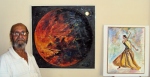
At 82, you wouldn’t normally expect a person to be excitedabout having found a new hobby in life. But then artists are made different andPune-based Gangadhar Tatake is one of them who has not only found a new callingin painting but has become a pioneer of sorts in what is known as encausticart. This form of painting involves making colours by mixing colour pigmentsinto melted beeswax. The wax’s adhesive quality makes the colours stick well,creating a medium so versatile that it can be used to paint on canvas, wood andeven tile. Tatake started experimenting with encaustic painting three years agoand now has more than 20 paintings to his credit which he displays from time totime at public art galleries in a bid to create more awareness among bothartists and aficionados.
Tatake, who received a diploma from the J J School of Artsin 1952, worked for four years after that as an artist and photographer. Thencame a long stint as a commercial artist involved in ad designing, among otherthings. “But I quit it all in 2000 and started researching on art mediums,” hesays. That’s when, while scouring the internet reading up about various artmediums - oils, acrylics, water colours and more - he came across the the term‘encaustic’. Curiosity led him to research deeper and he gradually realisedthat he had discovered a unique artistic medium that would offer a new challenge.“I was itching to explore a new horizon and encaustic art gave me that space,”he says, who also found valuable support and help from Welsh encaustic artist,Michael Bossom.
Tatake started by mixing the wax from Diwali candles with‘haldi’ and ‘kumkum’. “I realised that it could be used to create beautifulcolours,” he says. Encaustic painting is a tricky art form. The wax, once mixedwith the pigments, dries and solidifies almost immediately. “One needs to paintvery quickly with it. A hot plate or even an iron box can be used to melt thewax,” explains Tatake.
Now Tatake conducts workshops for those who want to try themedium. “I enjoy the whole process of melting beeswax and mixing it with rawpaint,” he says, demonstrating how he keeps several implements handy when he isat work: a palette knife to transfer the wax on to the painting surface and aniron, hotplate or hair dryer to get different effects of texture and gloss. Togive it value-addition, he often embeds thread and other materials in his paintings.Doesn’t he find it exhausting? Tatake smiles. “Not at all. In fact, art hasnothing to do with age. And I work at my own pace, giving time to develop newideas and designs,” he replies.