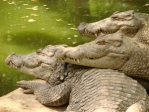
Spending a nice warm afternoon by the side ofa pond sounds idyllic, doesn’t it? But what if that pond has some 20 crocodileslazing around in the waters, surfacing now and then to cock an eye at you andyawn widely to display a perfect set of razor-sharp teeth? It’s no picnic then!But it’s fun and adventure in another way, for where else would you be able tocome in such close proximity to these giants? That’s the scenario at the MadrasCrocodile Bank (MCB) located in Mamallapurma in Chennai, which plays host to 18species of the crocodiles out of the 23 known to exist in the world. Thrivingin enclosures very similar to their natural habitat, the MCB has 2,500 reptilesspread over an area of 3.2 acres.
It’s here that you will find hundreds of theMugger crocodiles which are the most common of the Indian species. There’s alsothe Morelet’s crocodile which is considered highly endangered as well as theWest African Dwarf crocodile which is the largest captive-reared of its kind inthe world. A brain-child of the legendary wildlife conservationist RomulusWhitaker, the Madras Crocodile Bank came into being in 1976 in a desperateeffort to save India’s dwindling crocodilian populations.
Essentially, it was the large-scale harvest ofIndian crocodilians for their skins with the growing worldwide demand forexotic fashion accessories that raised concerns about their diminishingnumbers. By the mid-20th century, hunting crocodilians was alucrative enterprise throughout the tropics and by the 1970s India’scrocodilian population had been exploited to the brink of extinction. Realizingthis fact, the Indian government protected all the three species of the Indiancrocodilian under the Wild Life Protection Act of 1972. Responding to the needof that time, Romulus and his wife Zai Whitaker started working with the specificgoal of breeding the Mugger, the saltwater crocodile and the rarest of all, thegharial.
“The bank was originally designed to be aliving genetic repository of crocodiles for safekeeping, to protect andmultiply until such time when they could be returned to restock their originalwild habitats. What started with a handful of crocodiles and a hit-and-missexperimental approach to captive breeding was so successful, that by the 1990sthere were over 8,000 crocodiles in residence,” informs Nikhil Whitaker, thecurator of the MCB.
As for the future, there are some excitingplans in store, one of them being to construct more overhead walkways, arrangesafaris and make the MCB interactive. The conservation effort apart, this isperhaps the only place in India where you can actually see the crocodiles grabtheir food, swallow it with their heads raised and then lazily trundle backinto the pond. It’s a sight that will remain etched in your mind forever.