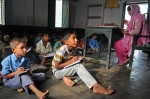
On any given day in a state primary school in India, upto one in four teachers is missing. The cost for a country that seesits young population as its ticket to superpower status is huge. In the poorand agricultural district of Baghpat in Uttar Pradesh, a state that is home tonearly 200 million people, or one in six Indians, absences afflict pupils andfellow teachers alike.
One frustrated headmistress showed the register for herstaff: two out of seven full-time teachers are routinely away. Onehas been seen only a handful of times in 2012 due to back-to-back medical andchildcare leave. "There are so many teachers who don't want towork," she complained in her simple and dimly lit office, asking not to benamed because of the sensitive nature of the information she was sharing.
"The government provides books, uniforms and middaymeals to all students for free. They are spending so much, butif teachers are not dedicated then all the money is just beingwasted." In other schools dotted around the area, about a two-hour drivefrom New Delhi, teacher shortages due to absences or under-recruitment meanclass sizes are often double the recommended level of 30. A recent scandal inthe area saw 77 teachers sacked after an investigation by a localtraining college revealed they had forged their own school certificates. Today'sdysfunctional education system is storing up problems for the future, sayexperts. "We have this very young population and it has so muchpotential," Rukmini Banerji from leading Indian education and researchgroup Pratham said.
"If you want children 10 years from now to have21st-century basic skills, you've got to begin now in grades one and two. If wedon't do this, we are going to lose a unique opportunity."
In general, state primary schools in India are"abysmal," says Karthik Muralidharan, a professor at the Universityof California and long-time researcher on the Indian system. His studies onteacher absenteeism, done in conjunction with other academics and the WorldBank, provide authoritative figures for the problem because they rely onunannounced visits to schools across the country. In 2003 a survey found anaverage of 25 percent of state primary school teachers were absent atany one time.
The consequence is a surge in private education. More than50 percent of primary school pupils in cities are enrolled in fee-charginginstitutions and 25 percent in rural areas, according to different studies,placing a huge burden on poorer families. But most continue to attend stateschools such as the ones in Baghpat, where the children of agricultural workersand labourers sit on the floor in dimly lit classrooms, learning from a textbook that leaves many of them baffled.