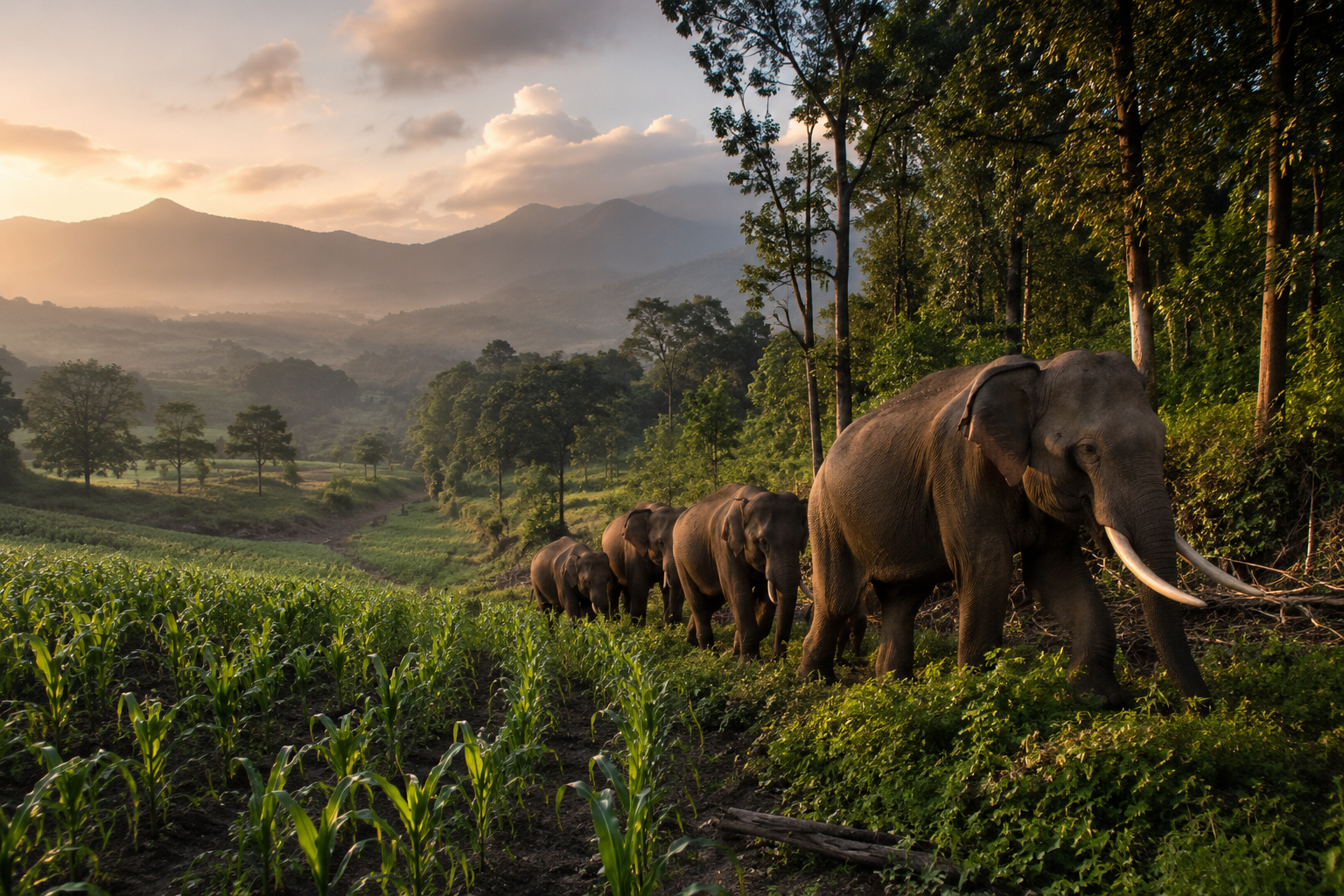
After writing recently about valley forests as bottlenecks where wildlife, water and people are forced through the same narrow spaces, we found ourselves returning to a more basic question. Long before an elephant steps into a field or a gaur appears on a road, what is it in these forests that has to keep working for life to go on at all? The answer is not an animal or a river or a policy. It is a process, and it sits inside every green leaf. We speak often of biodiversity. The word conjures tigers, elephants, hornbills, charismatic creatures that rightfully capture our imagination. But half of what makes a forest a forest is almost never seen, rarely celebrated, and dangerously overlooked. It is not an animal. It is a process. It is photosynthesis.
Every breath you take, every calorie you eat, every drop of fuel your vehicle burns, all of it traces back to photosynthesis. It is the largest biological process on this planet: trees and plants absorbing carbon dioxide from the air, using sunlight to convert it into food and energy, and releasing the oxygen we breathe. Even the coal and petroleum powering our cities are just ancient photosynthetic remains, stored underground for millions of years. Without this one process, there is no life on Earth. And yet, while we debate whether plants can “feel emotions”, we have skipped a far more important question. Is this engine of life under threat?
Trees Are More Diverse Than You Think
Most of what we know about photosynthesis comes from crop plants grown in laboratories. But the majority of photosynthesis on land happens in forests, in wild trees that are astonishingly varied in ways we rarely stop to appreciate.
Some trees live for decades, others for centuries. Some shed their leaves in summer and regrow them with the rains; others hold their leaves year-round. Some grow fast and die young; others take a slow, centuries-long path. Some can survive almost anywhere; others are adapted to one precise niche, one particular moisture level, one narrow temperature range. Each of these differences shapes how efficiently a tree photosynthesises and how well it copes when conditions change. This variety is not decoration. It is function. And when the climate shifts, not all of these strategies survive equally well.
Across India’s Western Ghats, this diversity plays out in a landscape of contrasts: cool, misty high-altitude forests in some places, warm, seasonally dry forests in others, including some valleys that are now warming faster than the global average. In one such seasonally dry belt in the central Ghats, our team has spent the past year asking a simple question: how much heat can a forest tree tolerate before its photosynthesis starts to fail, and how often are real conditions now approaching that limit?
Elephant in the Room, Literally
Here is why this matters beyond science. Think of the large animals living in these forests, elephants, gaurs, deer. Unlike us, they are not attached to one place. Unlike us, they are not greedy. When they find food, they eat and stay. But when the forest stops producing enough, when heat-stressed trees grow fewer fruits and leaves, these animals go hungry. And hungry animals move.
They cannot easily cross the high ridges of the Ghats, so they follow the low-lying corridors towards human settlements and farmland. What we call human-wildlife conflict is, in most cases, a hungry animal simply looking for a meal. The carnivores that depend on these herbivores follow them out, and the cascade begins.
It all starts with a tree’s ability to photosynthesise under heat.
This is not hypothetical. In the Amazon, the largest forest on Earth, severe droughts over the past decades caused widespread tree death, sending shockwaves through the global scientific community. India’s forests deserve the same seriousness of attention. The Western Ghats may be smaller in scale, but they are no less critical, for biodiversity, for water, for the millions of people living downstream from these forests.
A Moment for the Invisible
It helps to picture trees not as a green backdrop but as living machines, constantly turning light, carbon dioxide and water into the matter and energy that feed everything else in these landscapes.
Photosynthesis does not trend on social media. It does not make the evening news. But every organism alive today, every person reading these words, exists because of it. The forests of the Western Ghats are not just India’s green heritage. They are a working engine. And right now, that engine is being pushed harder than it has ever been. Whether it holds depends on whether we choose to understand it and protect it before it is too late.
From Goa’s valley forests to the central Ghats where we work, the details differ, but this core story is the same: when the quiet engine in the trees begins to fail, conflict at the forest edge is one of the first places we notice it. While photosynthesis and its thresholds are so crucial, studies that quantify them in trees are only slowly emerging across the Western Ghats and India. Given the diversity of species and habitats, the extent of work still to be done is large, and it needs urgent, sustained attention from both researchers and policymakers.
(The writers are scientists/professor working in the field of biodiversity conservation, research and environmental education)